Stock Analysis · HubSpot Inc (HUBS)
Overview
HubSpot is a cloud software company focused on helping businesses attract customers, manage marketing, organize sales activity, deliver customer service, and run parts of their operations from one platform. It is best known for its customer relationship management, or CRM, software aimed especially at small and midsize businesses, although it also serves larger organizations. The company’s approach is to offer an easy-to-use system that can start with a free or low-cost entry point and expand as customers add more tools.
Its revenue comes overwhelmingly from subscription fees rather than one-time software licenses. HubSpot reports revenue in two main categories.
- Subscription revenue: about 98% of total revenue in recent years. This includes recurring fees from access to HubSpot’s CRM platform and product hubs such as Marketing Hub, Sales Hub, Service Hub, Content Hub, Operations Hub, and commerce-related tools.
- Professional services and other revenue: about 2%. This includes onboarding, consulting, training, and implementation-related work that helps customers adopt the platform.
That revenue mix matters because subscription software tends to be more predictable than project-based businesses. Another notable feature is HubSpot’s strong gross margin: the business keeps a large share of each sales dollar after direct service delivery costs, which is typical for scaled software platforms. Over the last several years, revenue has climbed from roughly $1.3 billion in 2021 to just above $3.1 billion in 2025, while operating profit moved from losses into positive territory. That shift suggests the company is no longer only prioritizing expansion, but is also showing increasing financial discipline.
The long-term pattern is clear: revenue and gross profit have expanded steadily, while operating losses narrowed and then turned into operating income by 2024 and improved further in 2025. Research and development remains a major expense, showing that product investment is still central to the model.
Key Figures
| Metric | Value | Sector ⓘ |
|---|---|---|
| Date | Sep 12, 2026 | |
| Context | ||
| Sector | Technology | |
| Industry | Software - Application | |
| Market Cap ⓘ | $11.44B | |
| Beta ⓘ | 1.18 | |
Value (Cheapness) | ||
| P/E Ratio ⓘ | 81.89 | 29.51 |
| FCF Yield ⓘ | 6.70% | 4.25% |
| EBIT / EV ⓘ | 1.14% | 2.85% |
| PEG ⓘ | 0.28 | |
Growth (Business expansion) | ||
| Revenue Growth ⓘ | 19.80% | 15.40% |
| RPS Growth (5Y CAGR) ⓘ | 20.70% | 8.56% |
| EPS Growth (5Y CAGR) ⓘ | N/A | -11.88% |
| Margin Growth (5Y Trend) ⓘ | N/A | 0.46% |
| FCF Growth (5Y CAGR) ⓘ | 41.43% | 9.80% |
Quality (Business durability) | ||
| ROIC (Latest) ⓘ | 4.99% | 9.44% |
| ROIC (5Y Median) ⓘ | -2.70% | 8.30% |
| Net Debt / EBIT (Latest) ⓘ | -5.85 | 0.54 |
| Net Debt / EBIT (5Y Median) ⓘ | N/A | 0.44 |
| Operating Margin (Latest) ⓘ | 3.61% | 9.58% |
| Operating Margin (5Y Median) ⓘ | -3.35% | 8.25% |
| Debt to Equity (Latest) ⓘ | 14.30% | 33.33% |
| Profit Margin (Latest) ⓘ | 4.26% | 7.14% |
| Free Cash Flow (Latest) ⓘ | $767.23M | |
Momentum (Price trend) | ||
| 3Y Return ⓘ | -57.46% | +45.48% |
| 12M Return (excl. last month) ⓘ | -50.42% | +23.48% |
| 6M Return ⓘ | -12.54% | +20.93% |
| Price vs. 200-Day MA ⓘ | -12.66% | +7.43% |
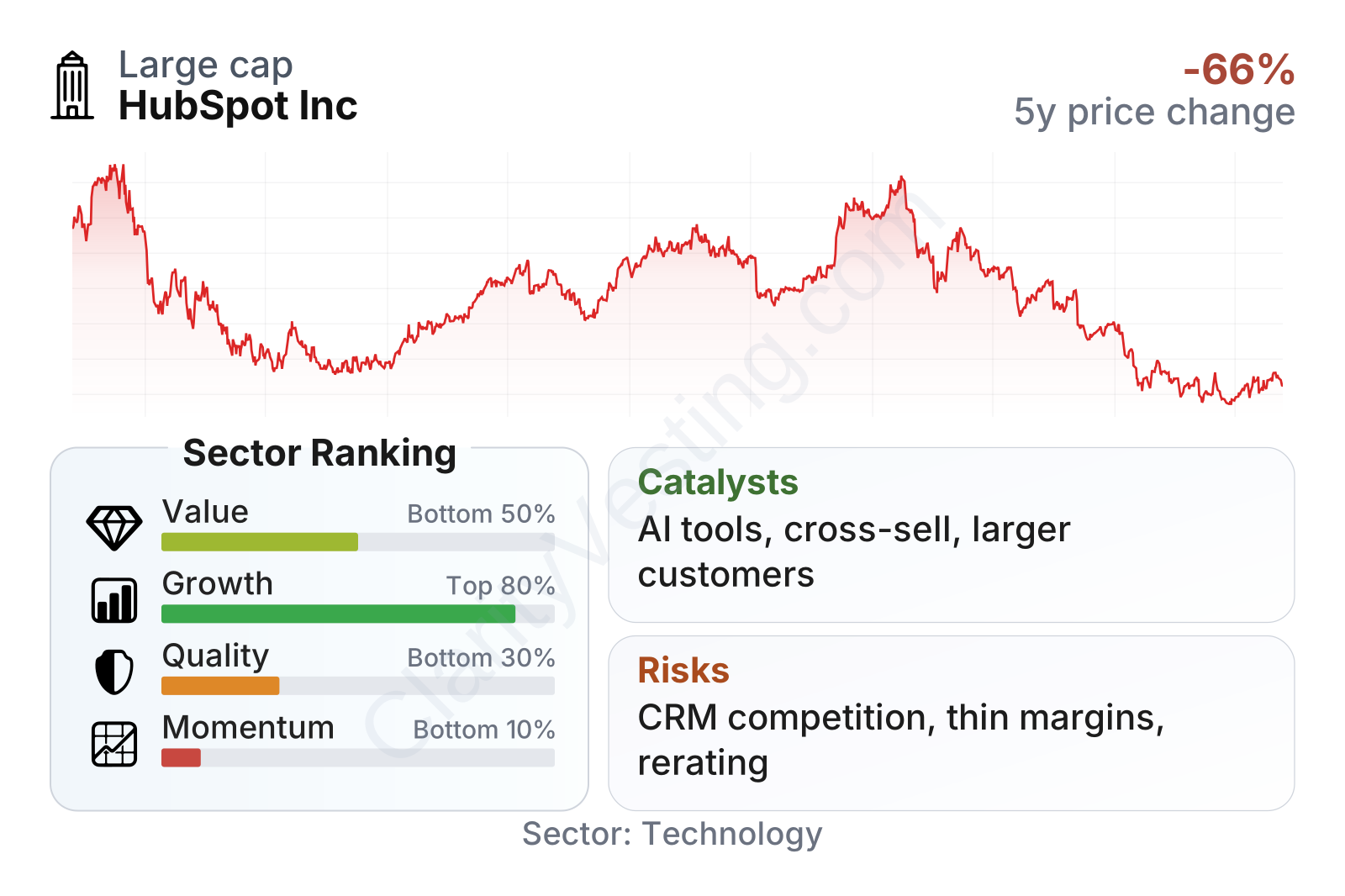
HubSpot is a mid-sized software company with above-average growth for its sector, but the market has recently treated it much more harshly than many peers. The factor breakdown points to a mixed profile: growth looks strong relative to the software median, balance-sheet risk looks low, free cash flow generation is solid, but profitability ratios still trail many software companies. The recent share-price trend has been notably weak, placing momentum near the bottom of the sector.
The stock chart also shows how volatile sentiment around software valuations can be. HubSpot traded at much higher levels in 2021 and early 2025 before a steep decline into 2026, which means the market has sharply reset expectations even though the underlying business continues to grow.
Growth
HubSpot operates in a growing part of enterprise software: cloud-based CRM, marketing automation, customer service software, and workflow tools. These categories continue to benefit from long-term trends such as digital customer acquisition, the shift from disconnected point solutions toward unified platforms, and ongoing adoption of AI-assisted software. For smaller and midsize businesses in particular, ease of use and fast implementation remain important, and that is where HubSpot has historically positioned itself well.
The company’s strategy also supports future expansion. Instead of relying on a single product, it builds around a broader customer platform with multiple hubs. That creates cross-selling opportunities: a customer that starts with marketing tools may later add sales, service, content, operations, payments, or AI features. This can lift average revenue per customer and reduce churn if the platform becomes embedded in daily workflows.
Revenue growth has cooled from the very high rates seen in 2021 and 2022, but it has remained close to 20% recently, which is still healthy for a software company already above $3 billion in annual revenue. The slowdown looks more like normalization after an earlier surge than a collapse in demand. On a five-year basis, revenue per share growth has also been far stronger than the sector median.
Cash generation has improved even faster than sales. Free cash flow has risen sharply from the low hundreds of millions of dollars a few years ago to roughly $0.7 billion on a trailing basis in the recent chart, and the latest metrics indicate trailing free cash flow close to $1.0 billion. That combination of continued top-line growth and rising cash conversion is one of the more constructive signals in HubSpot’s profile.
A meaningful catalyst is the company’s push into AI features across its platform. Management has been integrating AI tools to help users create content, automate repetitive tasks, improve customer interactions, and make better use of CRM data. If those capabilities improve productivity without requiring customers to adopt separate specialized tools, HubSpot could strengthen retention and gain wallet share. Another growth driver is international expansion and deeper penetration of larger businesses, where the company still has room to grow compared with more established enterprise software vendors.
Risks
This article is for informational purposes only and does not constitute financial advice. Some content is AI-generated. See Disclaimer