Stock Analysis · H&R Block Inc (HRB)
Overview
H&R Block is a tax preparation company best known for helping individuals file U.S. income tax returns. It operates through a mix of company-owned retail offices, franchise locations, and digital products that let customers prepare returns themselves online. The group also provides related financial products and small-business services, which makes it more than just a seasonal storefront tax brand.
Based on the company’s latest annual filing for fiscal 2026, revenue is concentrated in a few major activities:
- Assisted tax preparation in company-owned offices: about 49% of total revenue. This is the core business where clients meet tax professionals in person or through assisted channels.
- Assisted tax preparation from franchise royalties: about 18%. This includes royalties and related revenues from independently operated H&R Block offices.
- DIY tax software and online services: about 17%. This covers digital tax filing products for consumers who prepare their own returns.
- Wave and small-business services: about 9%. This includes bookkeeping, payroll, payments, and other tools for small businesses, especially through Wave.
- Other revenue, including financial products and ancillary services: about 7%. This includes add-on services tied to tax preparation and related offerings.
The business model is attractive in one important way: tax filing is recurring and necessary. Every year, millions of households and small businesses need help dealing with tax rules, deadlines, and refunds. That creates a recurring demand base, although a large part of the company’s earnings is still concentrated around tax season.
The broader financial picture shows a business that has grown revenue steadily in recent years, with total revenue moving from roughly $3.5 billion to nearly $4.0 billion over the last five fiscal years. Gross profit has also trended upward, and net income reached a notably stronger level in fiscal 2026. Even so, the latest operating income line looks less smooth than revenue growth, suggesting some year-to-year accounting or expense timing effects that are worth watching rather than ignoring.
Key Figures
| Metric | Value | Sector ⓘ |
|---|---|---|
| Date | Sep 12, 2026 | |
| Context | ||
| Sector | Consumer Cyclical | |
| Industry | Personal Services | |
| Market Cap ⓘ | $5.56B | |
| Beta ⓘ | 0.38 | |
Value (Cheapness) | ||
| P/E Ratio ⓘ | 7.93 | 17.10 |
| FCF Yield ⓘ | 13.59% | 8.53% |
| EBIT / EV ⓘ | 14.00% | 6.46% |
| PEG ⓘ | 0.57 | |
Growth (Business expansion) | ||
| Revenue Growth ⓘ | 3.00% | 5.75% |
| RPS Growth (5Y CAGR) ⓘ | 11.36% | 9.14% |
| EPS Growth (5Y CAGR) ⓘ | 9.41% | -18.21% |
| Margin Growth (5Y Trend) ⓘ | -3.96% | -0.23% |
| FCF Growth (5Y CAGR) ⓘ | 0.32% | 4.91% |
Quality (Business durability) | ||
| ROIC (Latest) ⓘ | 53.81% | 12.61% |
| ROIC (5Y Median) ⓘ | 40.43% | 10.72% |
| Net Debt / EBIT (Latest) ⓘ | 1.22 | 2.10 |
| Net Debt / EBIT (5Y Median) ⓘ | 1.48 | 2.32 |
| Operating Margin (Latest) ⓘ | 23.69% | 9.25% |
| Operating Margin (5Y Median) ⓘ | 22.58% | 9.64% |
| Debt to Equity (Latest) ⓘ | 1789.42% | 75.78% |
| Profit Margin (Latest) ⓘ | 18.59% | 5.33% |
| Free Cash Flow (Latest) ⓘ | $756.08M | |
Momentum (Price trend) | ||
| 3Y Return ⓘ | +26.88% | +14.53% |
| 12M Return (excl. last month) ⓘ | +9.77% | +3.08% |
| 6M Return ⓘ | +52.32% | +0.55% |
| Price vs. 200-Day MA ⓘ | +18.85% | -0.54% |
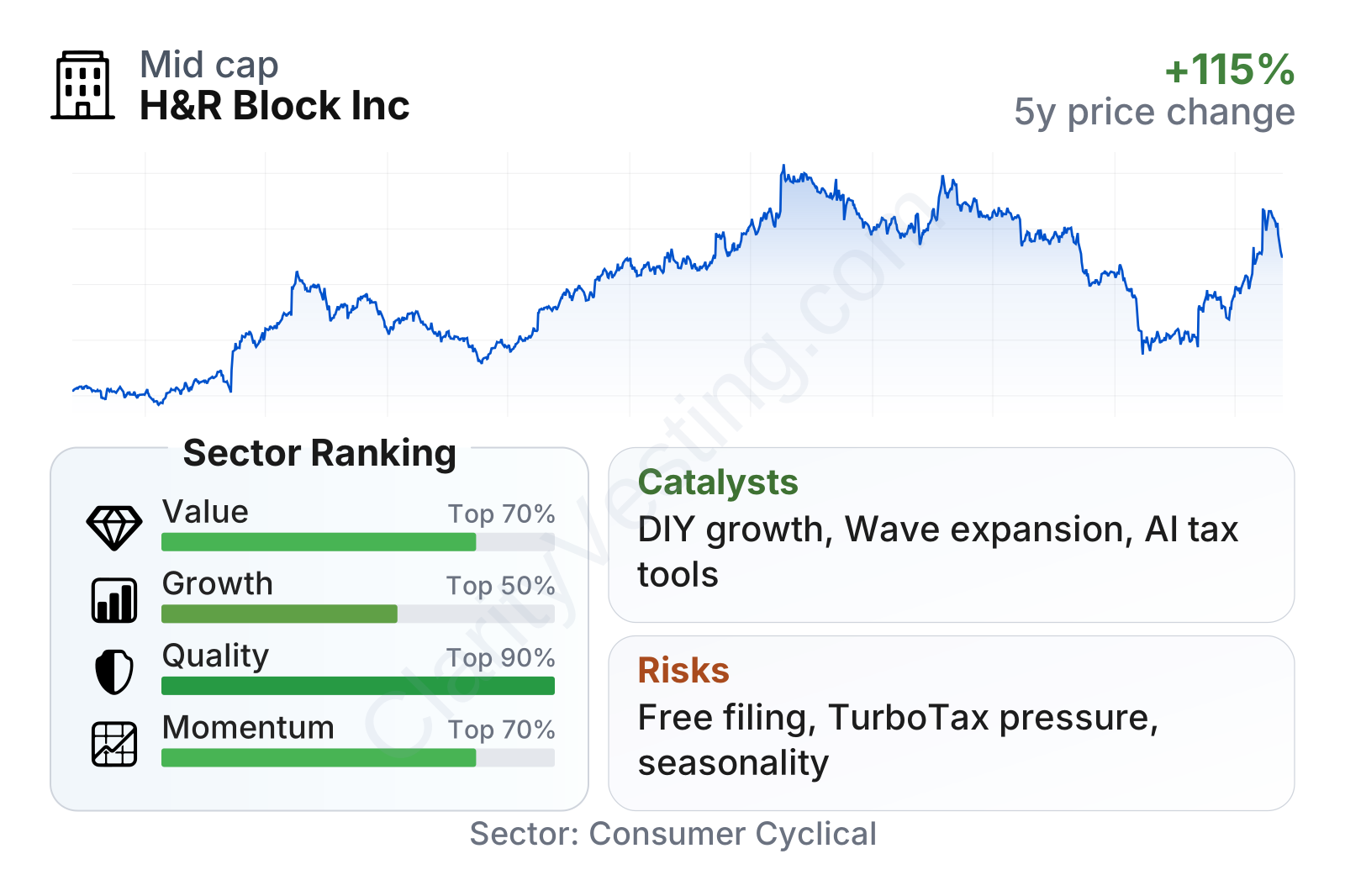
H&R Block is a mid-sized public company with a notably low share-price volatility profile, as shown by a beta well below 1. On valuation, profitability, and cash generation, it screens well against much of its sector. The strongest area is business quality: returns on invested capital are far above the sector median, operating margins are also much higher than peers, and net debt relative to EBIT remains manageable. Growth is more mixed. Long-term revenue per share and earnings per share have improved at healthy rates, but the most recent year-over-year revenue increase is moderate rather than fast, and free cash flow growth over five years has been limited.
The stock’s path has been uneven. Shares climbed strongly through 2024 and parts of 2025, then dropped sharply into early 2026 before rebounding. That pattern fits a company with durable earnings power but changing market expectations around growth and margins.
Growth
H&R Block operates in a stable rather than high-growth industry. Tax preparation is not a booming market in the usual sense, but it benefits from recurring demand, regulatory complexity, and the fact that many people still want help even when software is available. That means the company does not need explosive industry expansion to grow; it mainly needs to protect share, raise average revenue per client, improve digital conversion, and expand adjacent services.
Its strategy is reasonably coherent. The company is trying to keep its assisted tax business strong while expanding digital filing and building year-round small-business services through Wave. That matters because the classic tax business is highly seasonal, while bookkeeping, payroll, and payments can produce steadier activity across the year. In simple terms, H&R Block is trying to use its trusted tax brand to become more useful outside the spring filing season.
Recent revenue growth has been positive but not dramatic, generally running in the low- to mid-single digits outside of unusual periods. That profile fits a mature business with room for steady execution gains rather than a company being reshaped by rapid market expansion. Over a five-year view, revenue per share has grown faster than the sector median, helped not only by business performance but also by capital returns.
Cash generation remains an important growth support. Free cash flow has stayed strong, recently running around three-quarters of a billion dollars on a trailing basis after some fluctuations in prior years. That gives the company flexibility to invest in technology, support acquisitions or product development, reduce debt, and continue shareholder distributions. Public company communications in fiscal 2026 also emphasized ongoing investment in assisted and DIY tax offerings, AI-enabled tools for tax professionals and customers, and expansion of Wave’s capabilities for small businesses. Those are practical catalysts because they target convenience, efficiency, and cross-selling rather than relying on a single transformative event.
A meaningful opportunity comes from the increasing complexity of taxes for freelancers, side-hustle workers, and small businesses. If more consumers need help navigating multiple income streams, credits, and compliance rules, H&R Block’s mix of human expertise plus digital workflow could remain relevant even as simple returns migrate to low-cost software or free filing options.
Risks
This article is for informational purposes only and does not constitute financial advice. Some content is AI-generated. See Disclaimer


