Stock Analysis · Hewlett Packard Enterprise Co (HPE)
Overview
Hewlett Packard Enterprise is an enterprise technology company focused on the infrastructure that businesses, governments, and large organizations use to store data, run applications, connect networks, and manage computing workloads. In simple terms, HPE sells the hardware, software, and related services that sit behind corporate IT systems, from servers and storage equipment to networking products and cloud-like platforms delivered on a subscription basis.
The company’s revenue mix is spread across several business lines. Based on the latest annual reporting structure, the largest sources of revenue are approximately:
- Server business / compute: about 45% to 50% of revenue. This includes general-purpose servers, high-performance systems, and AI-oriented server platforms used in data centers.
- Intelligent edge / networking: about 20% to 25%. This includes campus and branch networking, Wi‑Fi, switching, and security products, largely tied to the Aruba portfolio.
- Hybrid cloud and software-related platforms: about 10% to 15%. This includes private cloud software, management tools, and consumption-based offerings such as HPE GreenLake.
- Storage: about 10% to 15%. This covers data storage systems, backup, and related data management infrastructure.
- Financial services and other: about 5% to 10%. This includes financing, asset lifecycle programs, and smaller corporate items.
That mix matters because HPE is not a pure software company. A meaningful share of sales still comes from hardware, where competition is intense and margins are usually lower. At the same time, management has spent years pushing the business toward recurring, service-like revenue through GreenLake, while also trying to capture demand for AI servers and modern networking.
Over the last several years, revenue has trended upward overall, but profitability has been less steady. Sales moved from roughly $28 billion in fiscal 2021 to more than $34 billion in fiscal 2025, yet operating results became much more volatile, showing that growth alone has not automatically translated into cleaner execution.
The long-term picture shows a business that has expanded revenue and kept research spending substantial, but recent cost pressure has weighed heavily on operating income. Gross profit held near the $9.5 billion to $10.0 billion range even as revenue rose, which suggests that mix and expenses are now central to the investment debate, not just top-line growth.
Key Figures
| Metric | Value | Sector ⓘ |
|---|---|---|
| Date | Sep 12, 2026 | |
| Context | ||
| Sector | Technology | |
| Industry | Communication Equipment | |
| Market Cap ⓘ | $73.30B | |
| Beta ⓘ | 1.44 | |
Value (Cheapness) | ||
| P/E Ratio ⓘ | 28.46 | 29.51 |
| FCF Yield ⓘ | 5.67% | 4.25% |
| EBIT / EV ⓘ | 2.96% | 2.85% |
| PEG ⓘ | 0.47 | |
Growth (Business expansion) | ||
| Revenue Growth ⓘ | 33.70% | 15.40% |
| RPS Growth (5Y CAGR) ⓘ | 5.45% | 8.56% |
| EPS Growth (5Y CAGR) ⓘ | 5.40% | -11.88% |
| Margin Growth (5Y Trend) ⓘ | -13.69% | 0.46% |
| FCF Growth (5Y CAGR) ⓘ | -34.32% | 9.80% |
Quality (Business durability) | ||
| ROIC (Latest) ⓘ | 5.29% | 9.44% |
| ROIC (5Y Median) ⓘ | 6.15% | 8.30% |
| Net Debt / EBIT (Latest) ⓘ | 5.13 | 0.54 |
| Net Debt / EBIT (5Y Median) ⓘ | 3.49 | 0.44 |
| Operating Margin (Latest) ⓘ | 6.53% | 9.58% |
| Operating Margin (5Y Median) ⓘ | 7.66% | 8.25% |
| Debt to Equity (Latest) ⓘ | 76.35% | 33.33% |
| Profit Margin (Latest) ⓘ | 6.67% | 7.14% |
| Free Cash Flow (Latest) ⓘ | $4.16B | |
Momentum (Price trend) | ||
| 3Y Return ⓘ | +292.82% | +45.48% |
| 12M Return (excl. last month) ⓘ | +181.49% | +23.48% |
| 6M Return ⓘ | +190.42% | +20.93% |
| Price vs. 200-Day MA ⓘ | +83.24% | +7.43% |
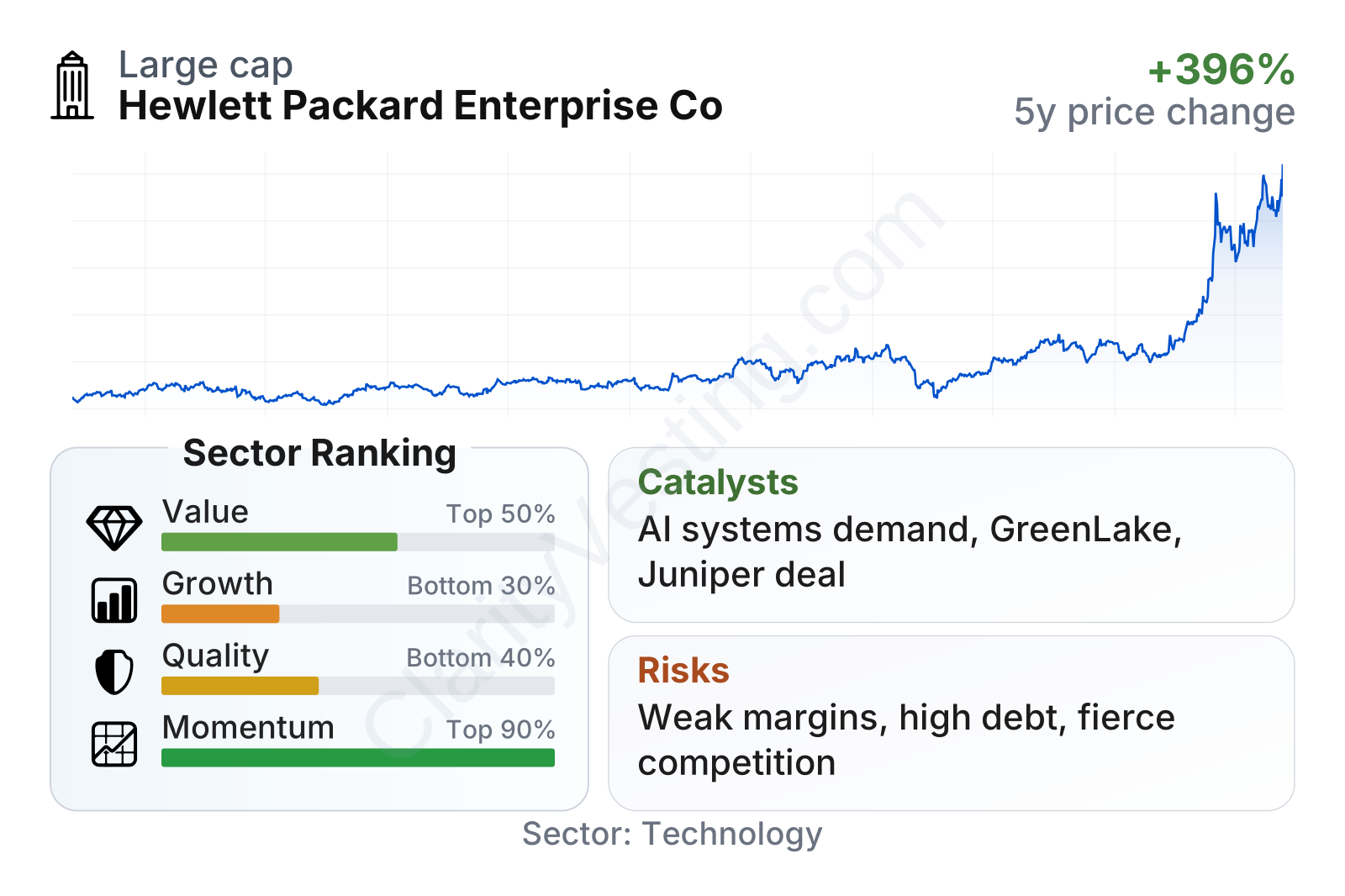
HPE stands out as a large technology infrastructure company with unusually strong recent share-price momentum. The stock has significantly outperformed the broader sector over the last one, three, and six-year comparison windows. On valuation, the earnings multiple sits somewhat below the sector median, while free cash flow yield looks better than average. That gives the company a mixed profile: the market has become more optimistic, but traditional value measures are not stretched in the same way as many high-growth technology names.
The weak point in the current snapshot is business quality. Returns on invested capital are well below the sector median, profitability is only modest, and leverage is elevated. Growth metrics are also uneven: recent revenue growth is strong, but the longer five-year record is less impressive, especially for free cash flow and margin trend. In short, the market is rewarding HPE for current momentum and AI-related expectations, while the fundamental profile remains more complicated than the stock chart alone suggests.
Growth
HPE operates in parts of the technology market that remain structurally important: data centers, enterprise networking, hybrid cloud, and AI infrastructure. These are growing areas, although not all at the same speed. Traditional enterprise servers and storage are mature markets, but AI systems, accelerated computing, and cloud-like IT consumption models are creating new spending cycles. That is where HPE is trying to position itself.
A major part of that strategy is HPE GreenLake, which lets customers use on-premises infrastructure with pricing that resembles cloud services. The idea is straightforward: many companies want flexibility similar to public cloud offerings, but still need control, compliance, or performance benefits from keeping workloads in their own environments. If HPE can keep converting customers to this model, it can gradually build a more recurring and more predictable revenue base.
Another growth driver is AI infrastructure. HPE has been expanding systems tied to accelerated computing, liquid cooling, and high-performance networking, helped by the 2024 acquisition of Juniper Networks still awaiting completion through regulatory processes during 2025-2026. Even before that transaction closes, the company has been emphasizing AI factories, supercomputing capability, and networking upgrades as areas of demand. This is strategically sensible because enterprise AI workloads need exactly the kind of infrastructure HPE already sells: servers, storage, interconnects, and management software.
Recent revenue growth has clearly accelerated, with year-over-year gains moving well above the company’s own longer-term pace and above the sector median. That is a positive sign, especially after weaker periods in 2023 and early 2024. The key question is whether this reflects durable demand in AI and enterprise infrastructure, or a shorter product cycle that may normalize later.
Cash generation has improved from earlier lows, but it has not followed a smooth upward line. Free cash flow remains meaningful in absolute dollars, which is important for a company of HPE’s size, yet the multi-year pattern is uneven. For long-term analysis, that makes execution more important than revenue headlines alone. A company selling more systems but converting that growth inconsistently into cash deserves closer scrutiny.
Recent company updates have also highlighted large AI-related system orders and a rising backlog in higher-performance infrastructure categories. If these deployments scale successfully, HPE could benefit from a stronger mix of premium systems, support contracts, and attached networking and software revenue. That combination is one of the clearest upside paths for the business over the next few years.
Risks
This article is for informational purposes only and does not constitute financial advice. Some content is AI-generated. See Disclaimer


