Stock Analysis · Harley-Davidson Inc (HOG)
Overview
Harley-Davidson is an American motorcycle company best known for heavyweight cruisers, touring bikes, and a lifestyle brand built around riding culture. The group operates through three main activities: selling motorcycles and related products under the Harley-Davidson name, offering financing and insurance support through Harley-Davidson Financial Services, and developing electric motorcycles through LiveWire.
For a long-term view, the key point is that Harley-Davidson is not just a vehicle manufacturer. It combines a premium consumer brand, a dealer network, parts and apparel sales, and an in-house finance arm that helps customers purchase motorcycles. That mix can support profitability when the brand is strong, but it also makes results sensitive to consumer confidence, financing conditions, and demand for discretionary purchases.
Based on recent annual reporting, the company’s revenue mix is roughly organized as follows:
- Motorcycles and related products: about 75% to 80% — this includes Harley-Davidson motorcycles, parts, accessories, apparel, and licensing-related activity. Motorcycles are the biggest element inside this category.
- Financial services: about 20% to 25% — this segment mainly includes retail and wholesale financing, along with related income tied to supporting dealers and customers.
- LiveWire electric motorcycles: less than 5% — this business remains small compared with the core Harley-Davidson operation.
The broader financial picture over the last several years shows a company that reached stronger revenue and earnings levels in 2022 and 2023, then moved into a clear slowdown in 2024 and 2025. Revenue has fallen from around $5.8 billion in 2023 to about $4.5 billion in 2025, while net income has dropped by more than 50% over that same period. In other words, Harley-Davidson still has meaningful scale and brand recognition, but the business is currently working through weaker demand and lower profitability than it had just a few years ago.
The long-term pattern is easy to see: after a solid post-pandemic rebound, sales and profits have been shrinking, and operating costs have been taking a larger share of revenue. That matters because a premium brand can tolerate softer volumes for a while, but a lasting decline becomes harder to offset if fixed costs remain high.
Key Figures
| Metric | Value | Sector ⓘ |
|---|---|---|
| Date | Sep 12, 2026 | |
| Context | ||
| Sector | Consumer Cyclical | |
| Industry | Recreational Vehicles | |
| Market Cap ⓘ | $2.90B | |
| Beta ⓘ | 1.30 | |
Value (Cheapness) | ||
| P/E Ratio ⓘ | 14.98 | 17.10 |
| FCF Yield ⓘ | -4.59% | 8.53% |
| EBIT / EV ⓘ | 8.08% | 6.46% |
| PEG ⓘ | 2.10 | |
Growth (Business expansion) | ||
| Revenue Growth ⓘ | -5.90% | 5.75% |
| RPS Growth (5Y CAGR) ⓘ | 1.74% | 9.14% |
| EPS Growth (5Y CAGR) ⓘ | -37.33% | -18.21% |
| Margin Growth (5Y Trend) ⓘ | -4.93% | -0.23% |
| FCF Growth (5Y CAGR) ⓘ | -16.53% | 4.91% |
Quality (Business durability) | ||
| ROIC (Latest) ⓘ | 2.95% | 12.61% |
| ROIC (5Y Median) ⓘ | 7.67% | 10.72% |
| Net Debt / EBIT (Latest) ⓘ | 1.58 | 2.10 |
| Net Debt / EBIT (5Y Median) ⓘ | 5.95 | 2.32 |
| Operating Margin (Latest) ⓘ | 6.32% | 9.25% |
| Operating Margin (5Y Median) ⓘ | 15.38% | 9.64% |
| Debt to Equity (Latest) ⓘ | 74.44% | 75.78% |
| Profit Margin (Latest) ⓘ | 4.78% | 5.33% |
| Free Cash Flow (Latest) ⓘ | -$133.07M | |
Momentum (Price trend) | ||
| 3Y Return ⓘ | -10.61% | +14.53% |
| 12M Return (excl. last month) ⓘ | +4.79% | +3.08% |
| 6M Return ⓘ | +56.29% | +0.55% |
| Price vs. 200-Day MA ⓘ | +21.66% | -0.54% |
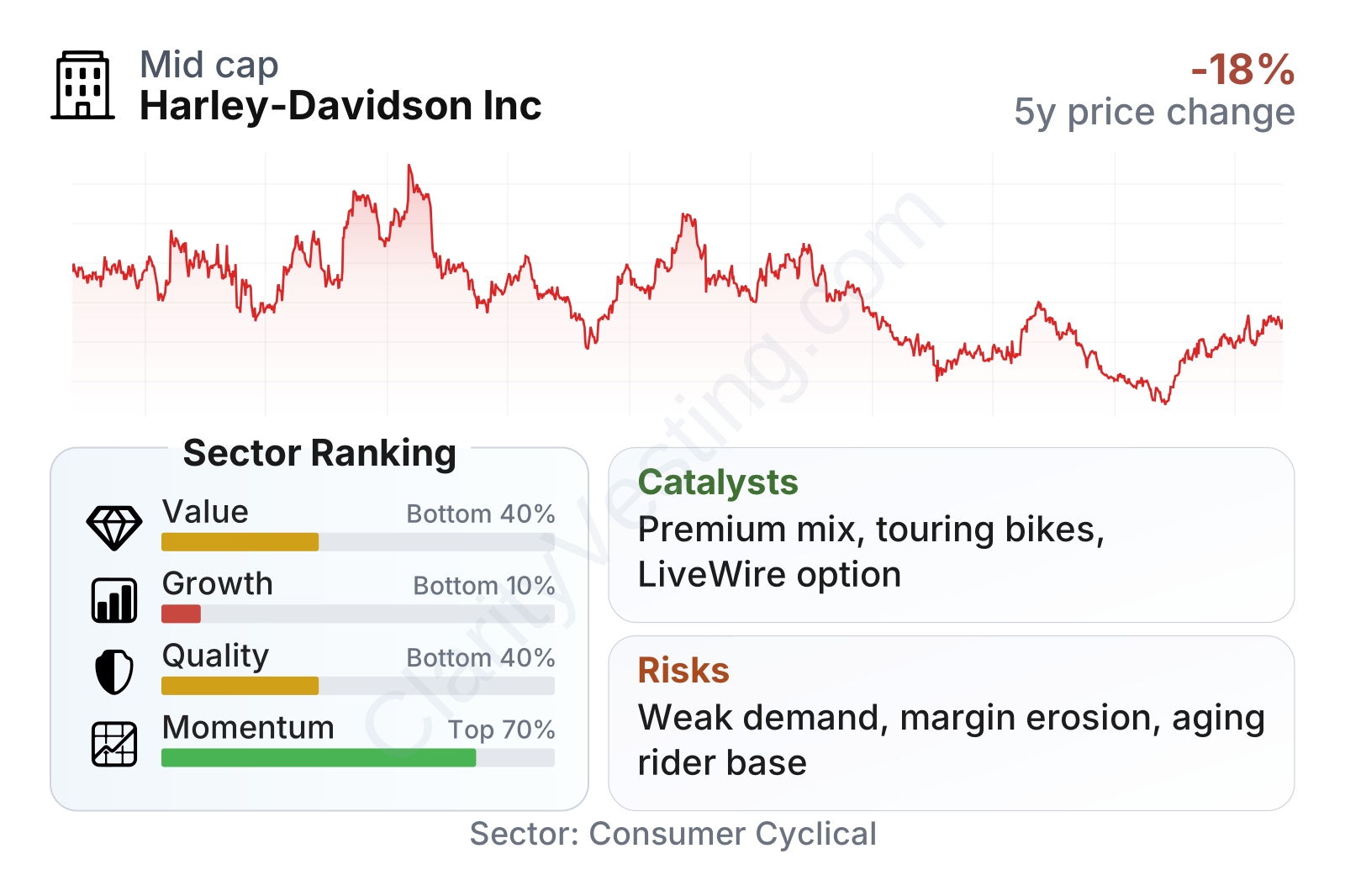
Harley-Davidson currently looks mixed on the main business metrics. Valuation is not especially high compared with the sector on earnings, but growth ranks near the bottom of the peer group and overall quality is also below average. Profitability remains positive, leverage is not extreme on the latest balance-sheet view, and recent share-price momentum has improved, yet the underlying operating picture is clearly weaker than it was in prior years.
The stock history also reflects that instability. Over the last several years, the share price has moved through sharp rebounds and equally sharp pullbacks, which is typical of a cyclical consumer business tied to discretionary purchases and financing conditions.
Growth
Harley-Davidson operates in a sector that is mature rather than fast-growing. Traditional heavyweight motorcycles are not a major structural growth industry in the United States, so long-term expansion depends less on overall market growth and more on market share, pricing power, customer loyalty, international development, and success in adjacent categories such as parts, apparel, and electric bikes.
The company’s strategy still has logic. Management has emphasized a more premium focus, tighter model discipline, and stronger economics per motorcycle rather than chasing volume at any cost. That approach can make sense for a brand with a distinct identity, because Harley-Davidson’s value comes partly from exclusivity and emotional appeal, not just unit sales. The challenge is that this strategy works best when affluent consumers keep spending and dealers maintain healthy inventory turns.
Recent growth trends have been weak. Year-over-year revenue has been negative through much of the latest period, with several quarters showing double-digit declines. That places Harley-Davidson in a difficult position: it is trying to protect pricing and brand value while the top line is shrinking, which raises pressure on margins and dealer activity.
Cash generation has also become less supportive. Free cash flow was strong in earlier periods, then faded sharply and recently turned much weaker, even dipping into negative territory on the latest trailing measure. For a long-term assessment, that is important because cash flow gives a business flexibility to invest in products, support the balance sheet, and return capital without depending too heavily on external financing.
A potential catalyst is product renewal and better execution in higher-value touring and cruiser categories, where Harley-Davidson remains most differentiated. Another is international expansion, especially if the company can improve distribution and brand reach in markets where premium motorcycles still have room to grow. LiveWire is a smaller but more speculative opportunity: if electric motorcycles gain broader acceptance and product economics improve, it could give Harley-Davidson exposure to a new category, though it is not yet large enough to move group results in a major way.
Recent company updates have also highlighted cost actions, inventory management, and efforts to align production more closely with demand. Those moves can help stabilize the business, but they are more defensive than transformative. The biggest future upside would likely come from a recovery in retail demand combined with sustained premium pricing.
Risks
This article is for informational purposes only and does not constitute financial advice. Some content is AI-generated. See Disclaimer


