Stock Analysis · HNI Corp (HNI)
Overview
HNI Corp is a U.S. manufacturer of workplace furnishings and residential building products. In simple terms, it sells office furniture and related workspace solutions through one side of the business, and fireplaces, inserts, stoves, and other hearth products through the other. Its brands serve commercial offices, education, government, healthcare, dealers, and homebuilders, giving the company exposure to both business spending and housing-related demand.
Revenue is mainly generated from two operating segments. Based on recent annual reporting, the mix is approximately as follows:
- Workplace Furnishings: about 80% to 85% of revenue. This includes office seating, desks, storage, architectural products, and broader workspace furniture sold largely through dealers and contract channels.
- Residential Building Products: about 15% to 20% of revenue. This includes hearth products such as gas, wood-burning, and electric fireplaces, inserts, and stoves, sold through distributors, retailers, and builders.
The business mix matters because it gives HNI two different demand drivers. Office furniture depends on corporate projects, public sector orders, and workplace refresh cycles, while hearth products depend more on home construction, remodeling activity, and consumer housing trends. That diversification can help, but both segments are still cyclical.
The long-term financial flow shows a company that has increased revenue over the past several years, but with profit conversion that has been uneven. Gross profit expanded meaningfully through 2025, yet selling and administrative costs also rose sharply, limiting how much of that growth reached the bottom line.
Key Figures
| Metric | Value | Sector ⓘ |
|---|---|---|
| Date | Sep 12, 2026 | |
| Context | ||
| Sector | Consumer Cyclical | |
| Industry | Furnishings, Fixtures & Appliances | |
| Market Cap ⓘ | $3.38B | |
| Beta ⓘ | 0.91 | |
Value (Cheapness) | ||
| P/E Ratio ⓘ | 148.64 | 17.10 |
| FCF Yield ⓘ | -3.05% | 8.53% |
| EBIT / EV ⓘ | 2.74% | 6.46% |
| PEG ⓘ | 0.49 | |
Growth (Business expansion) | ||
| Revenue Growth ⓘ | 120.70% | 5.75% |
| RPS Growth (5Y CAGR) ⓘ | 3.97% | 9.14% |
| EPS Growth (5Y CAGR) ⓘ | -8.42% | -18.21% |
| Margin Growth (5Y Trend) ⓘ | 0.57% | -0.23% |
| FCF Growth (5Y CAGR) ⓘ | 34.09% | 4.91% |
Quality (Business durability) | ||
| ROIC (Latest) ⓘ | 3.49% | 12.61% |
| ROIC (5Y Median) ⓘ | 8.40% | 10.72% |
| Net Debt / EBIT (Latest) ⓘ | 11.75 | 2.10 |
| Net Debt / EBIT (5Y Median) ⓘ | 2.63 | 2.32 |
| Operating Margin (Latest) ⓘ | 3.05% | 9.25% |
| Operating Margin (5Y Median) ⓘ | 4.43% | 9.64% |
| Debt to Equity (Latest) ⓘ | 92.89% | 75.78% |
| Profit Margin (Latest) ⓘ | 0.10% | 5.33% |
| Free Cash Flow (Latest) ⓘ | -$103.10M | |
Momentum (Price trend) | ||
| 3Y Return ⓘ | +61.99% | +14.53% |
| 12M Return (excl. last month) ⓘ | +14.34% | +3.08% |
| 6M Return ⓘ | +17.96% | +0.55% |
| Price vs. 200-Day MA ⓘ | +15.96% | -0.54% |
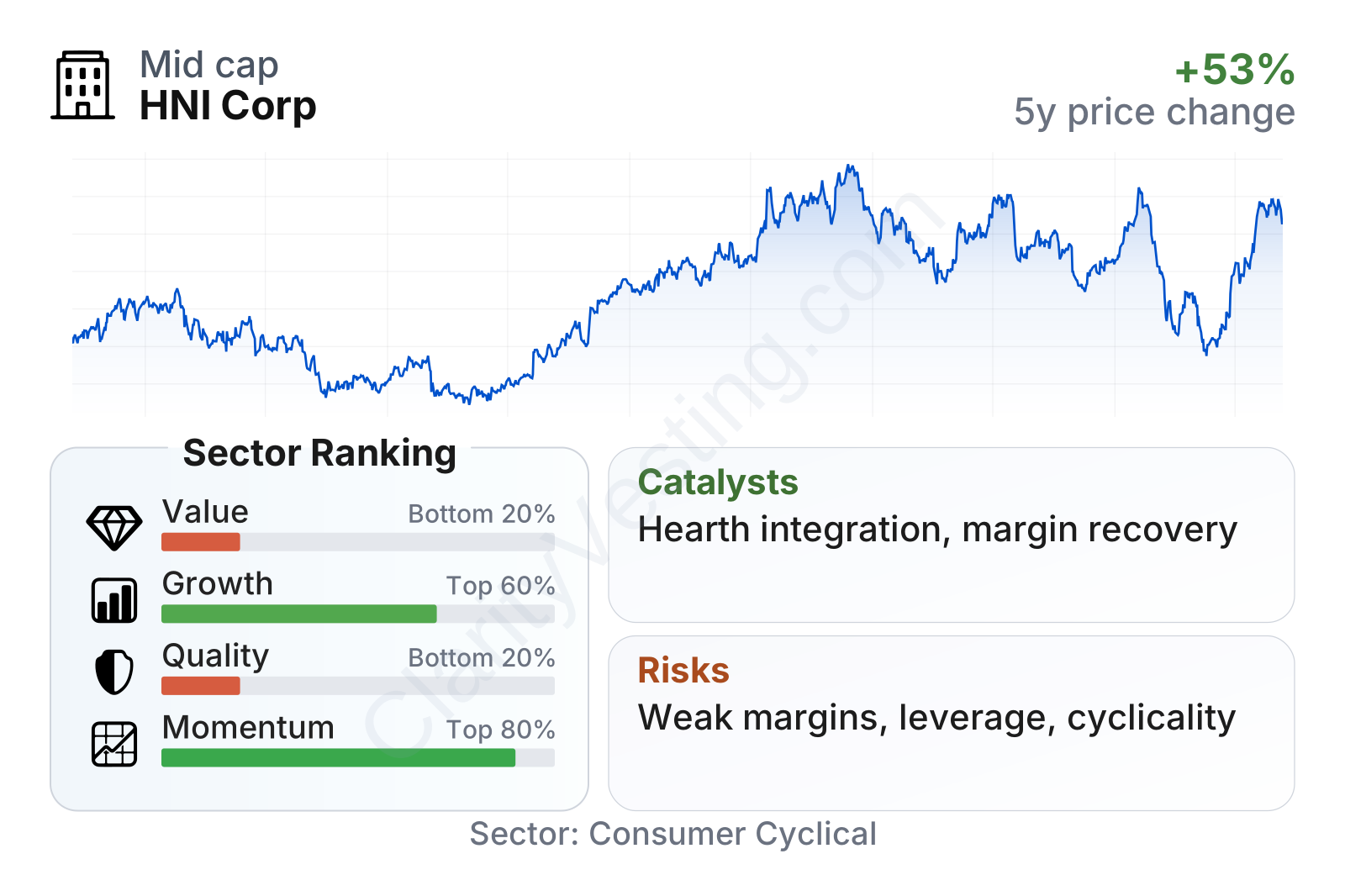
HNI is a mid-sized company with a stock market value in the low single-digit billions and a beta below 1, which suggests the shares have historically moved a bit less than the broader market. The current factor profile is mixed. Growth metrics look better than much of the sector, helped by strong recent revenue expansion and a solid multi-year free cash flow trend. By contrast, value and quality measures are weaker, largely because trailing earnings are depressed, free cash flow recently turned negative, and returns on invested capital are running below sector norms.
The stock price history also shows how cyclical the business can be. Shares climbed strongly from 2023 into early 2026, but that advance was followed by a sharp pullback. That kind of movement usually reflects changing expectations around earnings, margins, and demand rather than a purely defensive business profile.
Growth
HNI operates in markets that can still grow over time, even if they do not offer straight-line expansion. Workplace furnishings is tied to office redesign, hybrid work adaptation, school and healthcare projects, and government spending. Residential building products benefits from long-term housing stock replacement, remodeling, and demand for upgraded heating and fireplace systems. Neither market is a high-growth technology niche, but both can support durable demand when product innovation, channel reach, and manufacturing execution are strong.
The company’s strategy is logical for this kind of industry. HNI has focused on scale, brand breadth, dealer relationships, and operational efficiency. In workplace furnishings, that means serving a wide range of price points and customer categories. In hearth products, the company has added scale through acquisitions and broadened its brand portfolio. This can help it win share even when end markets are not booming.
Recent revenue growth has been volatile, which is typical for a cyclical manufacturer. There were periods of strong expansion, followed by declines, then another major surge. That very large recent jump likely reflects a combination of acquisition impact and easier comparisons, so it should not automatically be treated as a new normal growth rate. The more useful takeaway is that HNI has shown it can grow meaningfully when demand and portfolio moves line up well.
Cash generation tells a similar story. Free cash flow improved strongly over several years and reached very healthy levels before dropping sharply more recently. That swing deserves attention because long-term business quality is easier to trust when earnings and cash flow move together. Still, the earlier cash performance suggests the company has the ability to generate meaningful cash in a more stable operating environment.
A notable catalyst is the continued integration and scaling of the residential building products platform, especially after major portfolio expansion in hearth products. If management can improve manufacturing efficiency, pricing discipline, and cross-channel distribution, that segment could become a more important profit contributor. In workplace furnishings, any broader recovery in large commercial projects or government and education demand could also support results.
Recent company communications have also emphasized productivity initiatives and synergy capture. For a manufacturer like HNI, these are important because relatively small improvements in sourcing, plant utilization, freight, and overhead can produce an outsized impact on operating income.
Risks
This article is for informational purposes only and does not constitute financial advice. Some content is AI-generated. See Disclaimer


