Stock Analysis · HKT Trust and HKT Limited (HKTTF)
Overview
HKT Trust and HKT Limited is one of Hong Kong’s main telecommunications and digital infrastructure groups. The business provides mobile services, broadband, fixed-line communications, enterprise solutions, international telecommunications, and a range of digital services. In simple terms, it operates the networks and platforms that connect consumers, businesses, and public institutions across Hong Kong, while also selling technology services built on top of those networks.
The company’s business model is attractive for long-term analysis because a large part of its revenue comes from recurring subscriptions and contracted services. Telecom operators often have slower growth than pure software companies, but they can benefit from stable demand, strong cash generation, and high barriers to entry because building and maintaining networks is expensive and heavily regulated.
Based on company reporting, HKT’s revenue is mainly spread across a few major categories.
- Mobile communications: a major revenue source, supported by monthly plans, roaming, handset-related sales, and mobile data usage.
- Fixed-line and broadband services: home broadband, voice, and network access services for households and businesses.
- Enterprise and international telecommunications: connectivity, cloud-related communications, managed services, data solutions, and cross-border communications for corporate customers.
- Smart living and digital services: media, consumer digital offerings, and newer technology-enabled services, smaller than core telecom activities but important for expansion beyond basic connectivity.
Public company materials generally show that telecom services remain the core of the group, with mobile, broadband, and enterprise communications representing the large majority of revenue, while digital and adjacent services contribute a smaller but strategic layer. Total revenue has moved from about HK$34 billion in 2021 to about HK$36.5 billion in 2025, pointing to a business that is expanding gradually rather than rapidly.
The operating profile also suggests a company with solid profitability. Over the last several years, operating income and net income have remained resilient, and net income has risen from roughly HK$4.8 billion in 2021 to about HK$5.3 billion in 2025. That pattern fits a mature infrastructure operator: steady, cash-generative, and supported by essential services.
The flow from revenue to earnings shows a generally durable model. Revenue has edged upward over time, operating income has improved, and net income has remained stable to slightly higher despite meaningful financing costs, which is common for telecom businesses with large infrastructure needs.
Key Figures
| Metric | Value | Sector ⓘ |
|---|---|---|
| Date | Sep 12, 2026 | |
| Context | ||
| Sector | Communication Services | |
| Industry | Telecom Services | |
| Market Cap ⓘ | $12.58B | |
| Beta ⓘ | 0.43 | |
Value (Cheapness) | ||
| P/E Ratio ⓘ | 18.44 | 18.61 |
| FCF Yield ⓘ | 102.34% | 13.68% |
| EBIT / EV ⓘ | N/A | 4.54% |
| PEG ⓘ | N/A | |
Growth (Business expansion) | ||
| Revenue Growth ⓘ | 7.90% | 5.40% |
| RPS Growth (5Y CAGR) ⓘ | 1.84% | 4.62% |
| EPS Growth (5Y CAGR) ⓘ | -38.32% | -18.01% |
| Margin Growth (5Y Trend) ⓘ | 2.23% | 1.10% |
| FCF Growth (5Y CAGR) ⓘ | 3.18% | 5.88% |
Quality (Business durability) | ||
| ROIC (Latest) ⓘ | 17.74% | 8.38% |
| ROIC (5Y Median) ⓘ | 8.32% | 8.32% |
| Net Debt / EBIT (Latest) ⓘ | 2.85 | 1.99 |
| Net Debt / EBIT (5Y Median) ⓘ | 5.66 | 2.94 |
| Operating Margin (Latest) ⓘ | 22.79% | 14.89% |
| Operating Margin (5Y Median) ⓘ | 21.96% | 12.96% |
| Debt to Equity (Latest) ⓘ | 142.70% | 59.59% |
| Profit Margin (Latest) ⓘ | 14.16% | 8.77% |
| Free Cash Flow (Latest) ⓘ | $12.88B | |
Momentum (Price trend) | ||
| 3Y Return ⓘ | +104.31% | +46.64% |
| 12M Return (excl. last month) ⓘ | +15.34% | +2.16% |
| 6M Return ⓘ | +25.11% | +5.05% |
| Price vs. 200-Day MA ⓘ | +39.12% | +2.88% |
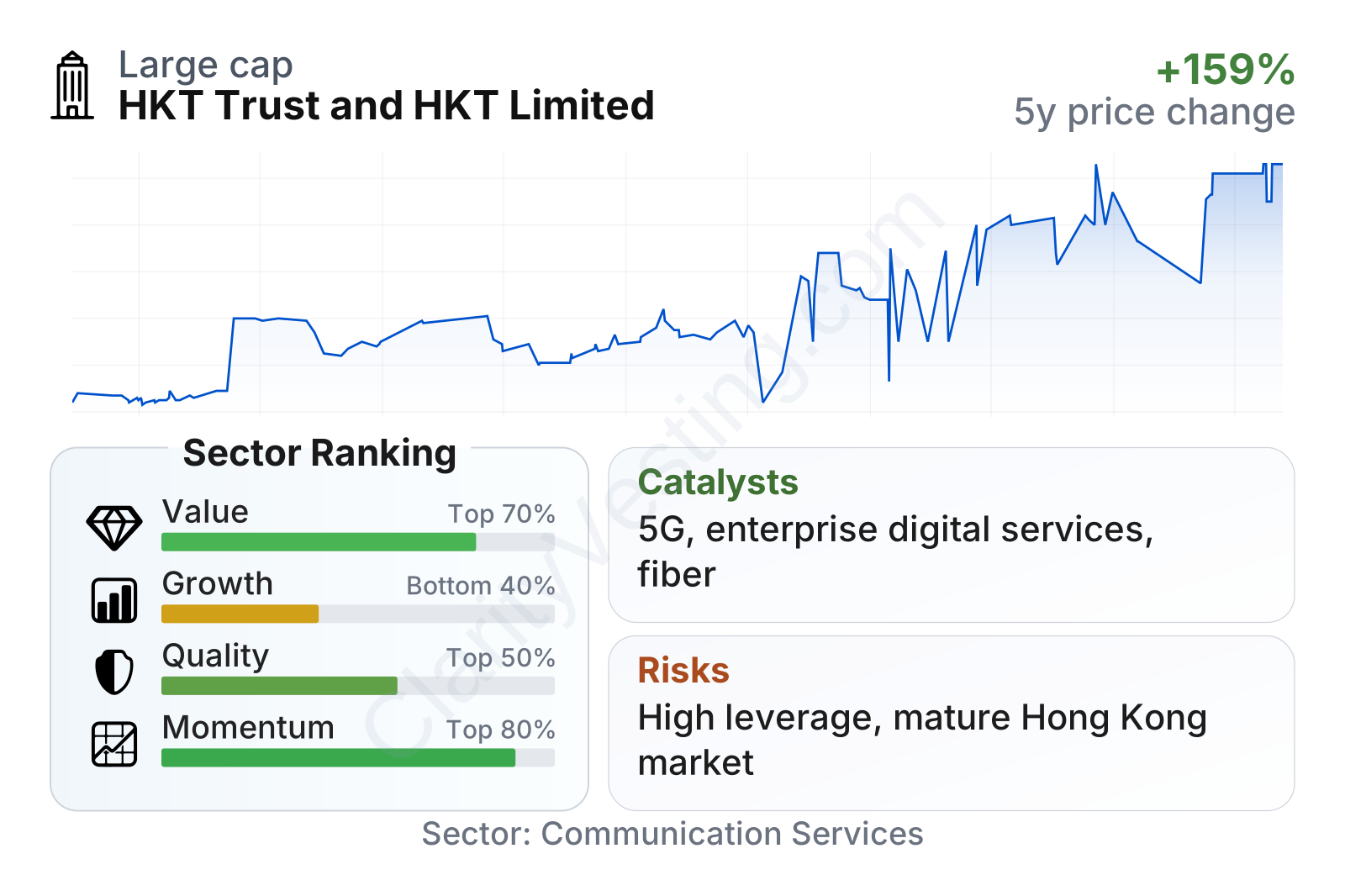
HKT stands out as a large but relatively defensive communications company. The stock’s market sensitivity is low, with a beta well below 1, which is often consistent with regulated or utility-like telecom demand. Profitability metrics are strong for the sector: operating margin is in the low-20% range and profit margin is in the mid-teens, both above sector medians. Return on invested capital is also notably stronger than the industry midpoint, suggesting the company has been able to earn solid returns from its network and service base. Growth metrics are more mixed, with recent revenue growth close to the sector median but long-term revenue-per-share growth more modest. Valuation measures look broadly in line with the sector on earnings, while cash generation appears unusually strong relative to the current market value.
Growth
Telecom is not a high-growth sector in the usual sense, but it remains a necessary one. Demand for mobile data, fiber broadband, enterprise connectivity, cybersecurity, cloud-linked communications, and digital transformation services continues to rise. That makes HKT’s sector structurally relevant even if annual expansion is usually moderate. For a long-term view, this matters because steady demand can support durable revenue and cash flow even without rapid headline growth.
HKT’s strategy appears sensible for this kind of environment. Rather than relying only on traditional voice and basic connectivity, the company has been broadening its role in enterprise solutions, digital services, and next-generation network usage. This is important because basic telecom services tend to mature over time, while enterprise technology and integrated digital offerings can support better customer retention and higher value per customer.
Recent growth has been steady rather than explosive. Year-over-year revenue growth is running around the sector median, and multi-year revenue growth has been positive but not especially fast. That is consistent with a mature operator in a developed market. The more encouraging point is that margin trends have improved over a five-year period, which suggests management has been able to protect profitability while still growing modestly.
Cash generation is one of the more compelling elements in HKT’s profile. Free cash flow is substantial, which gives the business flexibility to fund network investment, manage debt, and support distributions. In telecom, strong cash conversion can be more important than fast accounting growth because the sector is capital-intensive and requires regular infrastructure spending.
A major catalyst is the continued rise in data consumption and business reliance on resilient connectivity. Fiber usage, 5G monetization, enterprise digitization, and integrated communications services all provide room for incremental expansion. In Hong Kong, where telecom penetration is already high, the next phase is less about adding first-time users and more about selling more services to existing users and deepening enterprise relationships.
Recent company updates have also highlighted efforts around network quality, digital solutions, and higher-value service bundles. Those initiatives do not transform HKT into a fast-growth company, but they can help sustain moderate growth and defend margins in a mature market.
Risks
This article is for informational purposes only and does not constitute financial advice. Some content is AI-generated. See Disclaimer


