Stock Analysis · Himax Technologies Inc (HIMX)
Overview
Himax Technologies is a fabless semiconductor company focused on display imaging processing technologies. In simple terms, it designs chips and related components that help screens, cameras, and visual sensing systems work inside products such as TVs, laptops, monitors, smartphones, automotive displays, industrial devices, and augmented reality or virtual reality equipment. The company does not run its own large chip factories; instead, it develops the products and relies on manufacturing partners.
Its business is mainly built around display driver integrated circuits, often called display driver ICs. These chips control how images appear on screens. Himax also sells timing controllers, touch and display driver integration products, OLED-related solutions, wafer level optics, and image sensing technologies. Over time, the company has tried to broaden its mix beyond traditional consumer electronics toward automotive, industrial, and optical applications where product cycles can be longer and pricing pressure can be less severe.
Based on the company’s recent annual disclosures, revenue is concentrated in a few broad product groups, with display-related semiconductors clearly dominant.
- Large display driver ICs: approximately 45% to 55% of revenue. This includes chips used in TVs, monitors, notebooks, and tablets.
- Small and medium display driver ICs: approximately 20% to 30% of revenue. This category covers smartphones, automotive panels, industrial handheld devices, and other smaller screens.
- Non-driver products: approximately 20% to 30% of revenue. This includes timing controllers, touch/display integration, OLED components, image sensors, wafer level optics, and other related semiconductor products.
Geographically, the company is exposed to Asian electronics supply chains, which reflects where many displays and consumer devices are designed and assembled. That gives Himax access to major manufacturing ecosystems, but it also means results can be cyclical and sensitive to swings in device demand.
The long-term business picture is mixed. Himax still generates most of its sales from mature display chips, but it continues to invest heavily in research and development to capture higher-value niches such as automotive displays, edge AI vision, and optical components for head-mounted devices. Its cost structure shows that research spending remains a central priority even through weaker sales periods, which suggests management is trying to protect future product relevance rather than simply maximize short-term earnings.
The revenue base has shrunk materially from the 2021 peak, and profits have compressed even more sharply. At the same time, research spending has stayed relatively high, showing that the company is preserving technology development despite a difficult demand cycle.
Key Figures
| Metric | Value | Sector ⓘ |
|---|---|---|
| Date | Sep 12, 2026 | |
| Context | ||
| Sector | Technology | |
| Industry | Semiconductors | |
| Market Cap ⓘ | $2.40B | |
| Beta ⓘ | 2.39 | |
Value (Cheapness) | ||
| P/E Ratio ⓘ | 65.62 | 29.51 |
| FCF Yield ⓘ | 1.13% | 4.25% |
| EBIT / EV ⓘ | 1.75% | 2.85% |
| PEG ⓘ | 1.49 | |
Growth (Business expansion) | ||
| Revenue Growth ⓘ | 5.90% | 15.40% |
| RPS Growth (5Y CAGR) ⓘ | -14.33% | 8.56% |
| EPS Growth (5Y CAGR) ⓘ | -45.98% | -11.88% |
| Margin Growth (5Y Trend) ⓘ | -28.26% | 0.46% |
| FCF Growth (5Y CAGR) ⓘ | -25.06% | 9.80% |
Quality (Business durability) | ||
| ROIC (Latest) ⓘ | 2.83% | 9.44% |
| ROIC (5Y Median) ⓘ | 6.04% | 8.30% |
| Net Debt / EBIT (Latest) ⓘ | -5.16 | 0.54 |
| Net Debt / EBIT (5Y Median) ⓘ | 0.71 | 0.44 |
| Operating Margin (Latest) ⓘ | 5.77% | 9.58% |
| Operating Margin (5Y Median) ⓘ | 8.97% | 8.25% |
| Debt to Equity (Latest) ⓘ | 66.00% | 33.33% |
| Profit Margin (Latest) ⓘ | 4.26% | 7.14% |
| Free Cash Flow (Latest) ⓘ | $27.06M | |
Momentum (Price trend) | ||
| 3Y Return ⓘ | +181.12% | +45.48% |
| 12M Return (excl. last month) ⓘ | +108.07% | +23.48% |
| 6M Return ⓘ | +47.97% | +20.93% |
| Price vs. 200-Day MA ⓘ | +25.14% | +7.43% |
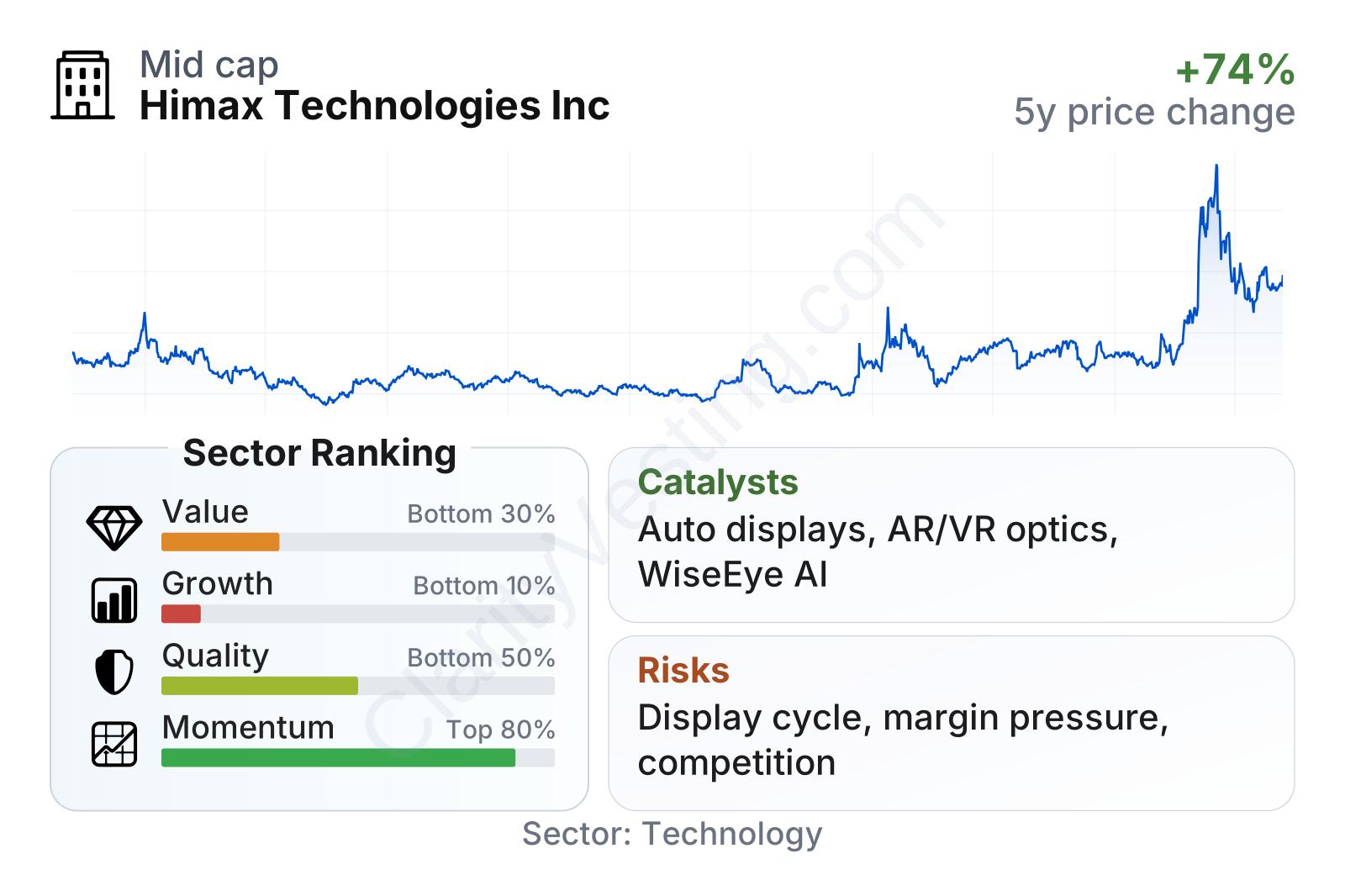
Himax is a mid-sized semiconductor company with a stock that has been far more volatile than the broader market, as reflected in its high beta. The market performance has been strong recently, but the underlying fundamentals are less impressive: valuation metrics sit in the weaker part of the sector, growth ranks near the bottom of peers, and profitability is below the semiconductor median. One clear financial strength is the balance between cash and earnings, with net debt metrics indicating the company is not under immediate leverage stress even though debt-to-equity has risen.
Growth
Himax operates in a sector with real long-term demand drivers. More screens are being added to cars, industrial equipment is becoming smarter, and demand for image processing and low-power visual sensing continues to expand. Automotive electronics in particular remain an attractive market because vehicles increasingly use larger dashboards, multiple displays, camera systems, and driver-assistance functions. Augmented reality, virtual reality, and edge AI devices also represent interesting future demand pools, especially for companies that combine display, optics, and image-sensing know-how.
That said, the company’s recent growth record has been uneven. Revenue surged in 2021 and then fell sharply as the electronics cycle normalized. More recently, sales have remained under pressure, and the latest year-over-year readings still point to contraction rather than a clean return to sustained expansion.
The pattern shows a business still recovering from a post-boom reset. Short rebounds have appeared, but they have not yet turned into a stable upward trend. Compared with the broader semiconductor sector, Himax’s recent sales growth has been notably weaker.
Its strategy for future expansion is logical even if execution remains uncertain. Management has emphasized automotive display ICs, timing controllers, OLED-related products, wafer level optics, and WiseEye ultra-low-power AI sensing solutions. Those areas make sense because they aim at applications where customers may value performance, power efficiency, integration, and product durability more than simple low-cost supply. This is important for Himax because mature display-driver products can face intense price competition.
A meaningful catalyst is the company’s positioning in optical and imaging technologies for head-mounted devices and always-on sensing applications. Public company materials have highlighted cooperation with ecosystem partners in AR, VR, and AI-enabled vision products. If those end markets grow into larger commercial volumes, Himax could benefit from a broader revenue mix and potentially better margins than standard display-driver products usually offer.
Another support point is that free cash flow remains positive even after the downturn, although it has declined substantially from earlier highs.
Positive cash generation suggests the business is still financially workable during a slow period, but the decline also shows less room for error than during the 2021 cycle peak. For long-term analysis, the key question is not whether Himax has technology opportunities; it does. The harder question is whether those opportunities can become large enough to offset the cyclical weakness and pricing pressure in its core display businesses.
Risks
This article is for informational purposes only and does not constitute financial advice. Some content is AI-generated. See Disclaimer


