Stock Analysis · Hilton Grand Vacations Inc (HGV)
Overview
Hilton Grand Vacations Inc. is a vacation ownership company. In simple terms, it sells timeshare interests that give customers access to resort stays, and it also earns recurring income from financing, resort operations, and membership-related services. The company operates under the Hilton Grand Vacations brand and also manages a broader set of vacation ownership assets and clubs after recent acquisitions that expanded its scale.
Its business is tied to leisure travel rather than traditional hotel ownership. That matters because the economics are different: a large share of revenue comes from selling vacation ownership intervals, while another important layer comes from servicing existing owners through financing collections, club dues, resort management, and exchanges.
Based on recent annual disclosures, revenue is mainly generated from the following areas, listed from largest to smallest:
- Vacation ownership sales: about 60% to 70% of revenue. This includes selling timeshare intervals and related products to new and existing customers.
- Financing: about 10% to 15%. Many buyers finance their purchases, and the company earns interest income on those loans.
- Resort operations and club management: about 10% to 15%. This includes property management, owner services, club membership fees, and recurring management-related income.
- Rental and ancillary revenue: about 5% to 10%. This includes short-term rentals of unsold inventory and other travel-related fees.
The revenue mix gives Hilton Grand Vacations a combination of upfront sales and recurring cash inflows. That structure can be attractive when travel demand is healthy, but it also means results depend on consumer confidence, financing conditions, and the company’s ability to keep converting vacation shoppers into buyers.
The business flow over the last few years shows a clear pattern: revenue has expanded strongly, but a larger cost base, much higher interest expense, and heavier operating expenses have limited how much of that growth has reached net income. Gross profit widened sharply after the portfolio expanded, yet bottom-line earnings have remained much thinner than operating profit would suggest.
Key Figures
| Metric | Value | Sector ⓘ |
|---|---|---|
| Date | Sep 12, 2026 | |
| Context | ||
| Sector | Consumer Cyclical | |
| Industry | Resorts & Casinos | |
| Market Cap ⓘ | $3.05B | |
| Beta ⓘ | 1.51 | |
Value (Cheapness) | ||
| P/E Ratio ⓘ | 22.27 | 17.10 |
| FCF Yield ⓘ | 13.85% | 8.53% |
| EBIT / EV ⓘ | 9.37% | 6.46% |
| PEG ⓘ | N/A | |
Growth (Business expansion) | ||
| Revenue Growth ⓘ | 6.20% | 5.75% |
| RPS Growth (5Y CAGR) ⓘ | 24.31% | 9.14% |
| EPS Growth (5Y CAGR) ⓘ | -16.15% | -18.21% |
| Margin Growth (5Y Trend) ⓘ | -6.39% | -0.23% |
| FCF Growth (5Y CAGR) ⓘ | 11.28% | 4.91% |
Quality (Business durability) | ||
| ROIC (Latest) ⓘ | 8.41% | 12.61% |
| ROIC (5Y Median) ⓘ | 5.74% | 10.72% |
| Net Debt / EBIT (Latest) ⓘ | 7.56 | 2.10 |
| Net Debt / EBIT (5Y Median) ⓘ | 10.42 | 2.32 |
| Operating Margin (Latest) ⓘ | 18.23% | 9.25% |
| Operating Margin (5Y Median) ⓘ | 15.76% | 9.64% |
| Debt to Equity (Latest) ⓘ | 712.43% | 75.78% |
| Profit Margin (Latest) ⓘ | 3.21% | 5.33% |
| Free Cash Flow (Latest) ⓘ | $422.00M | |
Momentum (Price trend) | ||
| 3Y Return ⓘ | -5.44% | +14.53% |
| 12M Return (excl. last month) ⓘ | -0.13% | +3.08% |
| 6M Return ⓘ | -5.71% | +0.55% |
| Price vs. 200-Day MA ⓘ | -14.41% | -0.54% |
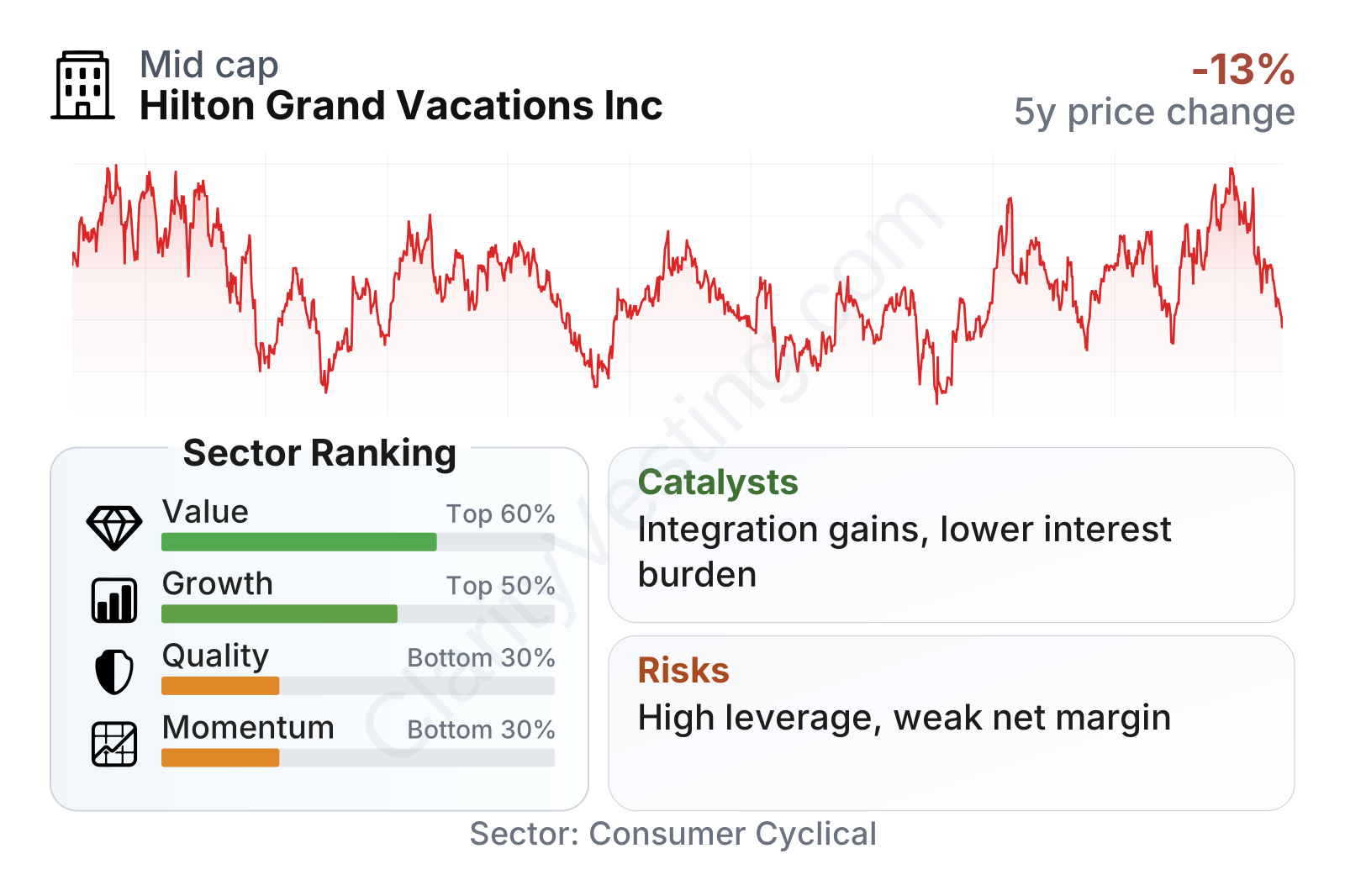
Hilton Grand Vacations is a mid-sized company in the consumer cyclical space, and its share price behavior reflects that. The stock has been volatile over the last several years, which fits a business exposed to discretionary spending and credit conditions. The latest factor view is mixed but understandable: value and growth metrics rank in the upper part of the sector, while quality is weaker. In practical terms, that points to a company that still generates meaningful cash flow and has grown revenue well over time, but carries balance-sheet and profitability pressures that reduce the overall strength of the profile.
One notable contrast is that free cash flow generation looks stronger than accounting earnings. Operating margin is above the sector median, and free cash flow yield is also favorable, yet return on invested capital and profit margin lag. That usually signals a business where scale and cash conversion are real strengths, but financing costs, acquisition-related effects, or capital structure weigh on the final earnings line.
Growth
The company operates in a part of the travel market that has long-term support from consumer demand for leisure experiences, branded travel products, and flexible vacation access. Vacation ownership is a niche within that broader market, but it can still grow when household travel spending remains resilient and when companies are able to use brand recognition and customer databases effectively.
Hilton Grand Vacations’ strategy is built around expanding its owner base, increasing cross-selling to existing members, and using a larger resort and club network to improve sales efficiency. The Hilton brand relationship remains important because it supports customer awareness and gives the company access to travelers already familiar with the broader Hilton ecosystem. The company has also become larger through acquisitions, which can create scale benefits in marketing, club operations, and inventory management if integrated well.
Revenue growth has cooled from the post-pandemic rebound phase, but the recent trend still points to positive expansion rather than stagnation. The latest year-over-year growth rate sits modestly above the sector median, while the longer five-year revenue-per-share growth rate is substantially stronger than the sector median. That suggests the company’s growth record is not only a short-term reopening effect; it also reflects a larger platform than it had several years ago.
Free cash flow has been uneven, which is common in this industry, but it remains meaningful in absolute terms and has recovered from the softer period seen after the major expansion phase. That matters because free cash flow supports debt service, inventory investment, and strategic flexibility. A business like this does not need perfectly smooth quarterly progression to be interesting over the long run, but it does need recurring cash generation, and Hilton Grand Vacations still shows that.
The clearest catalysts are operational rather than speculative. Better integration of acquired assets, improved tour flow and close rates, a healthier financing environment for customers, and stronger monetization of the enlarged member base could all lift results. If interest costs moderate over time, that could also have an outsized effect because operating income is materially higher than net income, leaving room for earnings improvement if financing pressure eases.
Risks
This article is for informational purposes only and does not constitute financial advice. Some content is AI-generated. See Disclaimer