Stock Analysis · Hagerty Inc (HGTY)
Overview
Hagerty Inc is a specialty insurance and automotive enthusiast company centered on classic cars, collector vehicles, motorcycles, boats, and related lifestyle services. Its best-known activity is arranging insurance for collectible vehicles, but the business is broader than a traditional insurer. Hagerty also operates member services, automotive events, media, valuation tools, and a marketplace ecosystem aimed at people who own, buy, sell, or enjoy collectible vehicles.
The company reports its business through three main revenue categories. Based on recent annual disclosures, the mix is led by commission and fee income from its insurance distribution platform, followed by written premium from its underwriting operations, with a smaller contribution from memberships, marketplace, events, and other enthusiast services.
- Commission and fee revenue: approximately 50% to 60% of total revenue. This is primarily earned by placing collector vehicle insurance policies through carrier partners and servicing those policies.
- Premiums earned: approximately 30% to 40% of total revenue. This comes from Hagerty’s underwriting activities, where it participates more directly in the economics of insurance risk.
- Membership, marketplace, events, media, and other revenue: approximately 10% to 15% of total revenue. This includes Hagerty Drivers Club subscriptions, auctions and marketplace-related activity, valuation and content offerings, and enthusiast events.
That structure matters because Hagerty is not only selling insurance policies. It is building a niche ecosystem around a passionate customer base, which can support retention, cross-selling, and brand strength over time. Revenue has also expanded sharply over the last several years, while operating income has moved from losses to a clearer profit base. At the same time, net margins remain thin, which shows the business is still balancing growth spending with profitability.
The long-term pattern is favorable: total revenue has climbed from the mid-hundreds of millions of dollars to well above $1 billion, and operating profit has improved meaningfully. Gross profit has scaled faster than selling and administrative costs, which suggests the model has some operating leverage as it grows.
Key Figures
| Metric | Value | Sector ⓘ |
|---|---|---|
| Date | Nov 21, 2026 | |
| Context | ||
| Sector | Financial Services | |
| Industry | Insurance - Property & Casualty | |
| Market Cap ⓘ | $5.60B | |
| Beta ⓘ | 0.83 | |
Value (Cheapness) | ||
| P/E Ratio ⓘ | 271.33 | 12.01 |
| P/B Ratio ⓘ | 5.75 | 1.48 |
| FCF Yield ⓘ | 5.00% | 8.77% |
| Dividend Yield ⓘ | N/A | 3.01% |
| EBIT / EV ⓘ | 3.24% | 8.31% |
| PEG ⓘ | 0.27 | |
Growth (Business expansion) | ||
| Revenue Growth ⓘ | -9.50% | 6.70% |
| RPS Growth (5Y CAGR) ⓘ | -12.01% | 12.35% |
| EPS Growth (5Y CAGR) ⓘ | N/A | -0.27% |
| BVPS Growth (5Y CAGR) ⓘ | -44.38% | 4.83% |
| Margin Growth (5Y Trend) ⓘ | 19.03% | -4.16% |
| FCF Growth (5Y CAGR) ⓘ | N/A | 4.69% |
| DPS Growth (5Y CAGR) ⓘ | -24.35% | 8.82% |
Quality (Business durability) | ||
| ROIC (Latest) ⓘ | 12.69% | 9.49% |
| ROE (Latest) ⓘ | 13.93% | 14.02% |
| ROA (Latest) ⓘ | 0.68% | 1.53% |
| ROIC (5Y Median) ⓘ | 32.72% | 7.80% |
| ROE (5Y Median) ⓘ | N/A | 12.09% |
| ROA (5Y Median) ⓘ | 1.42% | 1.28% |
| Net Debt / EBIT (Latest) ⓘ | -4.86 | 0.88 |
| Net Debt / EBIT (5Y Median) ⓘ | -5.67 | 0.73 |
| Net Debt / EBITDA (Latest) ⓘ | -2.99 | 0.71 |
| Operating Margin (Latest) ⓘ | 4.53% | 23.37% |
| Operating Margin (5Y Median) ⓘ | 4.43% | 24.29% |
| Debt to Equity (Latest) ⓘ | 84.29% | 59.34% |
| Profit Margin (Latest) ⓘ | 0.53% | 26.65% |
| Free Cash Flow (Latest) ⓘ | $279.65M | |
Momentum (Price trend) | ||
| 3Y Return ⓘ | +85.52% | +73.29% |
| 12M Return (excl. last month) ⓘ | +37.96% | +18.35% |
| 6M Return ⓘ | +47.40% | +3.24% |
| Price vs. 200-Day MA ⓘ | +30.67% | +2.17% |
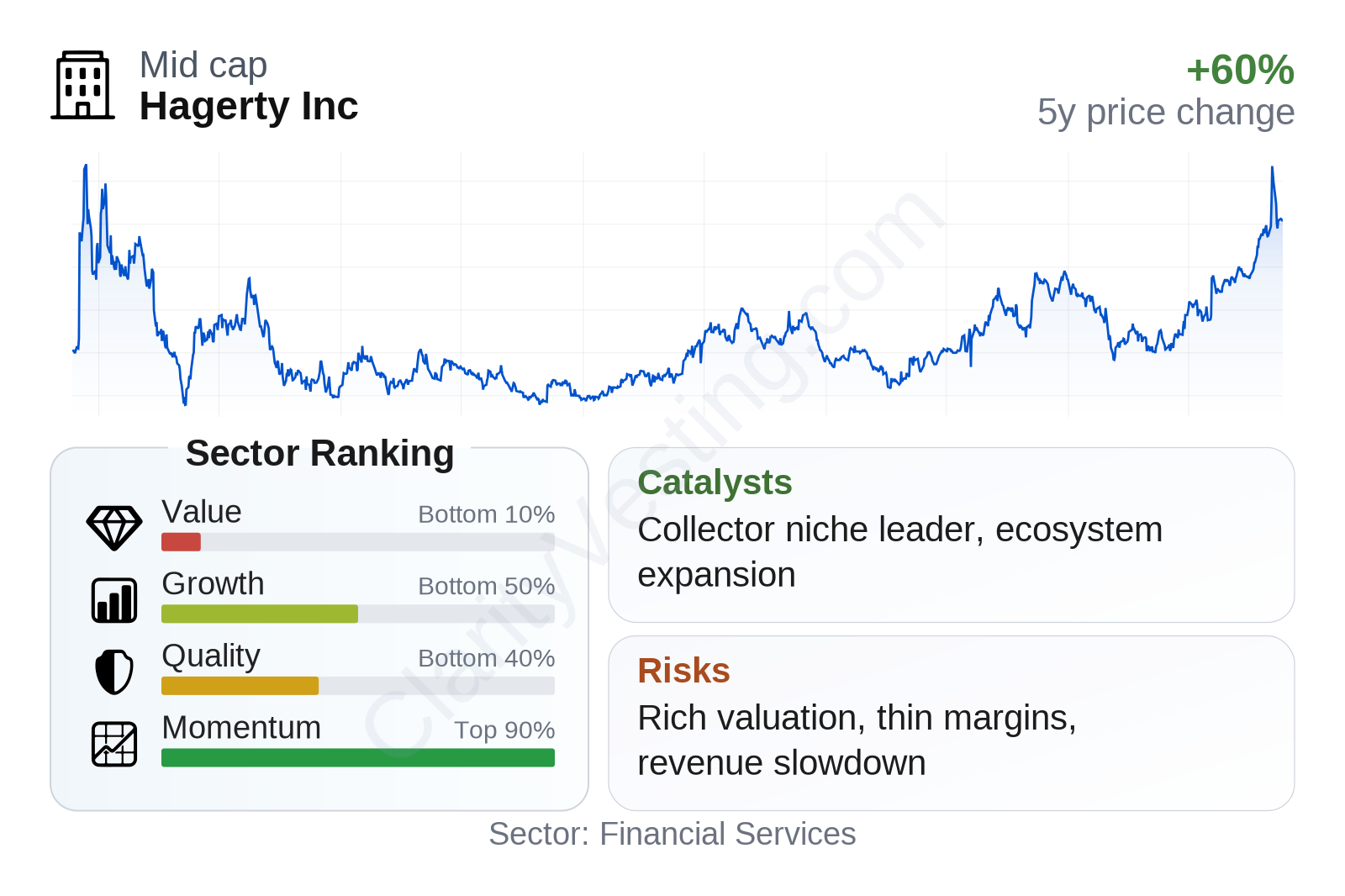
Hagerty currently sits in a mixed position. Market performance has been strong relative to much of the financial sector, and the company’s balance sheet appears less burdened by net debt than many peers. Profitability on invested capital is respectable, but margins and asset efficiency remain weaker than industry norms. The most striking point is valuation: the shares trade at a large premium on earnings and book value versus the sector median, while recent revenue growth has softened. In simple terms, the market is giving Hagerty credit for future improvement that has not yet fully appeared in the current fundamentals.
Growth
Hagerty operates in a niche that benefits from durable interest rather than a short-lived trend. The broader property and casualty insurance sector is mature, but collector vehicle insurance is more specialized and less commoditized. Owners of classic and enthusiast cars often want agreed-value coverage, expertise in restoration and storage issues, and service tailored to low-mileage or seasonal use. That makes this part of the market more relationship-driven than standard auto insurance.
Hagerty’s strategy for future growth is coherent. It is using insurance as the anchor product, then extending into memberships, events, valuation tools, financing, and vehicle transaction services. If that ecosystem works, the company can raise revenue per customer without relying only on policy count growth. It also helps differentiate Hagerty from larger insurers that may offer collector coverage but do not have the same enthusiast identity.
Another positive factor is the company’s ability to scale revenue faster than overhead over time. Revenue rose strongly from 2021 through 2025, and operating income improved from losses to a more meaningful positive level. That trend suggests the business has become more efficient as it matured after going public.
Earnings per share have been volatile, but the broader direction after 2022 has been upward, with a move from losses to positive annual earnings before some uneven quarterly results in 2026. For a company in expansion mode, that pattern points to progress, though not yet to steady predictability.
Book value per share remains unusual because it has been negative in recent years. That can happen when accounting adjustments, capital structure choices, or acquired intangible-heavy businesses shape the balance sheet. It does not automatically mean the business model is broken, but it does make traditional balance-sheet valuation less straightforward and helps explain why investors focus more on future earnings power and cash generation.
A meaningful catalyst is the continued expansion of the collector car ecosystem itself. Hagerty has often highlighted growth in insured vehicles, client retention, and the use of its broader member platform. The company has also pursued partnerships and product extensions that can bring more customers into its network. In a specialized market, brand trust and community reach can compound over time if execution remains solid.
Recent company communications have also pointed to ongoing investment in the Hagerty Drivers Club, digital tools, and adjacent services around buying, selling, financing, and enjoying collectible vehicles. Those initiatives are important because they widen the addressable market beyond insurance commissions alone.
Risks
This article is for informational purposes only and does not constitute financial advice. Some content is AI-generated. See Disclaimer