Stock Analysis · The Home Depot Inc (HD)
Overview
The Home Depot is the largest home improvement retailer in the United States. It sells building materials, tools, hardware, appliances, décor, garden products, and installation or home-related services through a large store network, digital channels, and business-focused distribution capabilities. Its customer base includes both do-it-yourself shoppers and professional contractors, with the professional segment becoming a larger strategic focus in recent years.
The company’s revenue is still primarily generated by selling merchandise rather than services or financing. Based on recent annual reporting, the business can be understood through a few main revenue streams:
- Building materials: approximately 35% of sales. This includes lumber, millwork, insulation, roofing, and related construction products.
- Décor and indoor products: approximately 33% of sales. This covers appliances, kitchen and bath, flooring, paint, plumbing, and home décor categories.
- Hardlines: approximately 22% of sales. This includes tools, hardware, electrical, lighting, storage, and similar everyday improvement items.
- Outdoor and garden: approximately 10% of sales. This includes lawn and garden, live goods, outdoor power equipment, and seasonal outdoor products.
Geographically, the business is overwhelmingly concentrated in North America, with the United States representing the clear majority of revenue and Canada and Mexico contributing a smaller share. The company also earns some revenue from installation and other service-related activities tied to home projects, but product sales remain the dominant driver.
Home Depot’s scale matters because home improvement retail benefits from supply chain efficiency, vendor relationships, store density, and the ability to fulfill large orders quickly. That helps explain why the company converts a very large revenue base into strong operating profit and cash flow, even in a slower housing market.
The business has kept expanding its revenue base over the last several years, but the flow of earnings shows some pressure underneath: sales have risen from roughly $151 billion to about $165 billion over five fiscal years, while operating income and net income have moved lower from their pandemic-era peaks as costs and interest expense increased.
Key Figures
| Metric | Value | Sector ⓘ |
|---|---|---|
| Date | Sep 12, 2026 | |
| Context | ||
| Sector | Consumer Cyclical | |
| Industry | Home Improvement Retail | |
| Market Cap ⓘ | $304.98B | |
| Beta ⓘ | 0.95 | |
Value (Cheapness) | ||
| P/E Ratio ⓘ | 21.41 | 17.10 |
| FCF Yield ⓘ | 4.95% | 8.53% |
| EBIT / EV ⓘ | 5.07% | 6.46% |
| PEG ⓘ | 1.73 | |
Growth (Business expansion) | ||
| Revenue Growth ⓘ | 5.70% | 5.75% |
| RPS Growth (5Y CAGR) ⓘ | 3.69% | 9.14% |
| EPS Growth (5Y CAGR) ⓘ | -17.96% | -18.21% |
| Margin Growth (5Y Trend) ⓘ | -2.51% | -0.23% |
| FCF Growth (5Y CAGR) ⓘ | -2.52% | 4.91% |
Quality (Business durability) | ||
| ROIC (Latest) ⓘ | 23.73% | 12.61% |
| ROIC (5Y Median) ⓘ | 37.62% | 10.72% |
| Net Debt / EBIT (Latest) ⓘ | 2.70 | 2.10 |
| Net Debt / EBIT (5Y Median) ⓘ | 2.22 | 2.32 |
| Operating Margin (Latest) ⓘ | 12.51% | 9.25% |
| Operating Margin (5Y Median) ⓘ | 14.32% | 9.64% |
| Debt to Equity (Latest) ⓘ | 376.52% | 75.78% |
| Profit Margin (Latest) ⓘ | 8.41% | 5.33% |
| Free Cash Flow (Latest) ⓘ | $15.10B | |
Momentum (Price trend) | ||
| 3Y Return ⓘ | +2.20% | +14.53% |
| 12M Return (excl. last month) ⓘ | -10.97% | +3.08% |
| 6M Return ⓘ | -7.55% | +0.55% |
| Price vs. 200-Day MA ⓘ | -8.73% | -0.54% |
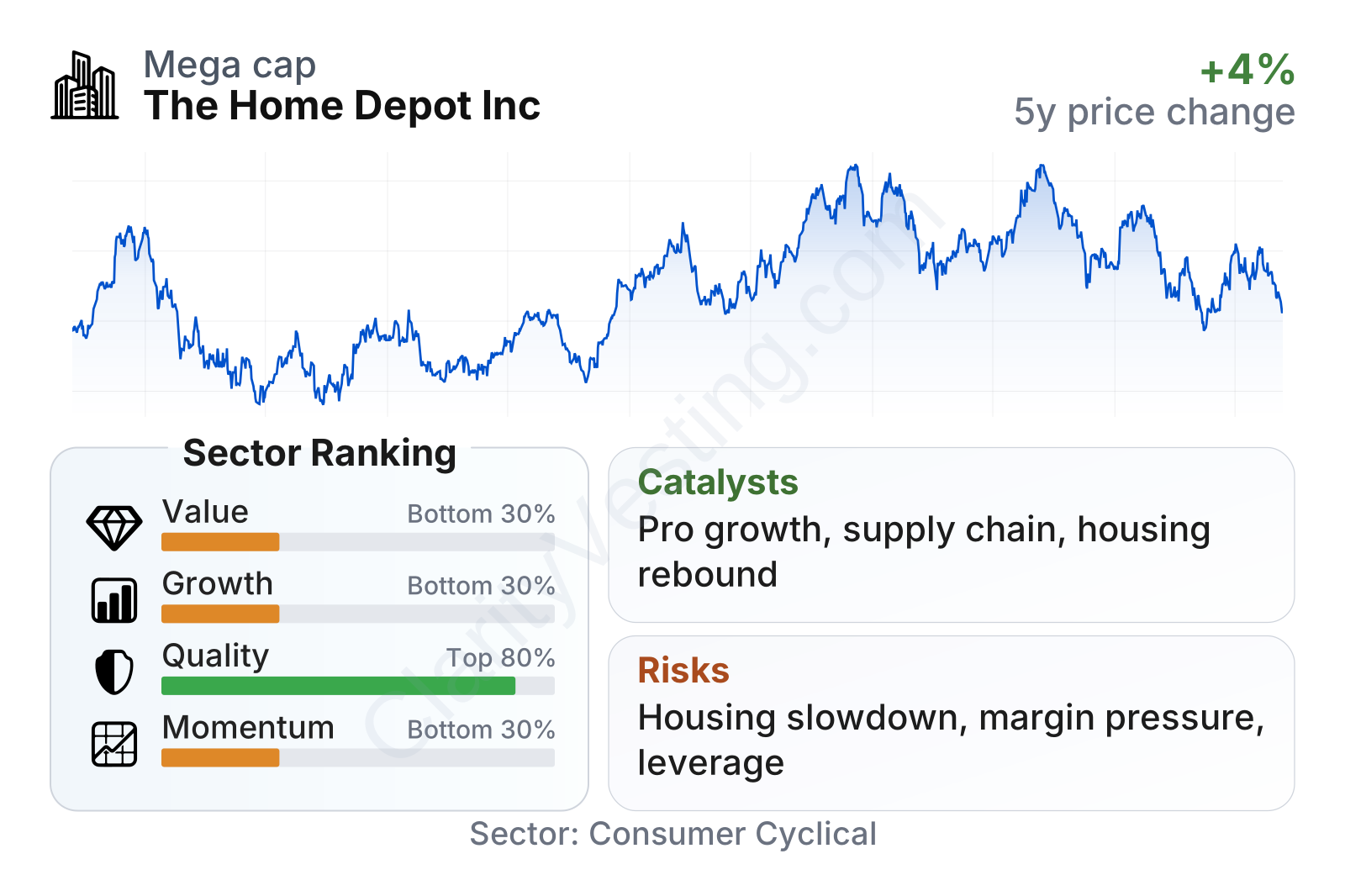
Home Depot remains a very large company with lower-than-market-type volatility, but the mix of metrics is uneven. Profitability and capital efficiency are clearly strong relative to much of the sector, while growth and valuation look less favorable. Returns on invested capital are notably high, margins remain above sector norms, and free cash flow generation is still substantial. At the same time, revenue growth has been modest over longer periods, recent share-price momentum has been soft, and valuation multiples remain above the sector median.
The stock’s longer-term path has been positive, but recent trading has been choppier, reflecting a business that is still solid operationally yet exposed to a slower housing and renovation environment. That combination often leads to a market debate between quality and price.
Growth
Home improvement is a mature sector, but it is not a stagnant one. Demand is supported by aging housing stock, ongoing repair and maintenance needs, and longer-term household spending on remodeling, energy efficiency, and project upgrades. Even when home sales slow, homeowners often keep investing in the properties they already own. That gives Home Depot a structural base of recurring demand, although the pace can swing with mortgage rates and consumer confidence.
Management’s strategy for future growth is logical. The company has been investing in supply chain modernization, delivery speed, digital capabilities, and especially in serving professional customers more effectively. That matters because professionals tend to purchase more frequently, buy in larger baskets, and rely on dependable inventory and fulfillment. Home Depot has also expanded capabilities in specialty trade distribution through acquisitions, which broadens its reach beyond traditional retail traffic and deeper into repair, maintenance, and construction workflows.
Revenue growth has been uneven since the post-pandemic slowdown, with a period of declines followed by a return to modest positive growth. More recently, year-over-year sales growth has recovered into the mid-single-digit range, which suggests the business is stabilizing rather than accelerating sharply. For a company of this size, steady improvement can still be meaningful, but it does not point to a high-growth profile.
Cash generation remains one of the more important support points. Free cash flow has fluctuated over recent years and sits below its stronger periods, but it is still comfortably in the multi-billion-dollar range. That gives Home Depot room to fund operations, invest in distribution and technology, and continue returning capital to shareholders, although the trend is less strong than it was earlier in the cycle.
A notable catalyst is the company’s deeper push into the professional market, where larger-ticket orders and repeat demand can improve mix and resilience. Another potential tailwind is any broad easing in financing conditions for housing and remodeling activity. If repair and renovation spending improves while Home Depot continues gaining share with professionals, revenue growth could become more durable than the recent stop-start pattern suggests.
Risks
This article is for informational purposes only and does not constitute financial advice. Some content is AI-generated. See Disclaimer