Stock Analysis · Hasbro Inc (HAS)
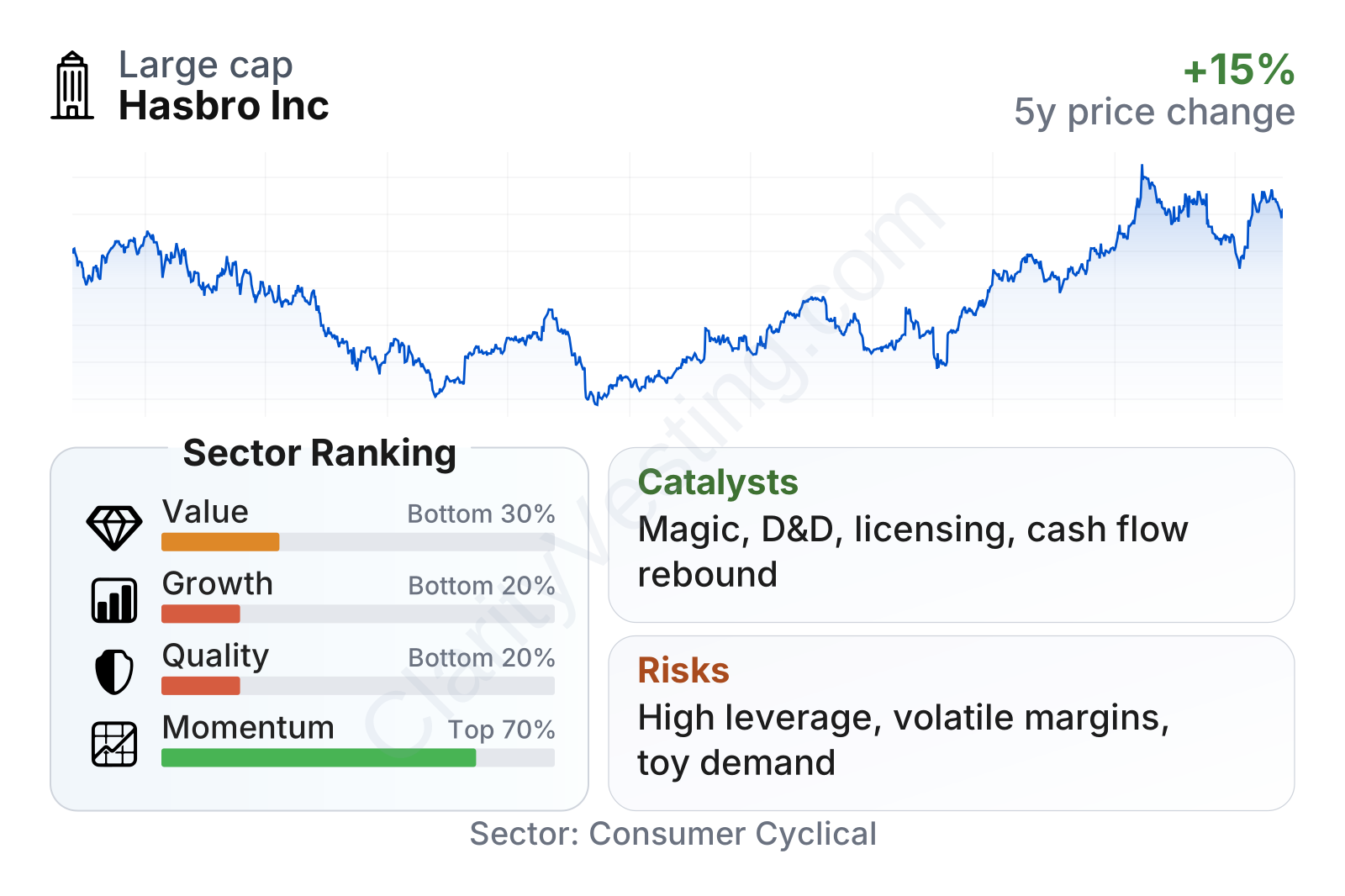
Stock Analysis · Hasbro Inc (HAS)

Overview

Hasbro is a global entertainment and toy company best known for brands such as Magic: The Gathering, Dungeons & Dragons, Monopoly, Nerf, Play-Doh, Peppa Pig, and Transformers. The business is no longer just about selling toys through retail stores. In recent years, management has been reshaping Hasbro into a broader brand company built around toys, tabletop gaming, digital games, licensing, and entertainment partnerships.

The company reports its business mainly through two operating segments: Wizards of the Coast and Digital Gaming, and Consumer Products. Wizards of the Coast includes trading cards, tabletop role-playing games, and digital gaming tied to those franchises. Consumer Products includes toys, games, and related merchandise sold around the world. Hasbro also earns revenue from licensing and from entertainment-related activities tied to its intellectual property.

Based on recent annual reporting, Hasbro’s revenue mix is roughly centered on the following sources:

  • Consumer Products: about 55% to 60% of revenue. This is the traditional toy and games business, including franchises such as Nerf, Play-Doh, Monopoly, Transformers, and preschool brands.
  • Wizards of the Coast and Digital Gaming: about 35% to 40% of revenue. This segment is driven largely by Magic: The Gathering and Dungeons & Dragons, two of Hasbro’s most valuable properties.
  • Licensing and entertainment-related revenue: a smaller but strategically useful share, generally in the low single digits to around 10% depending on the period and classification.

What stands out is the change in the business mix. Traditional toy sales remain important, but a growing share of value comes from owned intellectual property that can be monetized across games, digital content, merchandising, and licensing. That makes Hasbro easier to understand as a portfolio of brands rather than only a toy manufacturer. Over the last several years, revenue has become smaller than its earlier peak, but the gross profit mix has improved as the company leaned more heavily on higher-margin franchises and reduced lower-return activities.

The long-term pattern behind the revenue and cost structure is clear: total sales are below the 2021 level, but gross profit has held up better than revenue, showing the value of premium brands and a lighter cost base. The weak point has been operating profit volatility, which shows that restructuring charges, entertainment write-downs, and uneven consumer demand still have a major effect on bottom-line results.

Key Figures

MetricValueSector
DateJul 18, 2026
Context
SectorConsumer Cyclical
IndustryLeisure
Market Cap $11.61B
Beta 0.48
Value
(Cheapness)
P/E Ratio N/A18.58
FCF Yield 8.79%7.99%
EBIT / EV 1.24%5.91%
PEG 1.74
Growth
(Business expansion)
Revenue Growth 12.70%5.50%
RPS Growth (5Y CAGR) -7.79%9.20%
EPS Growth (5Y CAGR) -27.15%-26.43%
Margin Growth (5Y Trend) -10.56%-0.18%
FCF Growth (5Y CAGR) 4.91%5.02%
Quality
(Business durability)
ROIC (Latest) 3.35%12.03%
ROIC (5Y Median) 6.19%10.82%
Net Debt / EBIT (Latest) 17.842.12
Net Debt / EBIT (5Y Median) 6.092.25
Operating Margin (Latest) 3.51%9.28%
Operating Margin (5Y Median) 7.38%9.64%
Debt to Equity (Latest) 597.44%75.23%
Profit Margin (Latest) -4.62%5.28%
Free Cash Flow (Latest) $1.02B
Momentum
(Price trend)
3Y Return +46.65%+10.68%
12M Return (excl. last month) +27.82%+5.26%
6M Return -4.72%-2.41%
Price vs. 200-Day MA -4.75%+1.55%
Better than sector median
Slightly worse than sector median
More than 20% worse than sector median

Hasbro currently has a market value of around $12 billion, which places it in the mid-to-large range within its part of the consumer discretionary market. Its beta is below 0.5, suggesting the stock has been less volatile than the broader market. Recent price performance has been strong over one year and three years relative to much of the sector, reflecting confidence in the turnaround and in the strength of key franchises.

The factor summary is mixed. On growth, the company’s recent year-over-year revenue recovery looks better than the sector median, but the longer five-year picture is much weaker because sales per share and margins have trended down. On quality, Hasbro ranks poorly because returns on invested capital and operating margins remain below many peers, while leverage is far above the sector norm. On value, the picture is not especially cheap or especially rich at first glance: free cash flow yield looks solid, but enterprise-value-based earnings measures are less favorable.

Growth

Hasbro operates in parts of the market that are mature on the surface but still capable of selective growth. Traditional toys are not a high-growth industry overall, yet collectibles, tabletop gaming, trading cards, and digitally extended franchises remain attractive niches. That matters because Hasbro’s best assets are concentrated in exactly those categories. Magic: The Gathering and Dungeons & Dragons have stronger fan engagement, recurring purchasing behavior, and better monetization potential than a standard one-time toy sale.

Management’s strategy is broadly logical for future growth. The company has been focusing on fewer, bigger brands; tightening costs; licensing more aggressively; and placing greater emphasis on play systems that can live across physical products, digital gaming, and entertainment. This is especially relevant for Wizards of the Coast, which gives Hasbro exposure to repeat purchases, organized play, direct fan engagement, and digital expansion. These qualities can make revenue more resilient than a toy lineup that depends heavily on holiday shelf space.

The recent revenue trend suggests a rebound after a difficult period in 2023 and 2024. That recovery is important, but it should be viewed in context: the company is climbing back from a weak base rather than delivering uninterrupted expansion. In other words, the recent acceleration is encouraging, yet it does not erase the fact that Hasbro is still rebuilding its earnings profile after a sharp reset.

Cash generation is one of the more constructive parts of the picture. Free cash flow has improved sharply over the last few years and now sits above the $1 billion range on a trailing basis. For a company in turnaround mode, that matters because strong cash flow supports debt servicing, dividends, brand investment, and operational flexibility even when accounting earnings are uneven.

A meaningful catalyst is the company’s brand licensing and entertainment pipeline. Hasbro has continued to look for ways to expand franchises beyond toys, including digital gaming partnerships, content development, and merchandising tied to owned intellectual property. Another catalyst is the continued durability of Wizards of the Coast. If Magic releases remain healthy and Dungeons & Dragons continues extending into digital formats and entertainment, that segment can remain the main engine of profit mix improvement.

Recent company updates have also highlighted ongoing cost discipline and portfolio streamlining. That does not create growth on its own, but it can make moderate sales growth more valuable by allowing a larger portion of revenue to flow through to cash generation.

Risks

The biggest risk is that Hasbro still shows signs of financial fragility beneath the brand strength. Profitability has been inconsistent, and the latest trailing profit margin remains negative, while operating margin is well below the sector median. This means the company has not yet fully translated its valuable intellectual property into consistently strong bottom-line performance.

Leverage is the clearest balance-sheet concern. Debt to equity has risen to a level far above the sector norm, even allowing for the fact that accounting equity can be compressed by write-downs and restructuring effects. Net debt relative to EBIT is also elevated. That does not mean immediate distress, especially with cash flow improving, but it does reduce room for error if consumer demand softens or if a major product cycle underperforms.

The profit trend shows just how uneven recent execution has been. Hasbro moved from healthy profitability earlier in the cycle to deep losses during the reset period, then partially recovered, only to remain below normal levels again. For long-term analysis, that raises an important question: is the current business model structurally more profitable after restructuring, or is the company still exposed to repeated earnings swings from charges, weak toy demand, and content-related volatility?

Competition is intense. In toys, Hasbro competes with Mattel, Lego, Spin Master, Jakks Pacific, and a long tail of lower-cost manufacturers and private-label products. In trading cards and tabletop gaming, it has stronger differentiation, especially through Magic: The Gathering and Dungeons & Dragons. In that area, Hasbro has a real competitive advantage because these franchises are difficult to replicate: they have decades of lore, established player communities, tournament ecosystems, and strong brand loyalty.

That said, Hasbro is not the leader across everything it does. Lego has exceptional brand power and global momentum in construction toys, while Mattel remains a major rival in traditional toys and has also been pushing harder into entertainment and licensing. Hasbro’s strongest relative position is in fantasy tabletop and trading-card ecosystems, not across the entire toy aisle.

Another risk is execution around entertainment and digital expansion. Turning an intellectual property catalog into dependable film, television, or game profits is difficult. Hasbro has already gone through a period of write-downs and restructuring tied to previous strategic choices. If management overinvests again or fails to generate acceptable returns from content and partnerships, earnings quality could remain weak.

Consumer spending is also a practical risk. Toys, games, and collectibles are discretionary purchases. Holiday season demand, retailer inventory decisions, and franchise timing can all create sharp swings from one year to the next. This makes Hasbro less predictable than a consumer staples business, even when the brands themselves are durable.

Valuation

Valuing Hasbro requires more caution than a simple P/E comparison. Because recent earnings have been distorted and at times negative, the normal earnings multiple has limited usefulness. That is why the market often looks instead at free cash flow, brand durability, and the possibility of margin normalization over time.

The stock has often traded at a premium or unstable earnings multiple compared with the sector, largely because reported earnings have been volatile. At the same time, the current free cash flow yield looks relatively solid, which offers a more supportive valuation anchor than headline net income. Put differently, the market appears willing to give Hasbro credit for cash generation and franchise quality, but not full credit for a clean turnaround because profitability and leverage remain unresolved issues.

That leaves the valuation in a middle ground. It does not look obviously stretched if cash flow remains near recent levels and if Wizards of the Coast continues to support the mix. But it also does not look plainly inexpensive when judged against weaker quality metrics, high leverage, and below-median operating returns. The present price seems to reflect a company that has already regained some credibility, while still carrying a discount to cleaner, steadier consumer brand businesses.

Conclusion

Hasbro today looks less like a simple toy company and more like a branded intellectual property business with one outstanding asset cluster in Wizards of the Coast and a more cyclical, lower-quality toy operation around it. That combination creates an interesting contrast: the company owns valuable franchises with long shelf lives and strong fan engagement, yet its recent financial record still shows margin instability, negative trailing net profitability, and leverage well above normal sector levels.

The encouraging side is real. Revenue has returned to growth, free cash flow has improved meaningfully, the stock has responded well, and management’s focus on brand concentration, licensing, and cost discipline is sensible. The less comfortable side is also real. Hasbro still needs to prove that this recovery can produce durable earnings quality rather than just better cash flow after a difficult restructuring cycle.

Overall, Hasbro appears better positioned than it was during its reset period, with franchise strength and cash generation providing a stronger foundation than the income statement alone suggests. Even so, the current valuation already recognizes a meaningful part of that improvement, which leaves the company looking more like a recovering branded franchise platform than a clearly underappreciated compounder.

Sources:

  • Hasbro, Inc. Annual Report on Form 10-K for fiscal year 2025
  • Hasbro, Inc. Quarterly Report on Form 10-Q for quarter ended March 30, 2026
  • SEC EDGAR database filings for Hasbro, Inc.
  • Hasbro Investor Relations earnings releases and shareholder materials, 2026
  • Hasbro corporate website brand and business segment information
  • Wikipedia entry for Hasbro, Inc. for basic corporate background facts

This article is for informational purposes only and does not constitute financial advice. Some content is AI-generated. See Disclaimer


Sign up for exclusive research and insights.

Unsubscribe anytime.
