Stock Analysis · Guidewire Software Inc (GWRE)
Overview
Guidewire Software is a specialized enterprise software company focused on the property and casualty insurance industry. In simple terms, it sells the core systems that insurers use to run their businesses: policy administration, billing, claims handling, analytics, and digital customer interactions. Its customers are mainly insurance carriers rather than individual consumers, and the company increasingly delivers its products through a cloud-based model.
This specialization is important. Insurance is a large market, but it is also heavily regulated, operationally complex, and often runs on old technology. That makes switching systems difficult, expensive, and slow. Guidewire’s business is built around helping insurers modernize these mission-critical operations, which can create long customer relationships once its software is embedded.
Revenue is now led by recurring cloud and support-related streams, with services and older license activity making up smaller portions. Based on the latest annual filing, the mix is approximately:
- Subscription and support: about 64% of revenue. This includes cloud subscriptions, term licenses recognized over time, maintenance, and support tied to Guidewire’s software platform.
- Services: about 31% of revenue. This mainly covers implementation, consulting, training, and work that helps customers deploy or expand Guidewire products.
- License: about 5% of revenue. This is the smaller, more traditional software license component, which has become less central as the company shifts toward cloud subscriptions.
The broad pattern behind the business model is favorable: a growing share of recurring revenue, rising gross profit, and improving operating income as cloud scale increases. At the same time, Guidewire still spends heavily on product development, which reflects both the complexity of insurance software and the need to stay ahead in a niche market.
Over the last several years, revenue expanded from a little above $800 million to nearly $1.5 billion, while profitability moved from losses to meaningful positive operating and net income. Gross profit has climbed faster than operating expenses, which suggests the cloud transition is becoming financially productive rather than just strategic.
Key Figures
| Metric | Value | Sector ⓘ |
|---|---|---|
| Date | Sep 12, 2026 | |
| Context | ||
| Sector | Technology | |
| Industry | Software - Application | |
| Market Cap ⓘ | $11.66B | |
| Beta ⓘ | 0.97 | |
Value (Cheapness) | ||
| P/E Ratio ⓘ | 76.14 | 29.51 |
| FCF Yield ⓘ | 2.49% | 4.25% |
| EBIT / EV ⓘ | 1.50% | 2.85% |
| PEG ⓘ | 0.93 | |
Growth (Business expansion) | ||
| Revenue Growth ⓘ | 15.30% | 15.40% |
| RPS Growth (5Y CAGR) ⓘ | 16.06% | 8.56% |
| EPS Growth (5Y CAGR) ⓘ | N/A | -11.88% |
| Margin Growth (5Y Trend) ⓘ | N/A | 0.46% |
| FCF Growth (5Y CAGR) ⓘ | 37.43% | 9.80% |
Quality (Business durability) | ||
| ROIC (Latest) ⓘ | 8.15% | 9.44% |
| ROIC (5Y Median) ⓘ | -0.94% | 8.30% |
| Net Debt / EBIT (Latest) ⓘ | 1.86 | 0.54 |
| Net Debt / EBIT (5Y Median) ⓘ | N/A | 0.44 |
| Operating Margin (Latest) ⓘ | 12.03% | 9.58% |
| Operating Margin (5Y Median) ⓘ | -2.05% | 8.25% |
| Debt to Equity (Latest) ⓘ | 58.92% | 33.33% |
| Profit Margin (Latest) ⓘ | 9.44% | 7.14% |
| Free Cash Flow (Latest) ⓘ | $290.25M | |
Momentum (Price trend) | ||
| 3Y Return ⓘ | +52.26% | +45.48% |
| 12M Return (excl. last month) ⓘ | -16.74% | +23.48% |
| 6M Return ⓘ | -10.60% | +20.93% |
| Price vs. 200-Day MA ⓘ | -9.48% | +7.43% |
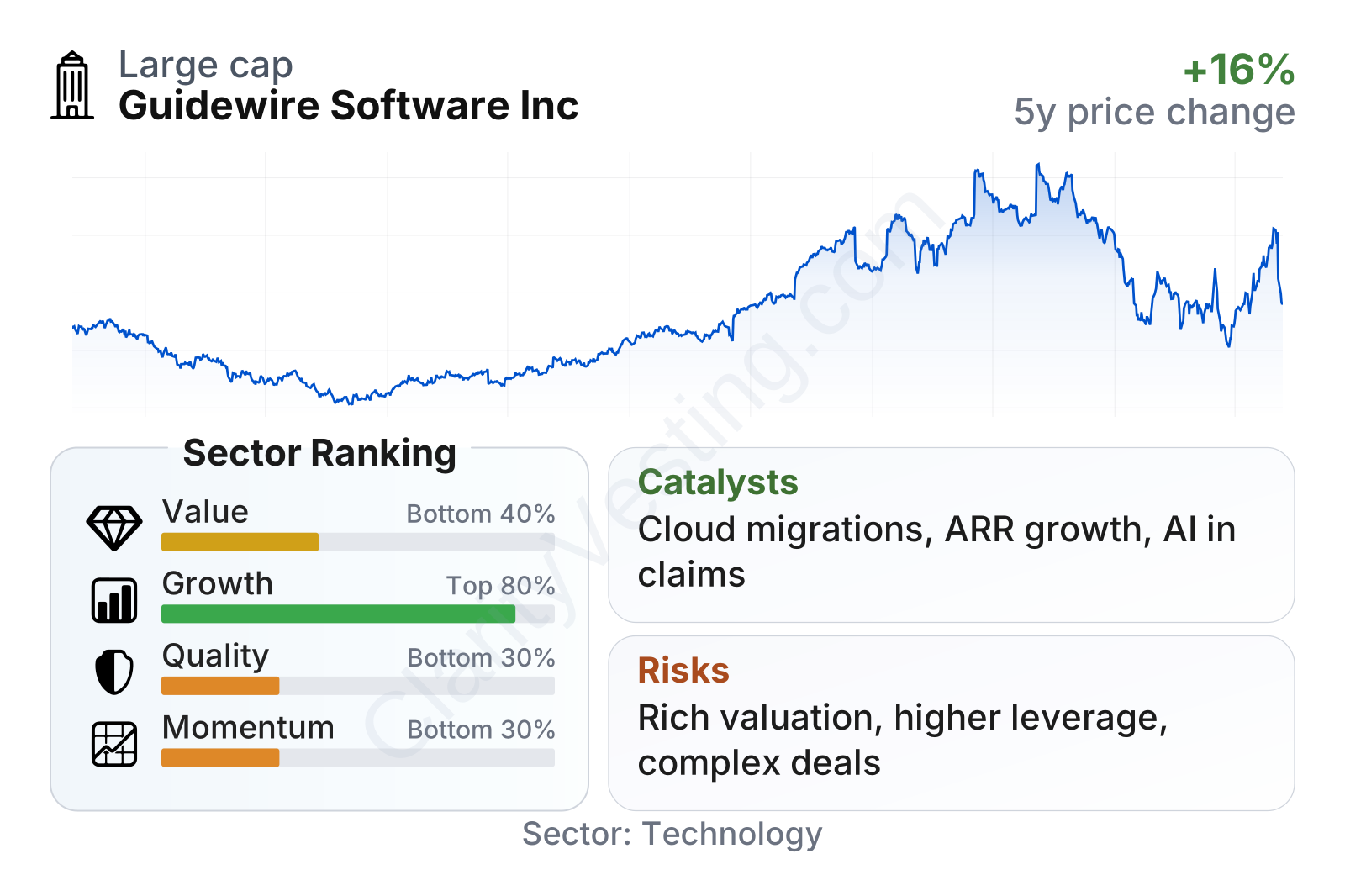
Guidewire is a mid-sized software company with a stock-market value in the low tens of billions of dollars and a beta close to 1, which means its share-price volatility has been broadly similar to the overall market. The factor profile is mixed. Growth stands well above much of the sector, helped by strong multi-year gains in revenue per share and free cash flow. Quality is more uneven because returns on invested capital remain modest and leverage is higher than many software peers. Value metrics look demanding, with earnings and cash-flow multiples above sector norms, while recent share-price momentum has weakened after a very strong multi-year run.
The stock-price history shows a sharp rebound from 2022 lows, followed by a notable pullback in 2026. That combination often reflects a company that has already won investor confidence on business improvement, but where expectations also became high enough to make the shares sensitive to any slowdown or valuation reset.
Growth
Guidewire operates in a part of software that still has room to grow. Property and casualty insurers continue to replace old on-premise systems with cloud platforms that are easier to update, integrate, and analyze. This is not a short-lived trend. Insurance carriers need better digital tools for underwriting, claims automation, customer service, pricing, and regulatory reporting, and many legacy systems were not built for that environment.
The company’s strategy fits that direction well. Management has spent several years shifting the business from traditional licenses toward cloud subscriptions, and that transition now appears much more mature. The benefit is twofold: revenue becomes more recurring, and the company gains more ongoing involvement in customers’ operations instead of relying as heavily on large one-time deals.
Recent growth has been consistently strong, with year-over-year revenue growth frequently landing in the mid-teens to high-20% range before easing back toward the mid-teens most recently. That is still healthy for enterprise software, especially in a niche where deals can be large and implementation cycles long. Over a five-year period, revenue per share growth has been materially stronger than the sector median, which suggests the company’s progress is not just a temporary bounce.
Cash generation has also improved sharply. Free cash flow moved from negative territory a few years ago to roughly $300 million on a trailing basis, with a five-year growth rate far above the sector median. That matters because it shows the cloud transition is no longer only an accounting or revenue-recognition story; it is increasingly showing up in actual cash production.
A major catalyst is Guidewire’s installed base. Existing insurer customers can adopt more products over time, including analytics, digital engagement tools, and additional cloud capabilities. Another potential growth driver is the insurance industry’s gradual use of artificial intelligence for claims, customer interactions, and workflow automation. Guidewire has been positioning AI features inside its platform, which could strengthen its role as a central operating system rather than a narrow back-office vendor.
Recent company updates have also pointed to continued cloud momentum, rising annual recurring revenue, and a larger mix of live cloud customers. For a business like this, each successful migration can do more than add one contract: it can serve as proof that large insurers are willing to modernize core systems on Guidewire’s platform.
Risks
This article is for informational purposes only and does not constitute financial advice. Some content is AI-generated. See Disclaimer


