Stock Analysis · Garrett Motion Inc (GTX)
Overview
Garrett Motion is an automotive technology supplier best known for turbochargers, but its business is broader than that. The company designs and manufactures boosting systems, air and thermal management products, and software and controls used by global vehicle makers. In simple terms, Garrett helps engines and powertrains deliver more power, better fuel efficiency, and lower emissions. Its products are used in passenger cars, commercial vehicles, and increasingly in electrified applications.
The business is still tied mainly to conventional and hybrid vehicles rather than fully battery-electric cars. That matters because Garrett sits in a part of the auto supply chain that benefits when automakers need to meet tighter emissions rules while keeping internal combustion engines competitive. The company also has an emerging segment focused on technologies such as electric compressors and fuel cell compressors, which are meant to extend its relevance as powertrains evolve.
Garrett reports revenue primarily by geography rather than by a detailed product split, so exact percentages by product line are not consistently disclosed in a way that allows a precise ranking across all categories. Based on company disclosures, the revenue mix is best understood as follows:
- Turbocharging and related boosting systems: the clear majority of revenue. This includes turbochargers and adjacent technologies used in gasoline, diesel, and hybrid vehicles.
- Commercial vehicle and aftermarket sales: meaningful but smaller than original-equipment passenger vehicle programs. This includes replacement parts and support for vehicles already on the road.
- Zero-emission and advanced technologies: still a small share of current revenue. This includes electric compressors for fuel cell systems and electric boosting products for newer powertrain architectures.
Geographically, Garrett is diversified across major auto markets, with Europe and Asia historically representing large portions of sales, followed by North America and other regions. That diversification helps reduce dependence on any single automaker or country, although it does not remove the industry’s cyclical nature.
One notable operating trend is that revenue has stayed in a fairly narrow range over the past several years, while gross profit and operating income have remained resilient. Research and development spending has also stayed meaningful, showing that Garrett is still funding product renewal even as its core market matures.
Key Figures
| Metric | Value | Sector ⓘ |
|---|---|---|
| Date | Sep 12, 2026 | |
| Context | ||
| Sector | Consumer Cyclical | |
| Industry | Auto Parts | |
| Market Cap ⓘ | $5.15B | |
| Beta ⓘ | 0.80 | |
Value (Cheapness) | ||
| P/E Ratio ⓘ | 14.93 | 17.10 |
| FCF Yield ⓘ | 7.09% | 8.53% |
| EBIT / EV ⓘ | 6.40% | 6.46% |
| PEG ⓘ | N/A | |
Growth (Business expansion) | ||
| Revenue Growth ⓘ | 6.90% | 5.75% |
| RPS Growth (5Y CAGR) ⓘ | -23.77% | 9.14% |
| EPS Growth (5Y CAGR) ⓘ | 10.53% | -18.21% |
| Margin Growth (5Y Trend) ⓘ | -3.53% | -0.23% |
| FCF Growth (5Y CAGR) ⓘ | N/A | 4.91% |
Quality (Business durability) | ||
| ROIC (Latest) ⓘ | 49.40% | 12.61% |
| ROIC (5Y Median) ⓘ | 51.85% | 10.72% |
| Net Debt / EBIT (Latest) ⓘ | 3.11 | 2.10 |
| Net Debt / EBIT (5Y Median) ⓘ | 2.67 | 2.32 |
| Operating Margin (Latest) ⓘ | 10.79% | 9.25% |
| Operating Margin (5Y Median) ⓘ | 14.39% | 9.64% |
| Debt to Equity (Latest) ⓘ | -209.93% | 75.78% |
| Profit Margin (Latest) ⓘ | 9.51% | 5.33% |
| Free Cash Flow (Latest) ⓘ | $365.00M | |
Momentum (Price trend) | ||
| 3Y Return ⓘ | +267.57% | +14.53% |
| 12M Return (excl. last month) ⓘ | +137.32% | +3.08% |
| 6M Return ⓘ | +57.16% | +0.55% |
| Price vs. 200-Day MA ⓘ | +15.33% | -0.54% |
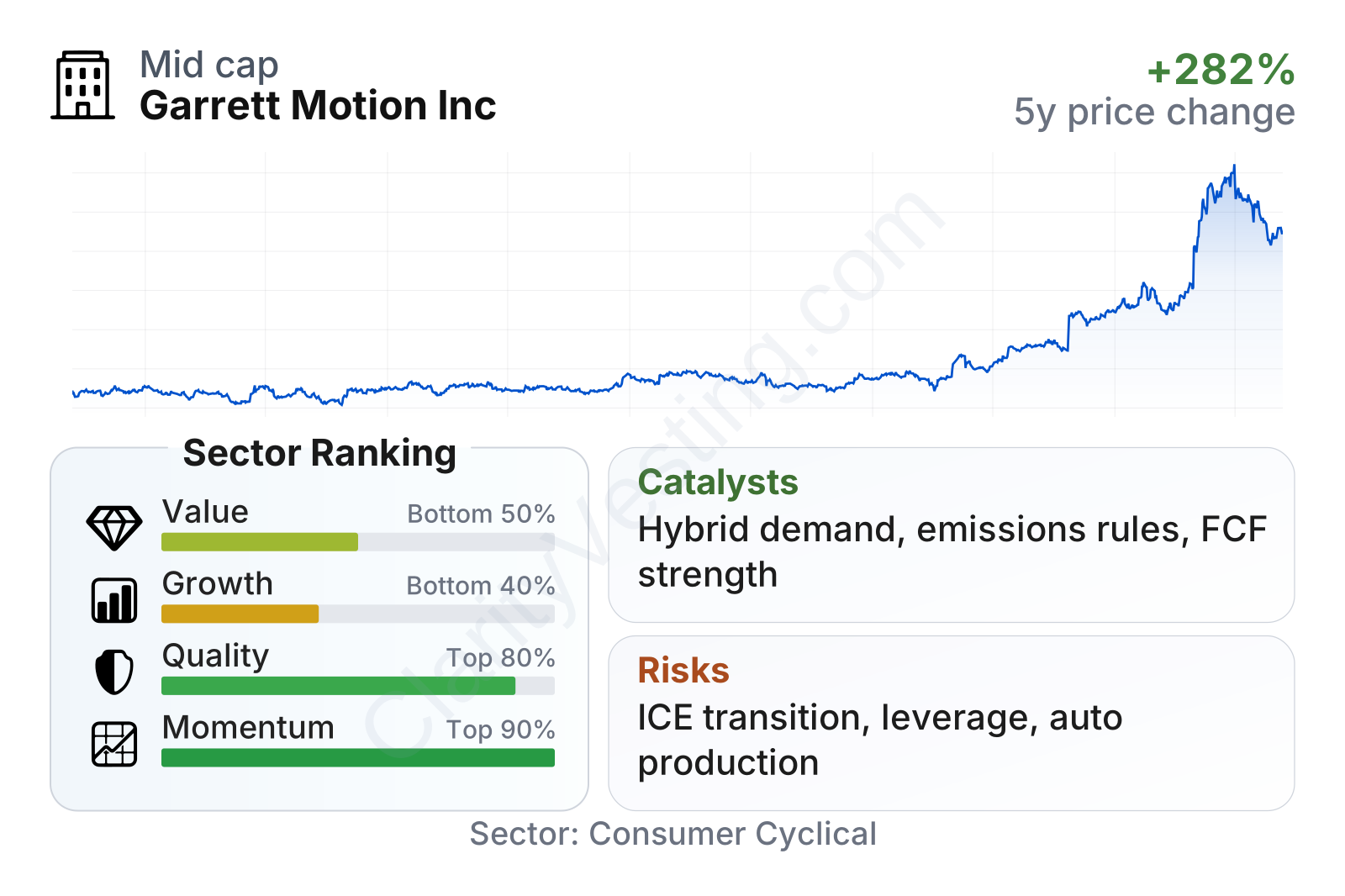
Garrett is now a mid-sized auto parts company with unusually strong profitability metrics for its sector. Return on invested capital is far above the sector median, and operating and net margins are also ahead of many peers. Free cash flow is positive and solid, while recent stock momentum has been exceptionally strong. The weaker area is growth: recent year-over-year revenue has improved, but the longer-term top-line record remains uneven, which is why the company ranks much better on quality and momentum than on growth or deep value measures.
Growth
Garrett operates in a sector that is no longer a simple growth market, but it is not necessarily in decline either. The long-term demand picture depends on how quickly internal combustion engines lose share and how much hybrids extend their life. That distinction is important. Hybrid vehicles still use many of the same efficiency technologies Garrett specializes in, and in some cases they can increase the need for advanced boosting and thermal solutions. As a result, Garrett’s addressable market may remain relevant longer than a simple “EVs replace engines” view would suggest.
The company’s strategy appears practical rather than speculative. It is defending its core turbo business, improving manufacturing discipline, and using its engineering base to expand into adjacent technologies for hybrid, fuel cell, and other lower-emission vehicles. That is a more grounded path than trying to transform overnight into a pure EV supplier. For long-term business durability, that approach makes sense, especially because automakers still need solutions that improve efficiency in their existing global fleets.
Recent revenue trends show a return to growth after a weaker period in 2024. Year-over-year sales have turned positive again in the latest quarters, landing in the high single digits recently, which suggests that customer demand and program mix have improved. Even so, the longer record is not smooth, so the main question is whether Garrett can convert this rebound into a steadier multi-year pattern rather than another short-cycle recovery.
Cash generation is one of the stronger parts of the growth profile. Free cash flow moved from deeply negative territory in 2022 to strongly positive levels in the following years, and it recently reached roughly the upper-$300 million range on a trailing basis. That gives the company more flexibility to reduce debt, support product development, and handle cyclical swings in vehicle production.
A meaningful catalyst is the continued global shift toward stricter fuel-economy and emissions standards. Those rules can support demand for Garrett’s core offerings because automakers often use turbocharging and related systems to get more efficiency from smaller engines. Another catalyst is hybridization, which may create a longer runway for Garrett’s existing engineering capabilities than the market once assumed. The company’s advanced technologies pipeline could also become more material if fuel cell or electric boosting programs gain traction, though that remains a smaller and less proven contributor today.
Risks
This article is for informational purposes only and does not constitute financial advice. Some content is AI-generated. See Disclaimer


