Stock Analysis · ZoomInfo Technologies Inc (GTM)
Overview
ZoomInfo Technologies Inc is a business-to-business software company focused on sales, marketing, recruiting, and customer operations. Its core product helps companies identify potential customers, enrich contact and company records, prioritize leads, and automate parts of go-to-market work. In simple terms, it sells tools that help businesses find the right people to contact and work more efficiently when trying to generate revenue.
The company mainly operates through a subscription model. Customers pay recurring fees to access ZoomInfo’s platform, which combines business contact information, organizational data, workflow tools, and increasingly AI-driven features. This makes the business relatively predictable compared with one-time software sales, although demand still depends on hiring, sales budgets, and broader business confidence.
Revenue disclosure is not highly granular, but public filings make the business mix clear enough to outline the main drivers.
- Subscription revenue: about 95% to 98% of total revenue. This is the main engine of the business and includes access to ZoomInfo’s intelligence platform, prospecting tools, conversation intelligence, data enrichment, and workflow applications.
- Services and other revenue: about 2% to 5% of total revenue. This includes implementation, support-related items, and smaller ancillary offerings tied to the software platform.
Within the platform itself, the company markets solutions across several use cases rather than reporting each one as a separate revenue line. The most important product families include sales intelligence, marketing intelligence, talent and recruiting solutions, and conversation or engagement tools. The business is therefore concentrated around one broad idea: monetizing commercial intelligence and workflow software for revenue teams.
Financially, the business has shown that it can produce strong gross profit and meaningful cash generation, but it has also gone through a slowdown after its earlier high-growth phase. Revenue expanded rapidly from 2021 to 2023, then flattened, which has pushed management to focus more on efficiency, product bundling, upmarket customers, and AI features that could improve the value of the platform.
The operating structure still reflects a software business with high gross margins, but the path from revenue to net income has become less smooth. Gross profit remains large relative to revenue, while operating profit and net income have been more volatile as spending, customer demand, and non-cash charges have shifted over time.
Key Figures
| Metric | Value | Sector ⓘ |
|---|---|---|
| Date | Aug 22, 2026 | |
| Context | ||
| Sector | Technology | |
| Industry | Software - Application | |
| Market Cap ⓘ | $1.16B | |
| Beta ⓘ | 0.81 | |
Value (Cheapness) | ||
| P/E Ratio ⓘ | 9.20 | 30.63 |
| FCF Yield ⓘ | 38.80% | 4.23% |
| EBIT / EV ⓘ | -18.52% | 2.79% |
| PEG ⓘ | N/A | |
Growth (Business expansion) | ||
| Revenue Growth ⓘ | 1.20% | 15.90% |
| RPS Growth (5Y CAGR) ⓘ | 20.78% | 8.68% |
| EPS Growth (5Y CAGR) ⓘ | -16.69% | -12.38% |
| Margin Growth (5Y Trend) ⓘ | -0.43% | 0.39% |
| FCF Growth (5Y CAGR) ⓘ | 8.96% | 9.76% |
Quality (Business durability) | ||
| ROIC (Latest) ⓘ | -14.03% | 9.19% |
| ROIC (5Y Median) ⓘ | N/A | 8.21% |
| Net Debt / EBIT (Latest) ⓘ | N/A | 0.46 |
| Net Debt / EBIT (5Y Median) ⓘ | 6.86 | 0.42 |
| Operating Margin (Latest) ⓘ | -36.78% | 9.23% |
| Operating Margin (5Y Median) ⓘ | 19.39% | 8.19% |
| Debt to Equity (Latest) ⓘ | 183.23% | 32.74% |
| Profit Margin (Latest) ⓘ | -43.02% | 7.01% |
| Free Cash Flow (Latest) ⓘ | $448.40M | |
Momentum (Price trend) | ||
| 3Y Return ⓘ | -77.83% | +46.51% |
| 12M Return (excl. last month) ⓘ | -72.86% | +18.95% |
| 6M Return ⓘ | -38.26% | +18.99% |
| Price vs. 200-Day MA ⓘ | -36.80% | +9.57% |
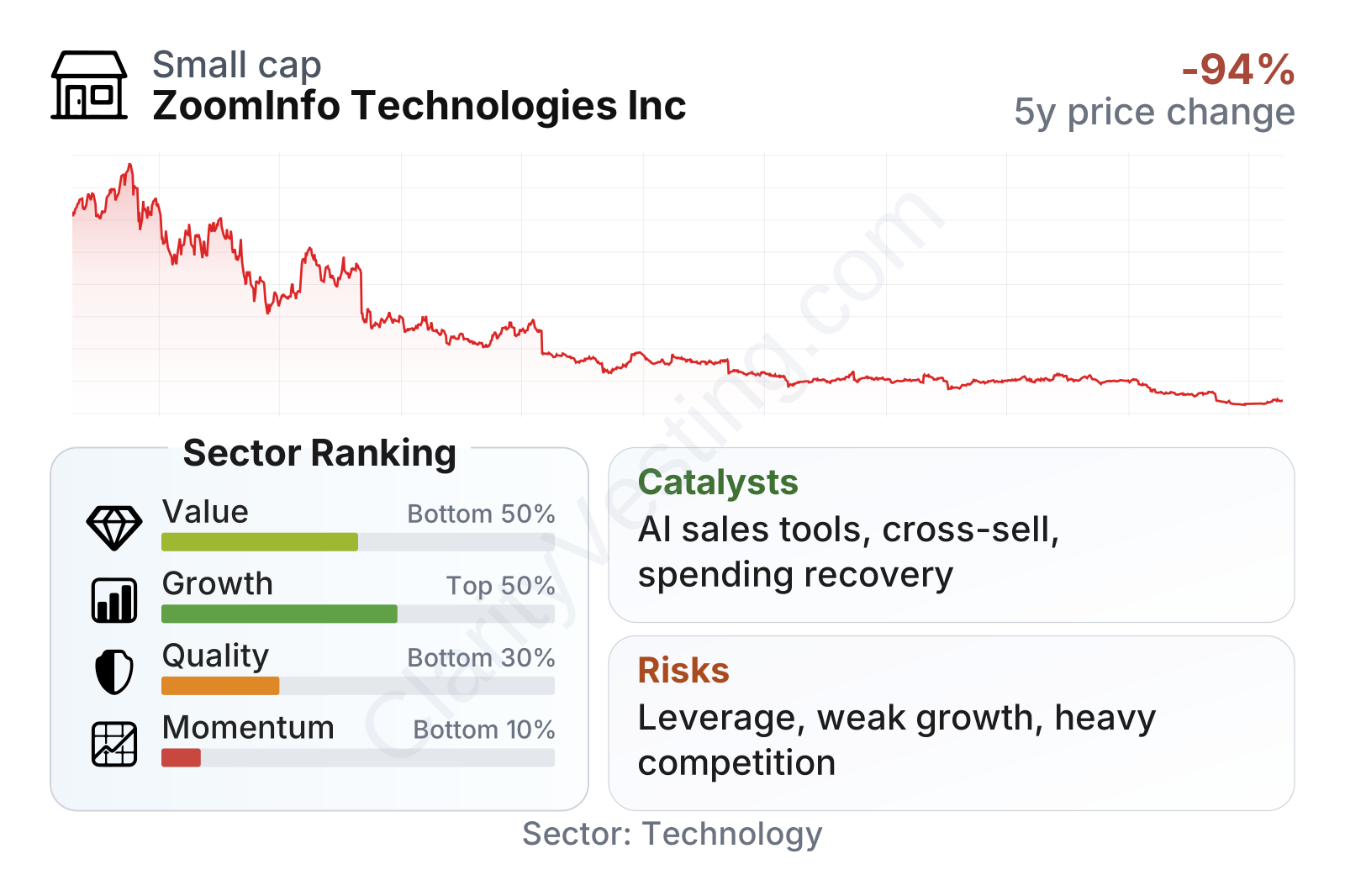
ZoomInfo is now a much smaller public company than it was near its post-listing peak, and the share price trend has been very weak over the last several years. At the same time, the metrics show a mixed profile: valuation screens as low versus the software sector, free cash flow generation remains strong, but quality and momentum rank poorly. Growth sits around the middle of the sector rather than near the top, which fits the picture of a company that is no longer in rapid expansion and is being judged more on durability and execution.
Growth
ZoomInfo operates in a sector that still has long-term growth potential. Companies continue to spend on software that helps them sell more effectively, automate repetitive work, and improve customer targeting. The broader themes behind the industry are still favorable: more digital selling, more data-driven marketing, and growing use of AI tools inside commercial teams. That said, the market is also more mature and more crowded than it was a few years ago, so growth depends less on category novelty and more on product depth, retention, and pricing power.
ZoomInfo’s strategy for future growth is sensible on paper. Rather than relying only on contact databases, it has been trying to become a broader go-to-market platform. That means embedding workflow tools, conversation intelligence, data orchestration, and AI features into the product so customers can do more inside one system. If this works, the company can increase revenue per customer and make the platform harder to replace.
The growth profile has clearly cooled. Revenue growth was once above 50%, then steadily decelerated, briefly turned negative, and has only recently returned to low positive territory around 1% to 5%. That is a major reset. For long-term analysis, the key question is no longer whether ZoomInfo can grow fast again soon, but whether it can stabilize the business and then build a steadier expansion cycle from a large installed base.
One encouraging point is cash generation. Free cash flow has remained substantial even through the slowdown, staying in the several-hundred-million-dollar range. That matters because it gives the company room to invest in product development, manage debt, and potentially absorb weaker operating periods without the same pressure faced by less cash-generative software firms.
A notable catalyst is the company’s push around AI-powered sales and marketing workflows. If AI features improve lead quality, prospecting productivity, and customer retention in a measurable way, ZoomInfo could strengthen its competitive position without needing a dramatic rebound in the broader economy. Another possible catalyst is a recovery in hiring and sales spending across business customers, because the company’s products are closely tied to commercial activity. Recent company communications have also emphasized platform consolidation and cross-sell opportunities, which could support moderate growth even if new customer additions stay restrained.
Risks
This article is for informational purposes only and does not constitute financial advice. Some content is AI-generated. See Disclaimer