Stock Analysis · Goodyear Tire & Rubber Co (GT)
Overview
Goodyear Tire & Rubber Co is one of the world’s best-known tire manufacturers. The company designs, makes, and sells tires for passenger cars, light trucks, commercial trucks, buses, aircraft, motorcycles, mining equipment, and industrial machinery. It also sells related services such as tire maintenance, retreading, and fleet solutions. Through brands including Goodyear, Cooper, Dunlop, and others, the company serves both vehicle manufacturers and replacement buyers who need new tires after wear and tear.
Its business is mainly driven by tire replacement demand rather than only new vehicle production. That matters because replacement tires usually create steadier demand over time: cars and trucks keep needing new tires even when auto sales slow down. Goodyear also has a broad geographic footprint, which helps diversify demand across regions, though it also exposes the company to currency swings and uneven economic conditions.
Based on recent annual reporting, Goodyear’s revenue sources can be approximated as follows:
- Americas: about 55% to 60% of revenue. This includes consumer replacement tires, commercial truck tires, and original equipment sales in North and Latin America.
- Europe, Middle East and Africa: about 25% to 30% of revenue. This region includes consumer and commercial tire sales, with exposure to both replacement and manufacturer channels.
- Asia Pacific: about 15% to 20% of revenue. This includes sales across developed and emerging markets, with a mix of consumer and commercial demand.
Another useful way to think about the business is by customer type:
- Replacement tires: the largest revenue source, typically a clear majority of sales. These are tires bought by consumers and fleets after the original tires wear out.
- Original equipment: a smaller but still important share. These are tires sold directly to vehicle manufacturers for new cars, trucks, and other equipment.
- Other tire-related services: a much smaller contribution, including retreading, maintenance, and mobility-related support.
Over the last few years, revenue has moved down from its 2022 peak, while costs remained heavy. Gross profit stayed in the multi-billion-dollar range, but operating profit and net income became much more volatile. That pattern shows a company with meaningful industrial scale, but one that has struggled to convert sales into durable earnings.
Key Figures
| Metric | Value | Sector ⓘ |
|---|---|---|
| Date | Sep 12, 2026 | |
| Context | ||
| Sector | Consumer Cyclical | |
| Industry | Auto Parts | |
| Market Cap ⓘ | $1.55B | |
| Beta ⓘ | 1.11 | |
Value (Cheapness) | ||
| P/E Ratio ⓘ | N/A | 17.10 |
| FCF Yield ⓘ | 12.42% | 8.53% |
| EBIT / EV ⓘ | -5.57% | 6.46% |
| PEG ⓘ | 0.43 | |
Growth (Business expansion) | ||
| Revenue Growth ⓘ | -4.80% | 5.75% |
| RPS Growth (5Y CAGR) ⓘ | -1.22% | 9.14% |
| EPS Growth (5Y CAGR) ⓘ | N/A | -18.21% |
| Margin Growth (5Y Trend) ⓘ | -3.44% | -0.23% |
| FCF Growth (5Y CAGR) ⓘ | N/A | 4.91% |
Quality (Business durability) | ||
| ROIC (Latest) ⓘ | -4.35% | 12.61% |
| ROIC (5Y Median) ⓘ | 2.22% | 10.72% |
| Net Debt / EBIT (Latest) ⓘ | N/A | 2.10 |
| Net Debt / EBIT (5Y Median) ⓘ | 10.41 | 2.32 |
| Operating Margin (Latest) ⓘ | -2.81% | 9.25% |
| Operating Margin (5Y Median) ⓘ | 3.59% | 9.64% |
| Debt to Equity (Latest) ⓘ | 276.65% | 75.78% |
| Profit Margin (Latest) ⓘ | -14.37% | 5.33% |
| Free Cash Flow (Latest) ⓘ | $192.00M | |
Momentum (Price trend) | ||
| 3Y Return ⓘ | -57.11% | +14.53% |
| 12M Return (excl. last month) ⓘ | -26.79% | +3.08% |
| 6M Return ⓘ | -24.05% | +0.55% |
| Price vs. 200-Day MA ⓘ | -27.02% | -0.54% |
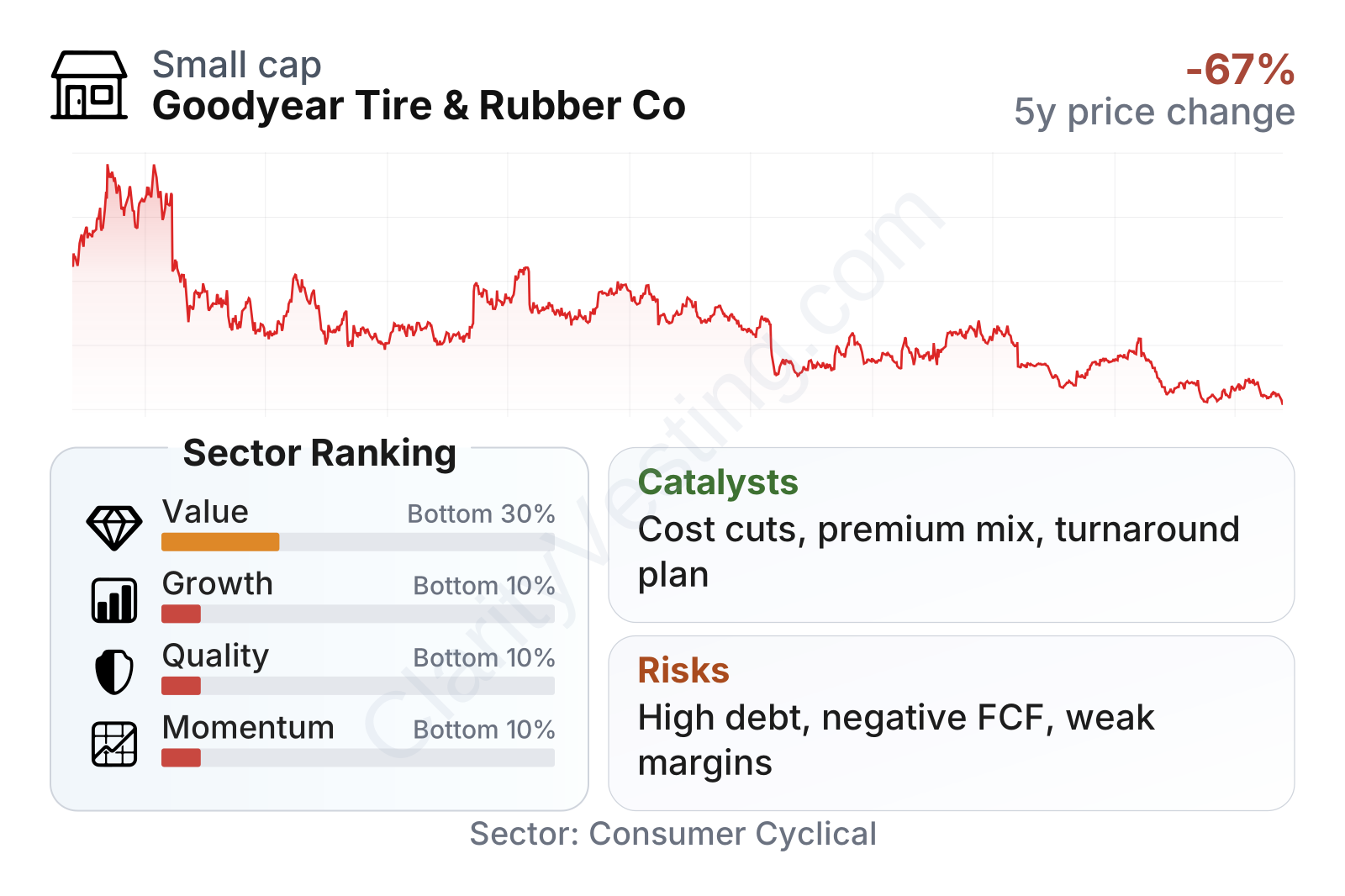
Goodyear currently sits in the weaker end of its sector on value, quality, growth, and momentum measures. The market value is relatively small for a global industrial brand, and the stock has been volatile rather than defensive. The table also points to a difficult mix of negative free cash flow, weak profitability, and high leverage, which helps explain why the shares have lagged much of the broader auto parts group.
Growth
The tire industry is not a classic high-growth sector, but it is a large and durable one. Long-term demand is supported by the global vehicle base, commercial transportation activity, and the simple fact that tires wear out and must be replaced. In that sense, Goodyear operates in a business with recurring demand, even if growth is usually tied to miles driven, fleet activity, product mix, and pricing rather than rapid market expansion.
Goodyear’s strategy for future growth is less about chasing volume at any cost and more about improving mix, simplifying operations, and lifting margins. Management has emphasized transformation efforts, portfolio optimization, cost savings, and a more disciplined capital allocation approach. For a mature manufacturer, that logic makes sense: stronger earnings can come from a better product mix, productivity gains, and tighter working capital control, even without strong top-line growth.
Revenue trends have been soft. Year-over-year growth has been negative for an extended period, and the latest reading remains below both zero and the sector median. That does not automatically mean the core demand base is broken, but it does show the company has not recently translated its scale and brand strength into sustained expansion.
Cash generation is another major point. Free cash flow has swung sharply from positive to negative over recent years, and the trailing figure remains below zero. For a capital-intensive manufacturer, this matters because a recovery case becomes more convincing when better operating results are matched by steadier cash coming in after capital spending.
A visible catalyst is the company’s ongoing transformation program, including asset actions and cost reduction efforts designed to improve profitability rather than simply protect market share. If those measures deliver as planned, the operating profile could improve faster than revenue trends alone suggest. Another long-term opportunity comes from premium tires, larger rim sizes, electric vehicle-related tire demand, and commercial fleet services, where performance and brand can support better pricing.
Recent company communications have also centered on restructuring and efficiency measures. Those initiatives can create a meaningful opportunity if they reduce complexity, lower overhead, and improve returns in weaker business lines. For Goodyear, the most important upside is not a booming tire market; it is a cleaner and more profitable version of the company.
Risks
This article is for informational purposes only and does not constitute financial advice. Some content is AI-generated. See Disclaimer