Stock Analysis · Globalstar Inc (GSAT)
Overview
Globalstar Inc is a satellite communications company. It operates a low Earth orbit satellite network and sells connectivity services for places, assets, and devices that cannot rely on traditional cellular coverage alone. In simple terms, the company helps people and machines stay connected in remote areas, and it also owns radio spectrum that can be used for private wireless networks and other specialized services.
Its business is built around service revenue, equipment sales, and engineering or spectrum-related work tied to customer programs. Based on recent annual disclosures, the largest sources of revenue are roughly the following:
- Wholesale capacity and subscriber services: approximately 50% to 60% of revenue. This includes network access sold to partners and recurring service revenue tied to satellite connectivity.
- Commercial IoT, simplex and duplex data services: approximately 20% to 30%. These services support asset tracking, monitoring, messaging, and machine-to-machine communications.
- Engineering, spectrum, and other service arrangements: approximately 10% to 20%. This category has become more important as Globalstar works on network customization and infrastructure projects.
- Equipment sales: usually less than 10%. This includes satellite phones, trackers, modules, and related hardware.
A notable feature of Globalstar is customer concentration. Public filings show that a very large share of revenue comes from a small number of counterparties, with Apple playing an especially important role through service and infrastructure arrangements linked to satellite-enabled emergency and messaging capabilities. That gives the company unusual visibility on one side of the business, but it also means the business is less diversified than many telecom peers.
Over the last several years, revenue has expanded meaningfully, while gross profit has also improved. Even so, operating profitability has remained inconsistent because the company still carries meaningful overhead, network investment needs, and financing costs.
The long-term pattern shows a business that has grown revenue from roughly $125 million in 2021 to around $273 million in 2025, with gross profit rising as well. The weak point has been the bottom line: operating income has hovered around break-even and net income has stayed negative, partly because interest expense and investment-related costs remain significant.
Key Figures
| Metric | Value | Sector ⓘ |
|---|---|---|
| Date | Sep 12, 2026 | |
| Context | ||
| Sector | Communication Services | |
| Industry | Telecom Services | |
| Market Cap ⓘ | $10.69B | |
| Beta ⓘ | 1.50 | |
Value (Cheapness) | ||
| P/E Ratio ⓘ | N/A | 18.61 |
| FCF Yield ⓘ | 1.70% | 13.68% |
| EBIT / EV ⓘ | -0.14% | 4.54% |
| PEG ⓘ | 0.50 | |
Growth (Business expansion) | ||
| Revenue Growth ⓘ | -3.50% | 5.40% |
| RPS Growth (5Y CAGR) ⓘ | 32.24% | 4.62% |
| EPS Growth (5Y CAGR) ⓘ | -13.58% | -18.01% |
| Margin Growth (5Y Trend) ⓘ | N/A | 1.10% |
| FCF Growth (5Y CAGR) ⓘ | 56.17% | 5.88% |
Quality (Business durability) | ||
| ROIC (Latest) ⓘ | -1.94% | 8.38% |
| ROIC (5Y Median) ⓘ | -0.25% | 8.32% |
| Net Debt / EBIT (Latest) ⓘ | 5.53 | 1.99 |
| Net Debt / EBIT (5Y Median) ⓘ | N/A | 2.94 |
| Operating Margin (Latest) ⓘ | -5.35% | 14.89% |
| Operating Margin (5Y Median) ⓘ | -1.02% | 12.96% |
| Debt to Equity (Latest) ⓘ | 140.73% | 59.59% |
| Profit Margin (Latest) ⓘ | -18.49% | 8.77% |
| Free Cash Flow (Latest) ⓘ | $181.78M | |
Momentum (Price trend) | ||
| 3Y Return ⓘ | +281.85% | +46.64% |
| 12M Return (excl. last month) ⓘ | +196.05% | +2.16% |
| 6M Return ⓘ | +44.42% | +5.05% |
| Price vs. 200-Day MA ⓘ | +13.53% | +2.88% |
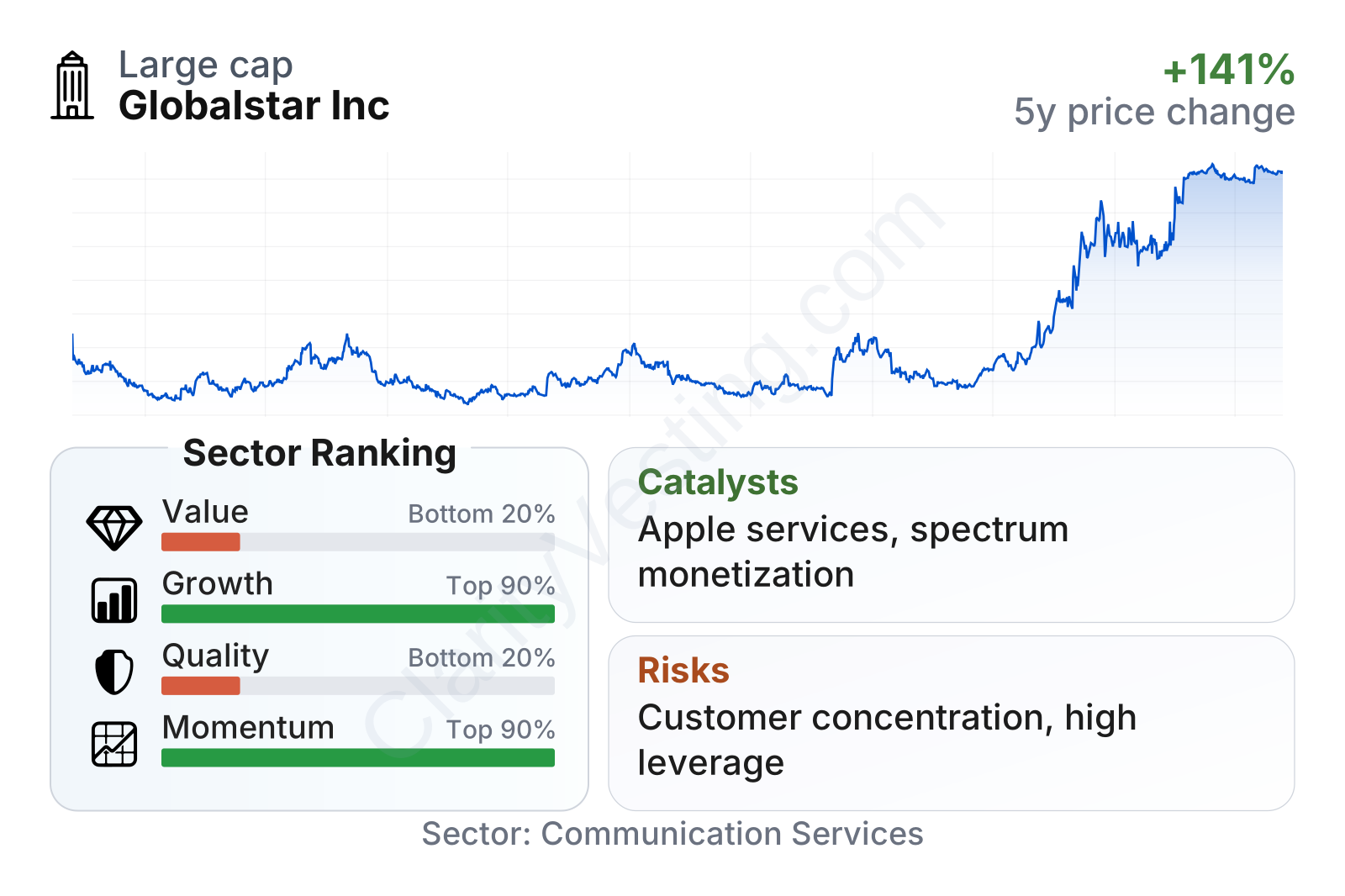
Globalstar is now a large-cap company by market value, but its operating profile still looks weaker than that size might suggest. The growth and momentum readings stand out as strong versus the sector, helped by a multiyear rise in revenue per share and a sharp stock move. By contrast, value and quality rank near the bottom of the sector, reflecting thin profitability, high leverage, and cash flow metrics that do not yet match the share price strength.
The stock has also been volatile. Its beta above 1.5 suggests the share price has tended to move more sharply than the broader market, which fits the wide swings visible over the last few years.
Growth
Globalstar operates in a part of the communications market that is clearly growing: direct satellite connectivity, industrial IoT, remote asset tracking, emergency communications, and private wireless infrastructure. These areas benefit from several durable trends, including the spread of connected devices, demand for backup communications outside terrestrial networks, and the push to connect more machines in agriculture, logistics, energy, transportation, and public safety.
The company’s strategy is logical for that backdrop. Instead of trying to compete head-on with the largest mass-market mobile carriers, it focuses on niche but valuable use cases where coverage matters more than speed, and where satellite or dedicated spectrum can solve a real operational problem. It also uses its licensed spectrum assets as a second growth lever, giving it a way to participate in private network deployments beyond traditional satellite subscriptions.
Revenue growth has not been smooth quarter to quarter, but the broader trend has been favorable. The business posted very strong gains through 2023, then settled into a more uneven pattern as the revenue base became larger and customer timing effects became more visible. The latest year-over-year comparison turned slightly negative, which is a reminder that this is still not a steady utility-like telecom business. Even so, over a five-year view, revenue per share growth has been far stronger than the sector median.
Cash generation has improved materially after a difficult period. Free cash flow turned negative in 2024, then rebounded strongly in 2025 and remained solid into 2026. That matters because Globalstar’s investment case depends heavily on converting strategic partnerships and network use into actual cash, not just reported sales.
The main catalyst remains the company’s relationship with Apple and the broader rollout of satellite-enabled consumer and safety services. Public disclosures and company announcements indicate that Globalstar has been expanding infrastructure to support these offerings. Another potential catalyst is monetization of its spectrum and private network capabilities, especially if more enterprises and public-sector users adopt dedicated wireless systems for secure or remote operations.
Recent company communications have also highlighted work on next-generation satellite capacity and continued network development. If that translates into more devices, more service usage, or additional wholesale agreements, the addressable opportunity could widen considerably from today’s niche base.
Risks
This article is for informational purposes only and does not constitute financial advice. Some content is AI-generated. See Disclaimer