Stock Analysis · Getlink SE (GRPTY)
Overview
Getlink SE is the company that owns and operates the infrastructure linking the United Kingdom and continental Europe through the Channel Tunnel. Its business is built around a rare asset: a long-life cross-border transport link with high barriers to entry, regulated safety requirements, and a strategic position in trade and passenger mobility between Britain and France.
The group mainly earns money from moving vehicles, passengers, and rail traffic through the tunnel, and from electricity interconnection activities. In simple terms, Getlink is paid when shuttle trains carry cars and trucks through the tunnel, when railway operators use the tunnel network, and when power transmission assets transport electricity between countries.
Based on the latest annual disclosures, revenue is broadly concentrated in the following areas:
- Eurotunnel shuttle services: about 65% to 70% — the core business. This includes truck shuttles and passenger vehicle shuttles carrying cars, coaches, motorcycles, and freight vehicles between Folkestone and Coquelles.
- Eurotunnel fixed-rail infrastructure access: about 20% to 25% — charges paid by rail operators using the tunnel, including high-speed passenger rail and rail freight operators.
- ElecLink electricity interconnector and other activities: about 10% to 15% — electricity transmission between the UK and France, plus smaller ancillary activities.
This mix matters because the company is not a typical railroad operator with many routes competing on price. It controls a unique corridor. That gives it a stronger strategic position than many transport businesses, although revenue still depends on traffic volumes, cross-border trade, and the reliability of the infrastructure.
The business recovery since 2021 is clear: revenue and operating income improved sharply after the pandemic period, and profitability has remained much stronger than it was in 2021. More recently, revenue has eased from the 2023 peak, but operating profit and net income have stayed resilient, suggesting a company that has moved from recovery mode into steadier cash generation.
Key Figures
| Metric | Value | Sector ⓘ |
|---|---|---|
| Date | Nov 21, 2026 | |
| Context | ||
| Sector | Industrials | |
| Industry | Railroads | |
| Market Cap ⓘ | $12.34B | |
| Beta ⓘ | 0.53 | |
Value (Cheapness) | ||
| P/E Ratio ⓘ | 32.50 | 20.77 |
| P/B Ratio ⓘ | N/A | 3.20 |
| FCF Yield ⓘ | 10.93% | 4.98% |
| Dividend Yield ⓘ | 4.07% | 1.88% |
| EBIT / EV ⓘ | 7.96% | 6.24% |
| PEG ⓘ | N/A | |
Growth (Business expansion) | ||
| Revenue Growth ⓘ | 10.80% | 9.60% |
| RPS Growth (5Y CAGR) ⓘ | 19.19% | 7.69% |
| EPS Growth (5Y CAGR) ⓘ | -4.30% | -5.74% |
| BVPS Growth (5Y CAGR) ⓘ | 19.73% | 6.13% |
| Margin Growth (5Y Trend) ⓘ | 46.89% | 0.72% |
| FCF Growth (5Y CAGR) ⓘ | 94.09% | 11.01% |
| DPS Growth (5Y CAGR) ⓘ | 81.96% | 9.09% |
Quality (Business durability) | ||
| ROIC (Latest) ⓘ | 14.97% | 10.48% |
| ROA (Latest) ⓘ | 6.45% | 5.38% |
| ROIC (5Y Median) ⓘ | 7.25% | 9.45% |
| ROA (5Y Median) ⓘ | 3.47% | 4.91% |
| Net Debt / EBIT (Latest) ⓘ | 3.31 | 2.12 |
| Net Debt / EBIT (5Y Median) ⓘ | N/A | 2.28 |
| Net Debt / EBITDA (Latest) ⓘ | 2.79 | 1.42 |
| Net Debt / Assets ⓘ | 44.05% | 19.19% |
| EBITDA / Interest ⓘ | 3.41 | 10.09 |
| Operating Margin (Latest) ⓘ | 36.33% | 10.44% |
| Operating Margin (5Y Median) ⓘ | 33.83% | 10.29% |
| Debt to Equity (Latest) ⓘ | 208.19% | 66.48% |
| Profit Margin (Latest) ⓘ | 18.79% | 6.98% |
| Free Cash Flow (Latest) ⓘ | $1.35B | |
Momentum (Price trend) | ||
| 3Y Return ⓘ | +36.85% | +48.25% |
| 12M Return (excl. last month) ⓘ | +35.11% | +10.31% |
| 6M Return ⓘ | +13.53% | +0.15% |
| Price vs. 200-Day MA ⓘ | +9.41% | 0.00% |
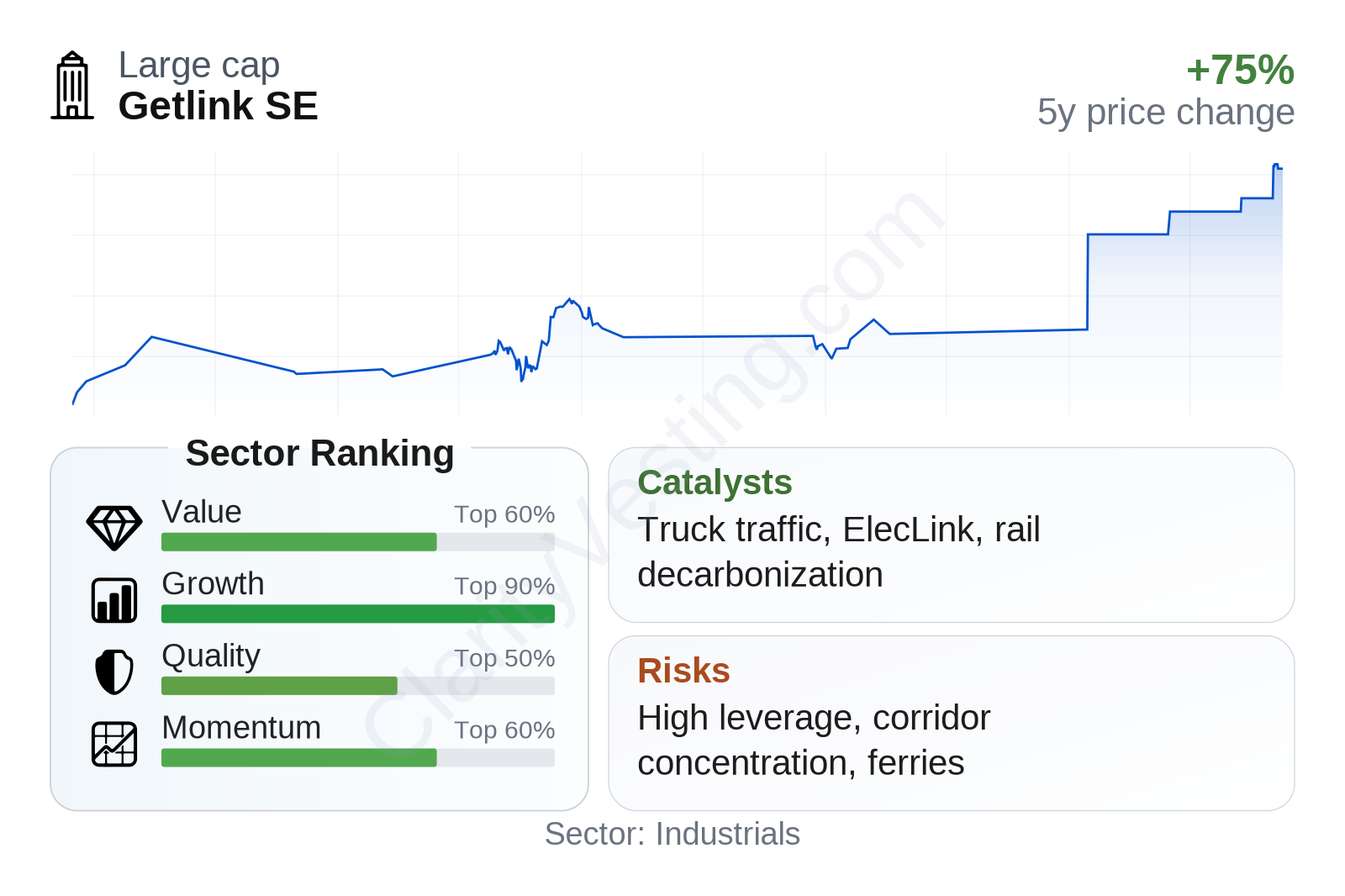
Getlink stands out as a large infrastructure operator with relatively low share-price volatility, which fits the profile of a business tied to essential transport assets rather than cyclical industrial manufacturing. Growth metrics are particularly strong versus the broader industrial sector, helped by the post-pandemic recovery, margin improvement, and a sharp rise in free cash flow over the last five years.
Quality is more mixed. Operating margin and profit margin are well above sector norms, showing the strength of the asset once traffic is flowing normally. Return on invested capital is also solid. The weaker point is leverage: debt levels are high compared with the sector, and interest coverage is noticeably lower than the median. In other words, the company converts its infrastructure position into strong cash flow, but it carries a heavier financing burden than many peers.
The recent share-price trend has been favorable, with better short- and medium-term momentum than much of the sector. That improvement has happened alongside a valuation that already sits above many industrial names, which is important when judging how much optimism is already reflected in the market.
Growth
Getlink operates in a sector that is mature rather than fast-changing, but that does not mean growth is absent. Cross-Channel freight, passenger mobility, and electricity interconnection all sit within long-term themes that remain relevant: trade continuity between the UK and Europe, lower-carbon transport, and the need for more flexible energy networks. That makes the company more of an infrastructure compounding business than a high-growth disruptor.
Its strategy is logical for that setting. The company can grow through traffic mix improvement, yield management on shuttle capacity, continued normalization in rail and tourism flows, and better use of connected assets such as ElecLink. Truck traffic is especially important because freight demand tends to be more structurally supported by trade flows than discretionary leisure travel. Passenger volumes can add upside when tourism and travel conditions are favorable.
A notable long-term catalyst is the environmental advantage of rail-linked transport over short-haul alternatives. As governments, logistics operators, and customers push for lower-emission supply chains, tunnel-based rail and shuttle transport can remain attractive relative to more carbon-intensive routes. This does not automatically create rapid expansion, but it strengthens the business case for keeping traffic on the corridor.
Another positive element is the scarcity value of the asset. Building a competing fixed link is not realistic, so growth depends less on defeating new entrants and more on maximizing utilization, maintaining service quality, and capturing demand when cross-border volumes rise.
Recent company communications have also highlighted continued operational focus on capacity, reliability, and selective investment. For long-term analysis, the main opportunity is not a dramatic transformation but the ability to keep converting a monopoly-like transport position into recurring cash flow while adding support from the electricity interconnection business.
Risks
This article is for informational purposes only and does not constitute financial advice. Some content is AI-generated. See Disclaimer