Stock Analysis · Groupon Inc (GRPN)
Overview
Groupon is a digital marketplace that connects local merchants with consumers looking for discounts on services, activities, travel packages, and goods. The company became well known for daily deals, but today its business is more focused on helping local businesses fill unused capacity—such as restaurant visits, beauty appointments, fitness classes, and entertainment—while giving shoppers lower prices and a simple way to discover nearby offers.
Its revenue mainly comes from transactions made on its platform. Based on recent annual reporting, the mix is heavily tilted toward local experiences and services, while goods and travel are now much smaller parts of the business.
- Local: approximately 85% to 90% of revenue. This includes vouchers and offers for restaurants, wellness, beauty, home services, fitness, and local entertainment.
- Goods: approximately 8% to 12% of revenue. This covers discounted physical products sold through the platform, a category that has become far less important than it once was.
- Travel: approximately 2% to 5% of revenue. This includes hotel and getaway offers and is now a relatively small contributor.
Geographically, North America remains the core of the company, with international operations contributing a smaller share. Over the last several years, Groupon has also simplified the business by shrinking lower-priority activities, reducing costs, and emphasizing its core local marketplace.
The long-term picture is that Groupon is no longer a broad e-commerce growth platform. It is a narrower turnaround centered on local commerce, brand recognition, merchant relationships, and tighter operating discipline.
The business has become much smaller than it was a few years ago, but the expense base has also been reduced significantly. Revenue has fallen sharply since 2021, while selling and administrative costs have come down even faster, showing a clear restructuring effort. Gross profit remains the main economic engine, but it has not yet translated into consistent net earnings.
Key Figures
| Metric | Value | Sector ⓘ |
|---|---|---|
| Date | Sep 12, 2026 | |
| Context | ||
| Sector | Communication Services | |
| Industry | Internet Content & Information | |
| Market Cap ⓘ | $933.27M | |
| Beta ⓘ | 0.28 | |
Value (Cheapness) | ||
| P/E Ratio ⓘ | N/A | 18.61 |
| FCF Yield ⓘ | 3.21% | 13.68% |
| EBIT / EV ⓘ | -7.61% | 4.54% |
| PEG ⓘ | 14.66 | |
Growth (Business expansion) | ||
| Revenue Growth ⓘ | -0.80% | 5.40% |
| RPS Growth (5Y CAGR) ⓘ | -19.09% | 4.62% |
| EPS Growth (5Y CAGR) ⓘ | -42.39% | -18.01% |
| Margin Growth (5Y Trend) ⓘ | N/A | 1.10% |
| FCF Growth (5Y CAGR) ⓘ | N/A | 5.88% |
Quality (Business durability) | ||
| ROIC (Latest) ⓘ | -24.50% | 8.38% |
| ROIC (5Y Median) ⓘ | -8.05% | 8.32% |
| Net Debt / EBIT (Latest) ⓘ | N/A | 1.99 |
| Net Debt / EBIT (5Y Median) ⓘ | N/A | 2.94 |
| Operating Margin (Latest) ⓘ | -16.89% | 14.89% |
| Operating Margin (5Y Median) ⓘ | -5.38% | 12.96% |
| Debt to Equity (Latest) ⓘ | -432.64% | 59.59% |
| Profit Margin (Latest) ⓘ | -25.26% | 8.77% |
| Free Cash Flow (Latest) ⓘ | $29.95M | |
Momentum (Price trend) | ||
| 3Y Return ⓘ | +141.83% | +46.64% |
| 12M Return (excl. last month) ⓘ | -22.54% | +2.16% |
| 6M Return ⓘ | +72.69% | +5.05% |
| Price vs. 200-Day MA ⓘ | +32.62% | +2.88% |
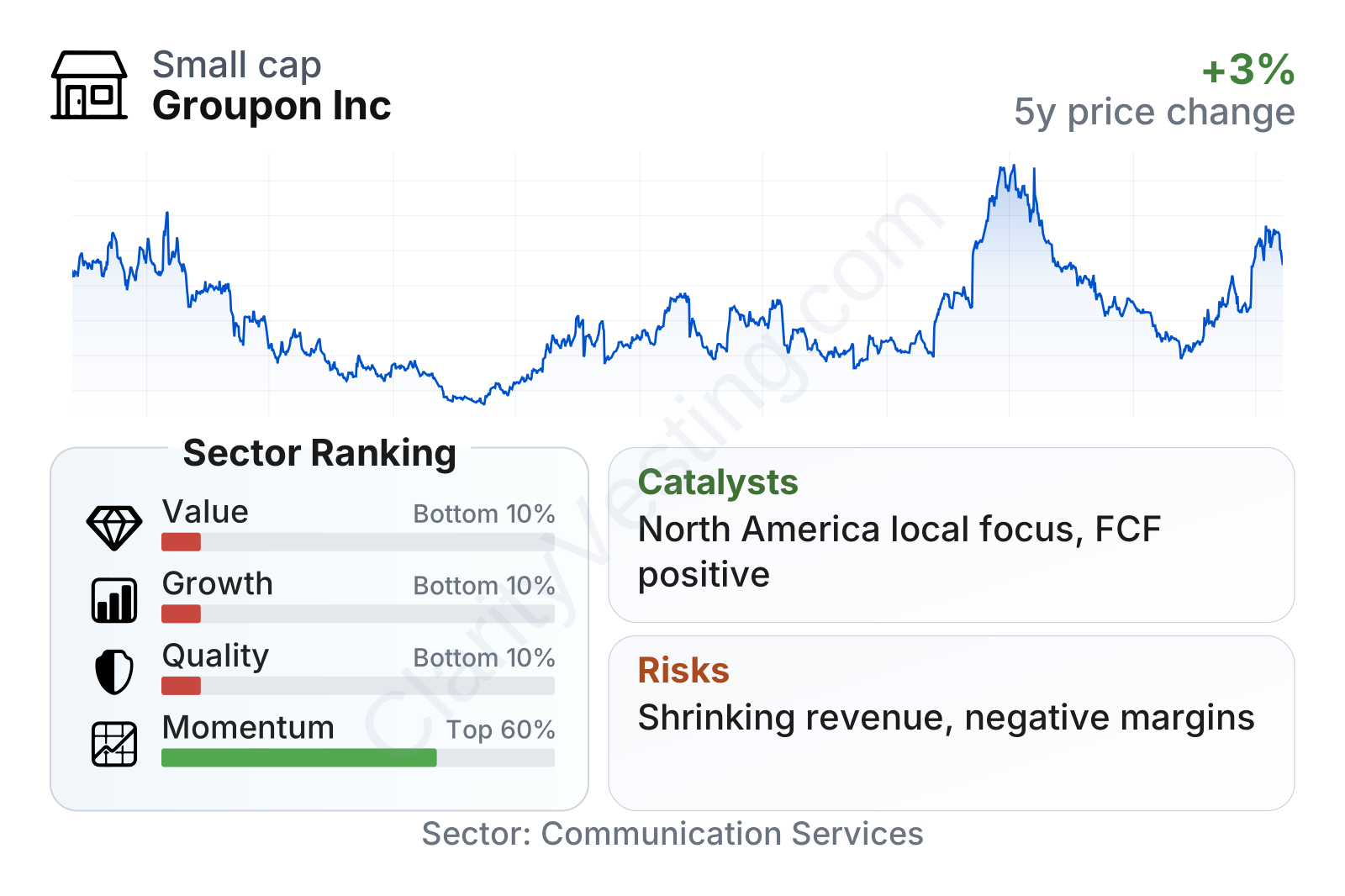
Groupon is now a small-cap company with unusually low share-price sensitivity versus the broader market, but the deeper operating metrics remain weak. Relative to its sector, it ranks near the bottom on value, growth, and quality, mainly because profitability is still negative and multi-year revenue trends are poor. The more encouraging point is cash generation: free cash flow has turned positive after a long weak stretch, and recent price momentum has been stronger than much of the sector, even though that momentum has also been volatile.
The stock history reflects that instability. Shares collapsed from 2021 into 2023, then rebounded sharply, which suggests the market has been reacting more to turnaround expectations than to a stable earnings profile.
Growth
Groupon operates in digital local commerce, which is still a relevant and growing part of consumer internet activity. People continue to search online for dining, wellness, home services, and nearby experiences, and merchants still need cost-effective customer acquisition tools. That broad market remains attractive. The issue is that Groupon has not been growing with it for most of the past several years.
Revenue performance shows a long period of contraction, with declines that were very steep in 2022 and then gradually improved. More recently, year-over-year revenue has moved closer to flat, with some quarters briefly returning to growth before slipping slightly again. That pattern suggests the core business may be stabilizing, but it does not yet show a clear return to durable expansion.
Management’s strategy is more logical than the old Groupon model. The company has been focusing on its strongest category—local offers—while simplifying operations, improving the marketplace, and trying to raise customer frequency and merchant quality rather than chasing low-quality volume. For a smaller platform, that approach makes sense: a concentrated marketplace with stronger repeat use is more realistic than rebuilding the old broad deal empire.
Cash flow is one of the most important signs of progress. After deeply negative levels earlier in the turnaround, trailing free cash flow moved into positive territory and has remained positive, though below peak recent levels. That matters because it suggests the business can still produce cash even without meaningful top-line growth, provided cost controls hold.
The most meaningful catalysts are operational rather than transformational. A sustained improvement in active customers, better conversion in the mobile and local marketplace experience, and stronger merchant retention would all support a healthier platform. Another possible catalyst is that even modest revenue growth could have an outsized effect if the cost base stays lean, because the business has already gone through large expense cuts. In that setup, a small improvement in sales can matter more than it would in a heavily expanding company.
Recent company communications have continued to emphasize execution around North America local, marketplace efficiency, and profitability discipline. That is a practical direction, but the opportunity depends on proving that stabilization can become repeatable growth rather than a temporary recovery.
Risks
This article is for informational purposes only and does not constitute financial advice. Some content is AI-generated. See Disclaimer


