Stock Analysis · Grindr Inc (GRND)
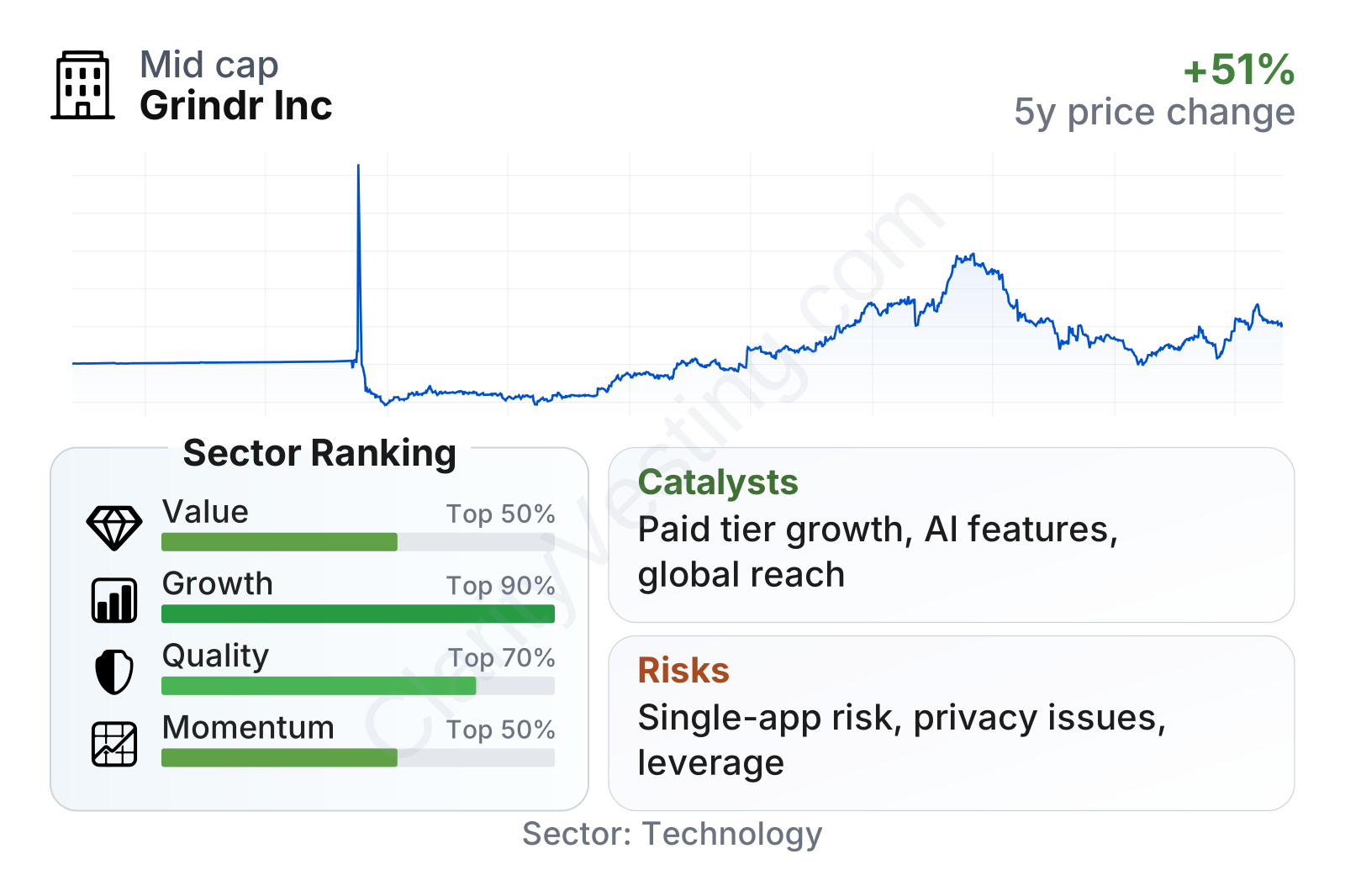
Overview
Grindr is a social networking and dating platform built primarily for gay, bisexual, transgender, and queer users. Its core product is a location-based mobile app that helps people connect, chat, meet, and build community. While it is often described simply as a dating app, the company presents itself more broadly as a digital platform for connection, identity, and lifestyle services for a large global LGBTQ audience.
The business model is relatively straightforward: Grindr monetizes a large free user base through paid subscriptions and advertising. Over time, management has also been expanding the platform with more features designed to deepen engagement, improve matching and discovery, and open additional monetization paths beyond the traditional swipe-and-chat model.
Based on company filings, the revenue mix is heavily concentrated in two main streams, with subscriptions clearly dominant.
- Subscriptions: roughly 70% to 75% of revenue. This includes premium tiers such as Grindr XTRA and Unlimited, which offer enhanced visibility, filters, browsing, and other paid features.
- Advertising and other revenue: roughly 25% to 30% of revenue. This comes from ads shown to free users and a smaller contribution from other in-app monetization activities.
That mix matters for long-term analysis because subscription revenue is usually more predictable and higher margin than ad revenue. It also means Grindr is less dependent on the advertising cycle than many consumer internet platforms.
The business has scaled meaningfully in recent years. Revenue has increased sharply from the early public-company period, while gross profit has remained very strong, showing that the platform can add revenue without a matching rise in direct operating costs. The main swing factor has been below the gross profit line, where operating expenses, interest, and accounting items have created more volatility in reported earnings than in the underlying cash generation.
The financial flow highlights a favorable core structure: revenue and gross profit have climbed steadily, and operating income improved materially by 2024 and 2025. It also shows why headline earnings need context, since interest expense and other non-operating items had an outsized impact in weaker periods.
Key Figures
| Metric | Value | Sector ⓘ |
|---|---|---|
| Date | Jul 18, 2026 | |
| Context | ||
| Sector | Technology | |
| Industry | Software - Application | |
| Market Cap ⓘ | $2.71B | |
| Beta ⓘ | 0.22 | |
Value (Cheapness) | ||
| P/E Ratio ⓘ | 33.91 | 31.76 |
| FCF Yield ⓘ | 5.33% | 4.18% |
| EBIT / EV ⓘ | 4.10% | 2.56% |
| PEG ⓘ | N/A | |
Growth (Business expansion) | ||
| Revenue Growth ⓘ | 38.30% | 13.50% |
| RPS Growth (5Y CAGR) ⓘ | 24.40% | 8.57% |
| EPS Growth (5Y CAGR) ⓘ | N/A | -21.87% |
| Margin Growth (5Y Trend) ⓘ | 13.83% | 0.41% |
| FCF Growth (5Y CAGR) ⓘ | 46.41% | 9.76% |
Quality (Business durability) | ||
| ROIC (Latest) ⓘ | 24.21% | 8.54% |
| ROIC (5Y Median) ⓘ | 30.42% | 8.12% |
| Net Debt / EBIT (Latest) ⓘ | -0.03 | 0.38 |
| Net Debt / EBIT (5Y Median) ⓘ | 3.68 | 0.38 |
| Operating Margin (Latest) ⓘ | 27.34% | 9.58% |
| Operating Margin (5Y Median) ⓘ | 17.14% | 8.25% |
| Debt to Equity (Latest) ⓘ | 2383.79% | 33.52% |
| Profit Margin (Latest) ⓘ | 19.85% | 6.96% |
| Free Cash Flow (Latest) ⓘ | $144.59M | |
Momentum (Price trend) | ||
| 3Y Return ⓘ | +159.08% | +30.91% |
| 12M Return (excl. last month) ⓘ | -42.31% | +28.90% |
| 6M Return ⓘ | +22.87% | +5.38% |
| Price vs. 200-Day MA ⓘ | +17.57% | +7.61% |
Grindr stands out most on growth and operating efficiency. Revenue expansion has been far above the typical software company in its sector, and profitability metrics such as operating margin, return on invested capital, and free cash flow generation are also notably strong. The main weak spot in the snapshot is not business momentum in the operational sense, but the mixed stock-market path over the last year after a very strong multiyear run.
At roughly a few billion dollars in market value, Grindr is still small compared with the largest consumer internet platforms. That smaller size can create room for expansion, but it also means results can be more sensitive to product execution, reputation shifts, and changes in user behavior.
Growth
Grindr operates in a part of the digital economy that still has room to grow. Online dating and social discovery are mature in the sense that they are already widely adopted, but they continue to evolve as users spend more time on mobile platforms and expect more personalized, identity-based communities. Grindr’s niche focus gives it a distinct position within that broader market. Unlike general dating apps that compete for everyone, Grindr is built around a specific audience with particular social and community needs, which can support strong engagement and pricing power if product quality remains high.
The company’s recent operating trajectory supports the idea that its strategy is working. Revenue growth has stayed consistently high for multiple quarters, rather than relying on a one-time spike. That suggests the business is benefiting from a mix of paid conversion, pricing, product expansion, and continued user activity.
Recent year-over-year revenue growth has remained well above the software sector norm, and the latest reading shows a clear reacceleration. For a platform business, that kind of sustained growth is often more important than any single quarter because it points to durable demand rather than a temporary promotion or accounting effect.
Free cash flow is another important growth indicator here because it shows whether expansion is translating into real financial flexibility. In Grindr’s case, cash generation has risen dramatically over the last few years.
The climb in free cash flow is a major positive sign. It indicates that the company is not just adding revenue, but also converting a meaningful share of that revenue into cash that can be used for product development, acquisitions, debt reduction, or shareholder-related capital allocation. For a consumer app business, that is often a stronger sign of business quality than accounting earnings alone.
Grindr’s strategy for future growth appears logical. Management has emphasized improving the app experience, using more intent-based and interest-based discovery features, and building a broader platform around the user relationship. The company has also discussed international opportunities, where monetization may still have room to improve as product features mature and pricing becomes more refined.
A notable catalyst is the possibility that Grindr becomes more than a single-purpose dating app. If it succeeds in adding adjacent services tied to identity, wellness, travel, events, or creator/community features, the average revenue per user could expand without requiring the company to rely only on adding more users. Another potential catalyst is margin expansion: with strong gross margins already in place, incremental revenue can have a powerful effect on profits and cash flow if operating expenses stay controlled.
Recent company communications have also pointed to ongoing product launches and AI-supported features intended to improve discovery, relevance, and engagement. For a platform that already has a recognized brand within its niche, better personalization can strengthen retention and create more opportunities to convert free users into paying subscribers.
Risks
The biggest risk is concentration. Grindr is closely tied to one flagship app and one primary user community. That focus is also part of its strength, but it means the business has less diversification than larger peers with multiple brands or broader ecosystems. If engagement weakens, app store dynamics change, or the brand suffers reputational damage, the effect could be felt quickly.
Competition is real even if Grindr occupies a strong niche. The company competes indirectly with larger dating platforms such as Match Group’s Tinder, Hinge, OkCupid, Archer, and other LGBTQ-focused or socially oriented apps. In pure scale, Grindr is not the leader of the overall online dating market. However, within its specific segment, it is one of the most recognized and established platforms globally. That brand recognition, network density in many cities, and long-standing community relevance give it a defensible position that newer entrants may find hard to replicate.
The competitive advantage is therefore less about technology and more about network effects, brand familiarity, and user habit. People often join location-based social apps because that is where other users already are. This can create a self-reinforcing effect in dense urban markets. Still, network effects in consumer apps are never permanent; poor product choices or declining trust can weaken them over time.
Financial structure needs careful interpretation. On one hand, Grindr’s net debt relative to EBIT currently looks modest to favorable, which suggests debt is not overwhelming compared with operating earnings. On the other hand, the debt-to-equity ratio appears unusually high and volatile because equity has been thin and distorted at times by accounting movements. That makes the ratio look more alarming than a simple cash-flow view might suggest, but it still signals a capital structure that deserves attention.
The debt-to-equity trend has been erratic and often far above the sector norm, which reflects balance-sheet sensitivity more than a stable leverage profile. Even with stronger recent earnings and cash flow, this remains an area where readers should focus on the quality of equity and debt management rather than on a single headline ratio.
Profitability has improved sharply, but it has not been perfectly smooth. Reported net margins swung from losses to strong profits over a relatively short period. That kind of volatility can happen when stock-based compensation, tax items, interest expense, and other accounting effects have a large impact on bottom-line results.
The latest margin level is comfortably above the sector median, which is encouraging, but the recent history shows that Grindr should not be treated like a fully mature, highly stable software business. The underlying operations look much healthier than earlier reported losses implied, yet earnings quality still deserves monitoring.
There are also non-financial risks. Grindr operates in a category where privacy, user safety, moderation, and data protection are central to brand trust. Any high-profile incident involving personal data, harmful behavior on the platform, or weak content moderation could damage user confidence and attract regulatory scrutiny. Because the app serves a community that can face social sensitivity in some regions, these issues carry added reputational weight.
In recent years, the company has also had periods of management transition and strategic repositioning as a newly public business. That is not unusual, but it raises execution risk. A company growing this quickly must balance monetization with user experience; pushing too hard on ads or subscriptions can lift revenue in the short term while hurting long-term engagement.
Valuation
Valuation is where the case becomes more nuanced. Grindr’s current earnings multiple is not far from the software sector median, even though its growth profile is much stronger than average. On that basis alone, the stock does not appear obviously stretched.
The recent price-to-earnings readings have generally sat around or below the sector median after earlier periods when the multiple was either much higher or not meaningful due to losses. That reset matters because it suggests the market is no longer valuing Grindr like a speculative early-stage app despite the company still delivering unusually strong growth.
Other valuation signals also lean more favorable than expensive. Free cash flow yield is modestly better than the sector median, and EBIT relative to enterprise value is also stronger than typical software peers. In plain terms, the business appears to generate a respectable amount of operating profit and cash for its current enterprise value.
That said, the stock price still assumes that recent progress is sustainable. If revenue growth slows materially, or if margins slip as the company invests in product and expansion, the valuation could look less comfortable. This is not a case where the market is assigning a bargain-basement price to a distressed asset. Instead, the current level appears to reflect a company that has already proven substantial improvement but still needs to confirm that the improvement is durable.
Overall, the valuation context looks more reasonable than exuberant. The market seems to be recognizing Grindr’s stronger cash generation, higher margins, and niche positioning, while still leaving room for doubt about stability, governance, and long-term scalability beyond the core app.
Conclusion
Grindr is no longer just a niche app with a recognizable brand; it is increasingly showing the financial profile of a scalable digital platform. Revenue growth has remained unusually strong, free cash flow has expanded rapidly, and recent profitability is much stronger than earlier headline losses suggested. The company also benefits from a clear identity within its market, where brand familiarity and network density can be difficult for rivals to copy.
The main challenge is that the business still carries the traits of a focused, evolving platform rather than a fully settled software franchise. Its dependence on one brand, the sensitivity of its user base to trust and safety issues, and the uneven history of reported earnings all keep the risk profile above that of larger, more diversified internet companies. The balance sheet also requires more care than the headline cash generation might first imply.
In valuation terms, the stock appears to sit in a middle ground that is easier to justify than it was when the business had less proof behind it. The market is recognizing Grindr’s momentum, but it is not valuing the company as if success is guaranteed. That leaves the current picture tilted toward a business with credible long-term upside supported by improving fundamentals, while still demanding continued execution to fully earn a premium standing.
Sources:
- Grindr Inc. — Annual Report on Form 10-K for fiscal year 2025
- Grindr Inc. — Quarterly Report on Form 10-Q for quarter ended March 31, 2026
- Grindr Inc. — SEC EDGAR company filings
- Grindr Inc. Investor Relations — shareholder letters and earnings materials
- Grindr Inc. Investor Relations — company-hosted earnings call materials
- Wikipedia — Grindr
This article is for informational purposes only and does not constitute financial advice. Some content is AI-generated. See Disclaimer


