Stock Analysis · Graphic Packaging Holding Company (GPK)
Overview
Graphic Packaging Holding Company is a paper-based consumer packaging manufacturer. In simple terms, it makes the cartons, cups, foodservice containers, trays, and related packaging used by food, beverage, household, and consumer product brands. Its products are commonly found in grocery stores, convenience stores, restaurants, and fast-food chains. The company focuses heavily on replacing plastic packaging with paperboard alternatives, which is an important part of its long-term positioning.
The business is vertically integrated. That means Graphic Packaging does not only convert packaging for customers; it also makes a large part of the paperboard that goes into those products. This matters because it can support supply reliability, customer relationships, and cost control better than a converter that depends entirely on outside material suppliers.
Revenue is mainly generated from paperboard packaging for consumer end markets. Based on company disclosures, the business is organized around consumer packaging and a smaller paperboard manufacturing and supply activity, but economically the largest end uses are food and beverage packaging. A practical breakdown is:
- Paperboard consumer packaging solutions: about 80% to 90% of revenue. This includes folding cartons for cereals, frozen food, snacks, pet food, and multipack beverage packaging, plus packaging machinery and integrated service offerings.
- Foodservice packaging: about 10% to 15% of revenue. This includes cups, lids, plates, bowls, trays, containers, and other packaging used in restaurants and on-the-go consumption.
- Paperboard sales and other activities: less than 10% of revenue. This includes externally sold paperboard and certain related items.
The revenue mix is not driven by one narrow niche. Instead, it is spread across everyday consumption categories, which can make demand steadier than in many discretionary consumer businesses. The trade-off is that packaging is still a manufacturing business with input cost exposure and pressure from large customers.
The company’s earnings profile improved materially from 2021 through 2023 as revenue and operating income expanded, but 2024 and especially 2025 show that margin pressure can return quickly. Revenue stayed in the high single-digit billions of dollars range, yet profit conversion weakened as gross profit and operating income retreated from their earlier peak.
Key Figures
| Metric | Value | Sector ⓘ |
|---|---|---|
| Date | Sep 12, 2026 | |
| Context | ||
| Sector | Consumer Cyclical | |
| Industry | Packaging & Containers | |
| Market Cap ⓘ | $2.81B | |
| Beta ⓘ | 0.66 | |
Value (Cheapness) | ||
| P/E Ratio ⓘ | 14.62 | 17.10 |
| FCF Yield ⓘ | 6.72% | 8.53% |
| EBIT / EV ⓘ | 6.86% | 6.46% |
| PEG ⓘ | 3.33 | |
Growth (Business expansion) | ||
| Revenue Growth ⓘ | -0.70% | 5.75% |
| RPS Growth (5Y CAGR) ⓘ | 4.84% | 9.14% |
| EPS Growth (5Y CAGR) ⓘ | -48.50% | -18.21% |
| Margin Growth (5Y Trend) ⓘ | 3.67% | -0.23% |
| FCF Growth (5Y CAGR) ⓘ | -19.51% | 4.91% |
Quality (Business durability) | ||
| ROIC (Latest) ⓘ | 5.13% | 12.61% |
| ROIC (5Y Median) ⓘ | 8.83% | 10.72% |
| Net Debt / EBIT (Latest) ⓘ | 9.21 | 2.10 |
| Net Debt / EBIT (5Y Median) ⓘ | 5.86 | 2.32 |
| Operating Margin (Latest) ⓘ | 6.98% | 9.25% |
| Operating Margin (5Y Median) ⓘ | 9.67% | 9.64% |
| Debt to Equity (Latest) ⓘ | 179.57% | 75.78% |
| Profit Margin (Latest) ⓘ | 2.25% | 5.33% |
| Free Cash Flow (Latest) ⓘ | $189.00M | |
Momentum (Price trend) | ||
| 3Y Return ⓘ | -53.96% | +14.53% |
| 12M Return (excl. last month) ⓘ | -46.79% | +3.08% |
| 6M Return ⓘ | -1.15% | +0.55% |
| Price vs. 200-Day MA ⓘ | -18.67% | -0.54% |
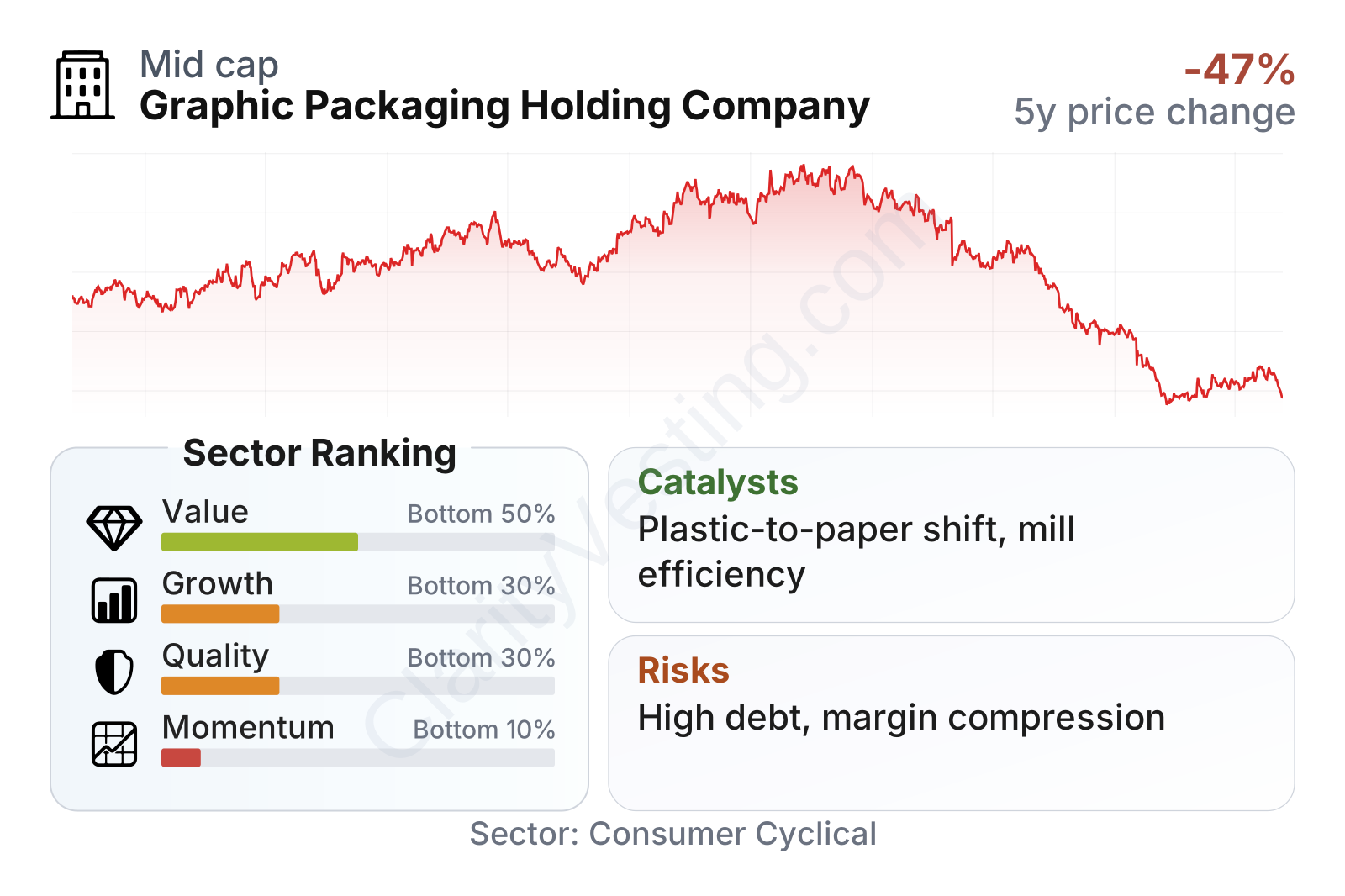
Graphic Packaging is a mid-sized public company with a relatively low beta, meaning its stock has historically moved less than the broader market. The latest factor snapshot looks mixed. Valuation is roughly around the sector median on earnings, but growth, quality, and momentum rank below much of the sector. Leverage stands out as the weakest area: debt is high relative to both equity and operating earnings, while returns on invested capital and profit margins are currently below typical sector levels.
The share price history also reflects this softer backdrop. After a strong run into 2024, the stock lost substantial ground through 2025 and into 2026, which suggests the market has been repricing the business around slower growth, weaker margins, and balance sheet constraints rather than treating it as a stable defensive compounder.
Growth
Graphic Packaging operates in a sector with a credible long-term growth angle, even if short-term demand can be uneven. Consumer brands and foodservice operators continue to look for paper-based alternatives to plastic, lighter packaging formats, and designs that improve shelf appeal while meeting sustainability targets. That does not guarantee fast growth every year, but it does support a durable demand case for companies that can supply large volumes at scale.
The company’s strategy broadly makes sense for that environment. It has emphasized innovation in recyclable and fiber-based packaging, investment in manufacturing efficiency, and deeper relationships with large packaged goods customers. Its integrated paperboard system can also help when customers want reliable sourcing and coordinated product development.
The recent growth record, however, has been modest. After very strong expansion in 2022, year-over-year revenue growth slowed sharply, then turned negative for several quarters. By 2026, growth appears close to flat overall rather than clearly accelerating. That suggests the structural opportunity in paper substitution is real, but it has not recently translated into broad-based top-line momentum.
Cash generation tells a similar story. Free cash flow has been positive at times, but it has also been volatile, swinging from strong inflows to negative territory and then recovering again. For a capital-intensive packaging company, that matters because internal cash is needed for plant upgrades, debt reduction, and shareholder returns. A more stable cash pattern would strengthen the long-term case considerably.
A meaningful catalyst is the continued replacement of plastic rings, trays, and foodservice items with paperboard formats. Graphic Packaging has spent years building products around this shift, and that gives it a chance to win incremental business as large consumer brands adjust packaging designs. Another potential catalyst is further productivity improvement from its mill and converting network, which could support margins even if volume growth remains moderate.
Recent company communications have also highlighted commercial wins tied to sustainability-focused packaging formats and ongoing operating improvements. Those developments are important because they point to opportunity through product mix and execution, not just through broad economic growth.
Risks
This article is for informational purposes only and does not constitute financial advice. Some content is AI-generated. See Disclaimer


