Stock Analysis · Genuine Parts Co (GPC)
Overview
Genuine Parts Co. is a long-established distribution company best known for supplying replacement parts for vehicles and industrial equipment. Through brands such as NAPA, the company sells automotive replacement parts to repair shops, commercial customers, and retail buyers, while its industrial business distributes bearings, power transmission products, motion control components, safety supplies, and other maintenance items used by factories and infrastructure operators. The business is built around large distribution networks, deep inventory availability, and repeat demand tied to repair and maintenance rather than new product launches.
Revenue is primarily split between automotive parts and industrial parts. Based on the company’s recent reporting structure, the largest sources are:
- Automotive Parts Group: about 75% of revenue. This includes replacement parts, accessories, tools, and related items sold under NAPA and other banners across North America, Europe, and Australasia.
- Industrial Parts Group: about 25% of revenue. This includes MRO products such as bearings, hydraulics, pneumatics, power transmission, automation-related components, and safety equipment used by industrial customers.
The business mix matters for long-term analysis. Automotive replacement parts tend to be more defensive than many consumer-facing businesses because vehicles need ongoing maintenance regardless of new car sales cycles. The industrial segment adds diversification, but it also introduces more exposure to manufacturing activity and capital spending trends.
Over the last several years, revenue has continued to rise, but the flow from sales to earnings has become less efficient. Gross profit has stayed substantial as the company has grown, yet operating income and net income weakened sharply in the most recent annual period, showing that higher costs and margin pressure have recently offset much of the top-line progress.
Key Figures
| Metric | Value | Sector ⓘ |
|---|---|---|
| Date | Sep 12, 2026 | |
| Context | ||
| Sector | Consumer Cyclical | |
| Industry | Auto Parts | |
| Market Cap ⓘ | $18.50B | |
| Beta ⓘ | 0.66 | |
Value (Cheapness) | ||
| P/E Ratio ⓘ | N/A | 17.10 |
| FCF Yield ⓘ | 4.11% | 8.53% |
| EBIT / EV ⓘ | 0.69% | 6.46% |
| PEG ⓘ | 1.61 | |
Growth (Business expansion) | ||
| Revenue Growth ⓘ | 6.00% | 5.75% |
| RPS Growth (5Y CAGR) ⓘ | 7.46% | 9.14% |
| EPS Growth (5Y CAGR) ⓘ | -19.42% | -18.21% |
| Margin Growth (5Y Trend) ⓘ | -5.80% | -0.23% |
| FCF Growth (5Y CAGR) ⓘ | -19.29% | 4.91% |
Quality (Business durability) | ||
| ROIC (Latest) ⓘ | 1.34% | 12.61% |
| ROIC (5Y Median) ⓘ | 16.05% | 10.72% |
| Net Debt / EBIT (Latest) ⓘ | 35.58 | 2.10 |
| Net Debt / EBIT (5Y Median) ⓘ | 2.19 | 2.32 |
| Operating Margin (Latest) ⓘ | 0.68% | 9.25% |
| Operating Margin (5Y Median) ⓘ | 6.69% | 9.64% |
| Debt to Equity (Latest) ⓘ | 146.99% | 75.78% |
| Profit Margin (Latest) ⓘ | 0.13% | 5.33% |
| Free Cash Flow (Latest) ⓘ | $759.35M | |
Momentum (Price trend) | ||
| 3Y Return ⓘ | -0.15% | +14.53% |
| 12M Return (excl. last month) ⓘ | +3.01% | +3.08% |
| 6M Return ⓘ | +27.27% | +0.55% |
| Price vs. 200-Day MA ⓘ | +13.45% | -0.54% |
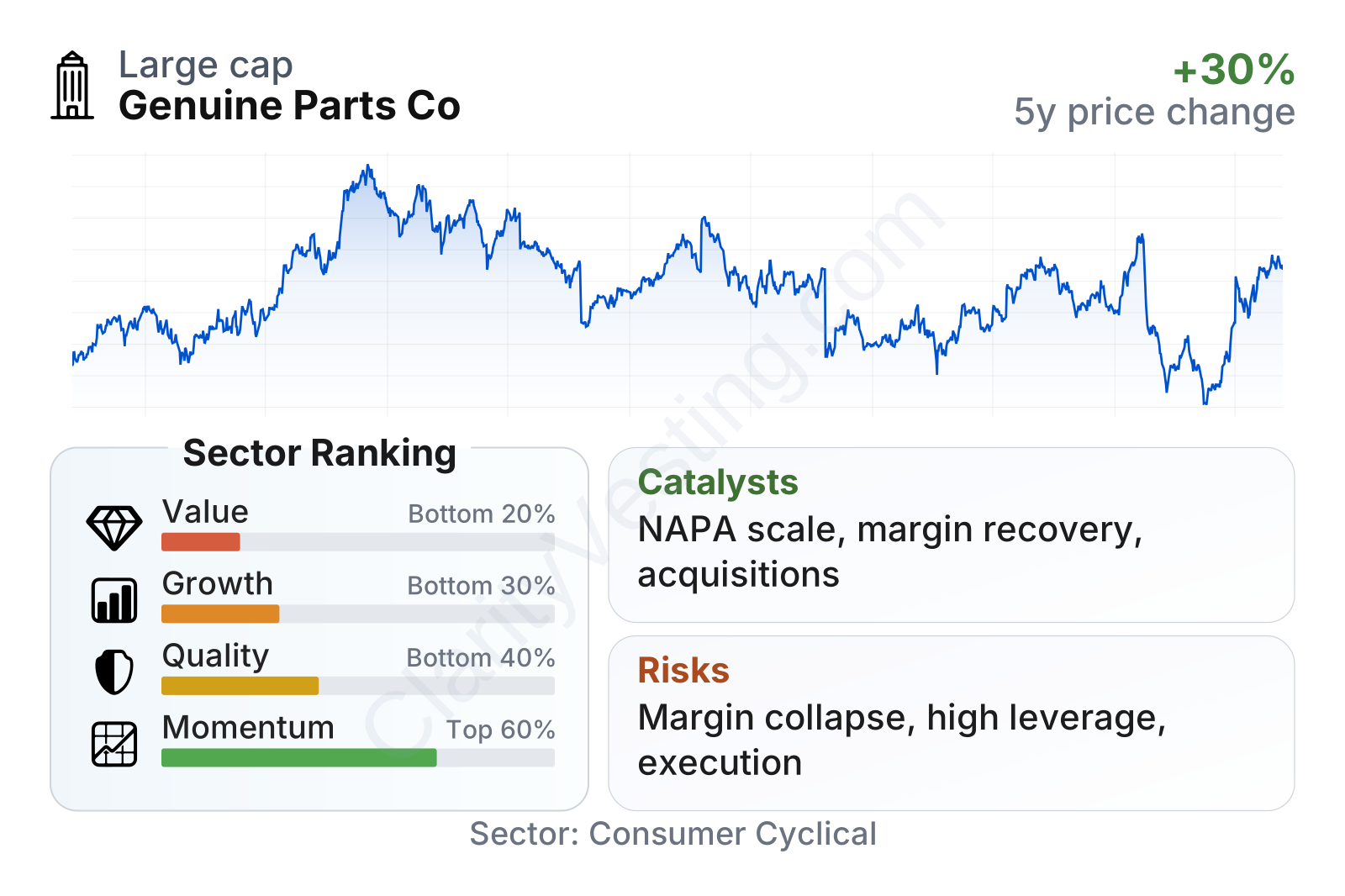
Genuine Parts is a large, established company with a relatively low beta, which suggests its stock has historically moved less sharply than the broader market. That lower volatility fits the company’s repair-and-maintenance profile. Even so, the latest factor snapshot is mixed. Revenue growth is still positive, but value, quality, growth, and momentum all rank in the lower part of the broader consumer cyclical group. The biggest reason is not scale or demand, but profitability: margins and returns have weakened materially, and leverage now looks much heavier than the sector norm.
The headline P/E ratio is unusually high at the moment and should be interpreted with caution. In this case, it appears to reflect depressed earnings rather than a dramatic re-rating of the business. Looking past that distortion, free cash flow remains positive, but current cash generation is below earlier levels and below what would normally support a strong value profile.
Growth
The company operates in parts of the market that have durable long-term demand. Vehicle fleets are aging in many developed markets, which generally supports replacement-part sales because older cars require more maintenance. On the industrial side, customers still need ongoing maintenance, repair, and operating supplies even when factory spending slows. That does not make the business a high-growth platform, but it does support a steadier demand base than many discretionary categories.
Genuine Parts’ strategy is centered on distribution density, inventory availability, digital ordering tools, and bolt-on acquisitions that expand geography or product depth. That approach makes sense for its industry because customers often prioritize fast delivery and dependable supply over brand novelty. Scale can help the company negotiate with suppliers, serve commercial accounts more efficiently, and keep a wide catalog close to the customer.
Recent revenue growth shows that the company is still expanding, with year-over-year growth recently running around the mid-single-digit range. That is respectable for a mature distributor and slightly ahead of the sector median in the latest reading. The more important point is that growth has slowed from the stronger post-pandemic rebound period and is no longer strong enough on its own to offset pressure on profitability.
Free cash flow remains positive, which is important for a business that supports dividends, acquisitions, and network investment. However, cash generation has become much less consistent than it was a few years ago. There was a notable drop in 2025 followed by a partial recovery, which suggests the company still has underlying earning power but is going through a period where working capital, costs, or one-time items are reducing the amount of cash left after operations and capital spending.
A practical catalyst for future performance is execution in the automotive aftermarket. If the company can improve parts availability, pricing discipline, and operating efficiency while vehicle repair demand stays healthy, profit recovery could matter more than additional sales growth. Another useful tailwind is the fragmented nature of distribution in some markets, which can leave room for acquisitions and market share gains. Recent company communications have also emphasized actions to streamline operations and improve productivity, which is relevant because margin recovery now appears more important than pure expansion.
Risks
This article is for informational purposes only and does not constitute financial advice. Some content is AI-generated. See Disclaimer


