Stock Analysis · Alphabet Inc (GOOGL)
Overview
Alphabet Inc. is the parent company of Google and several other businesses. Its core activity is helping people find information, watch videos, navigate, communicate, and use cloud-based software and computing services. In practice, Alphabet makes money mainly by selling advertising tied to Google Search, YouTube, and its wider network of online properties, while also expanding in cloud infrastructure, productivity software, devices, subscriptions, and emerging artificial intelligence products.
The company’s business is still centered on Google services used by billions of people every day. That scale matters because it gives Alphabet a large audience, a vast amount of user intent data, and a strong base for distributing new products such as AI-powered search features, enterprise AI tools, and cloud services. Outside the core Google segment, Alphabet also owns “Other Bets,” which includes earlier-stage businesses such as Waymo and Verily, though these remain much smaller financially.
Based on Alphabet’s recent annual reporting structure, the main sources of revenue are approximately:
- Google Search & other: about 56% to 57% — search advertising, shopping ads, app-related advertising, and other Google-owned monetization tied to user queries and intent.
- YouTube ads: about 10% to 11% — advertising sold on YouTube video surfaces.
- Google Network: about 7% to 8% — ads served on third-party websites and apps using Google’s advertising tools.
- Google Cloud: about 12% to 13% — cloud infrastructure, data analytics, cybersecurity, and productivity applications such as Google Workspace.
- Google subscriptions, platforms, and devices: about 13% to 14% — YouTube subscriptions, Google One, hardware such as Pixel, and app store-related revenue.
- Other Bets: less than 1% — early-stage ventures including autonomous driving and health-related initiatives.
Alphabet’s revenue mix shows a business that is more diversified than it used to be, but still clearly powered by advertising. At the same time, cloud and subscription-related activities are becoming more meaningful, which is important because they broaden the company beyond the ad cycle.
Over the last several years, revenue, gross profit, operating income, and net income have all moved sharply higher. Research and development spending has also climbed materially, showing that Alphabet is reinvesting a large amount into AI, infrastructure, and new products while still expanding profitability.
Key Figures
| Metric | Value | Sector ⓘ |
|---|---|---|
| Date | Sep 12, 2026 | |
| Context | ||
| Sector | Communication Services | |
| Industry | Internet Content & Information | |
| Market Cap ⓘ | $4.14T | |
| Beta ⓘ | 1.23 | |
Value (Cheapness) | ||
| P/E Ratio ⓘ | 16.69 | 18.61 |
| FCF Yield ⓘ | 1.29% | 13.68% |
| EBIT / EV ⓘ | 7.63% | 4.54% |
| PEG ⓘ | 1.23 | |
Growth (Business expansion) | ||
| Revenue Growth ⓘ | 24.20% | 5.40% |
| RPS Growth (5Y CAGR) ⓘ | 14.73% | 4.62% |
| EPS Growth (5Y CAGR) ⓘ | 38.53% | -18.01% |
| Margin Growth (5Y Trend) ⓘ | 4.26% | 1.10% |
| FCF Growth (5Y CAGR) ⓘ | 2.26% | 5.88% |
Quality (Business durability) | ||
| ROIC (Latest) ⓘ | 45.76% | 8.38% |
| ROIC (5Y Median) ⓘ | 30.35% | 8.32% |
| Net Debt / EBIT (Latest) ⓘ | 0.19 | 1.99 |
| Net Debt / EBIT (5Y Median) ⓘ | 0.08 | 2.94 |
| Operating Margin (Latest) ⓘ | 67.51% | 14.89% |
| Operating Margin (5Y Median) ⓘ | 34.31% | 12.96% |
| Debt to Equity (Latest) ⓘ | 17.60% | 59.59% |
| Profit Margin (Latest) ⓘ | 54.77% | 8.77% |
| Free Cash Flow (Latest) ⓘ | $53.27B | |
Momentum (Price trend) | ||
| 3Y Return ⓘ | +152.49% | +46.64% |
| 12M Return (excl. last month) ⓘ | +69.43% | +2.16% |
| 6M Return ⓘ | +11.65% | +5.05% |
| Price vs. 200-Day MA ⓘ | +0.63% | +2.88% |
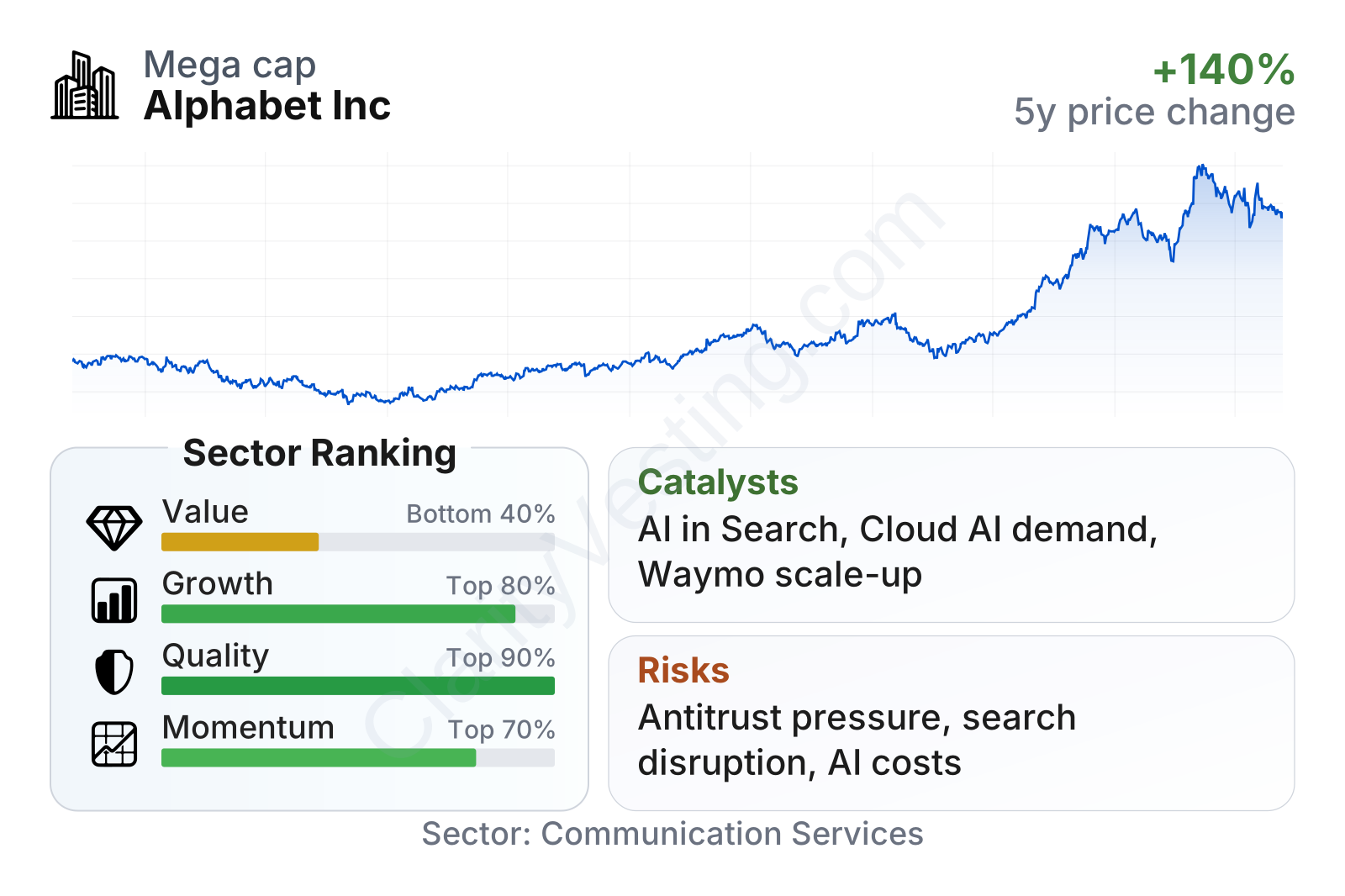
Alphabet stands out for business quality more than for traditional cheapness. Profitability, returns on invested capital, balance sheet strength, and long-term earnings expansion place it near the upper end of its sector. Growth is also clearly ahead of the sector median. The weaker point in the snapshot is value: the earnings multiple is not extreme, but cash flow yield looks less generous than many sector peers because the market already recognizes the company’s scale, resilience, and AI optionality.
The stock’s longer-term price trend has been strong, with a large rebound after the 2022 slowdown and continued appreciation through 2025 and into 2026. That performance suggests the market has steadily reassessed Alphabet from a mature digital advertising company to a business with both high cash generation and major AI exposure.
Growth
Alphabet operates in several growing markets at once: digital advertising, cloud computing, online video, AI infrastructure, AI software, and autonomous driving technology. Not all of these are growing at the same speed, but together they give the company multiple paths to expand. Search remains a mature business in terms of penetration, yet it can still grow through higher commercial activity, better ad targeting, and AI features that improve user engagement and monetization.
Cloud is one of the most important growth engines. Enterprises continue shifting workloads to the cloud, and AI is increasing demand for computing power, model training, data storage, and analytics tools. Alphabet’s strategy makes sense here because it connects custom chips, global data centers, AI models, and enterprise software into one offering. That allows the company to benefit whether customers want infrastructure, AI development tools, or productivity software enhanced with generative AI.
Revenue growth slowed sharply in 2022, then rebuilt in a fairly steady way and has recently accelerated back above 20% year over year. That is a strong signal for a company of Alphabet’s size. It suggests that cloud, search monetization, YouTube, and AI-related demand are working together rather than relying on one temporary boost.
Free cash flow remains very large even after heavy investment. It has not moved in a straight line, which is normal for a company spending aggressively on infrastructure, but the overall level remains substantial. That matters because Alphabet can fund AI expansion, data centers, chips, acquisitions, and experimental projects without depending heavily on outside financing.
A major catalyst is the integration of generative AI into Google Search, YouTube, Android, Workspace, and Google Cloud. If AI improves the usefulness of search results and enterprise software while expanding cloud demand, Alphabet can capture growth on both the consumer and enterprise sides. Another visible opportunity is Waymo: autonomous ride-hailing is still early, but if commercial deployment continues to expand, it could become a more meaningful business over time. Recent company communications have also emphasized growing capital expenditure to support AI infrastructure, which points to management seeing durable demand rather than a short-lived wave.
Risks
This article is for informational purposes only and does not constitute financial advice. Some content is AI-generated. See Disclaimer


