Stock Analysis · Alphabet Inc (GOOG)
Overview
Alphabet is the parent company of Google and several other businesses built around search, advertising, cloud computing, video, mobile software, and artificial intelligence. For most people, the company is easiest to understand through the products they already use: Google Search, YouTube, Android, Chrome, Google Maps, Gmail, and Google Cloud. Its business model is centered on attracting enormous global user traffic and then monetizing that reach through advertising, subscriptions, enterprise software, and digital infrastructure services.
The company’s revenue is still heavily led by advertising, but its mix has broadened over time. Based on Alphabet’s recent annual reporting, the main sources of revenue can be summarized approximately as follows:
- Google Search and other advertising-related activity: roughly half to mid-50% of total revenue. This remains the core engine of the business.
- YouTube ads: around 10% of revenue, supported by the scale of YouTube’s global audience.
- Google Network advertising: high single digits, generated when ads are served on partner websites and apps.
- Google Cloud: about low- to mid-teens of revenue, including cloud infrastructure, data tools, and productivity software.
- Subscriptions, platforms, and devices: about 10% to 12%, including YouTube subscriptions, Google One, app store activity, and hardware.
- Other Bets: a very small share, including businesses such as Waymo and Verily.
What stands out is not only the size of Alphabet’s advertising machine, but also how profitable the broader ecosystem has become. Over the last several years, revenue, gross profit, operating income, and net income have all moved materially higher, while research and development spending has also climbed sharply. That combination suggests a company that is still investing aggressively while expanding earnings power.
Key Figures
| Metric | Value | Sector ⓘ |
|---|---|---|
| Date | Jul 18, 2026 | |
| Context | ||
| Sector | Communication Services | |
| Industry | Internet Content & Information | |
| Market Cap ⓘ | $4.32T | |
| Beta ⓘ | 1.25 | |
Value (Cheapness) | ||
| P/E Ratio ⓘ | 28.26 | 19.52 |
| FCF Yield ⓘ | 1.49% | 12.73% |
| EBIT / EV ⓘ | 4.36% | 4.37% |
| PEG ⓘ | 1.46 | |
Growth (Business expansion) | ||
| Revenue Growth ⓘ | 21.80% | 6.10% |
| RPS Growth (5Y CAGR) ⓘ | 14.74% | 5.02% |
| EPS Growth (5Y CAGR) ⓘ | 3.38% | -26.68% |
| Margin Growth (5Y Trend) ⓘ | 4.06% | 0.79% |
| FCF Growth (5Y CAGR) ⓘ | 2.26% | 5.18% |
Quality (Business durability) | ||
| ROIC (Latest) ⓘ | 35.57% | 8.74% |
| ROIC (5Y Median) ⓘ | 30.35% | 8.07% |
| Net Debt / EBIT (Latest) ⓘ | 0.27 | 2.09 |
| Net Debt / EBIT (5Y Median) ⓘ | 0.06 | 3.02 |
| Operating Margin (Latest) ⓘ | 46.31% | 15.46% |
| Operating Margin (5Y Median) ⓘ | 34.31% | 13.17% |
| Debt to Equity (Latest) ⓘ | 18.90% | 59.09% |
| Profit Margin (Latest) ⓘ | 37.92% | 9.11% |
| Free Cash Flow (Latest) ⓘ | $64.43B | |
Momentum (Price trend) | ||
| 3Y Return ⓘ | +181.41% | +36.38% |
| 12M Return (excl. last month) ⓘ | +104.89% | +8.16% |
| 6M Return ⓘ | +4.03% | +2.31% |
| Price vs. 200-Day MA ⓘ | +7.95% | +1.57% |
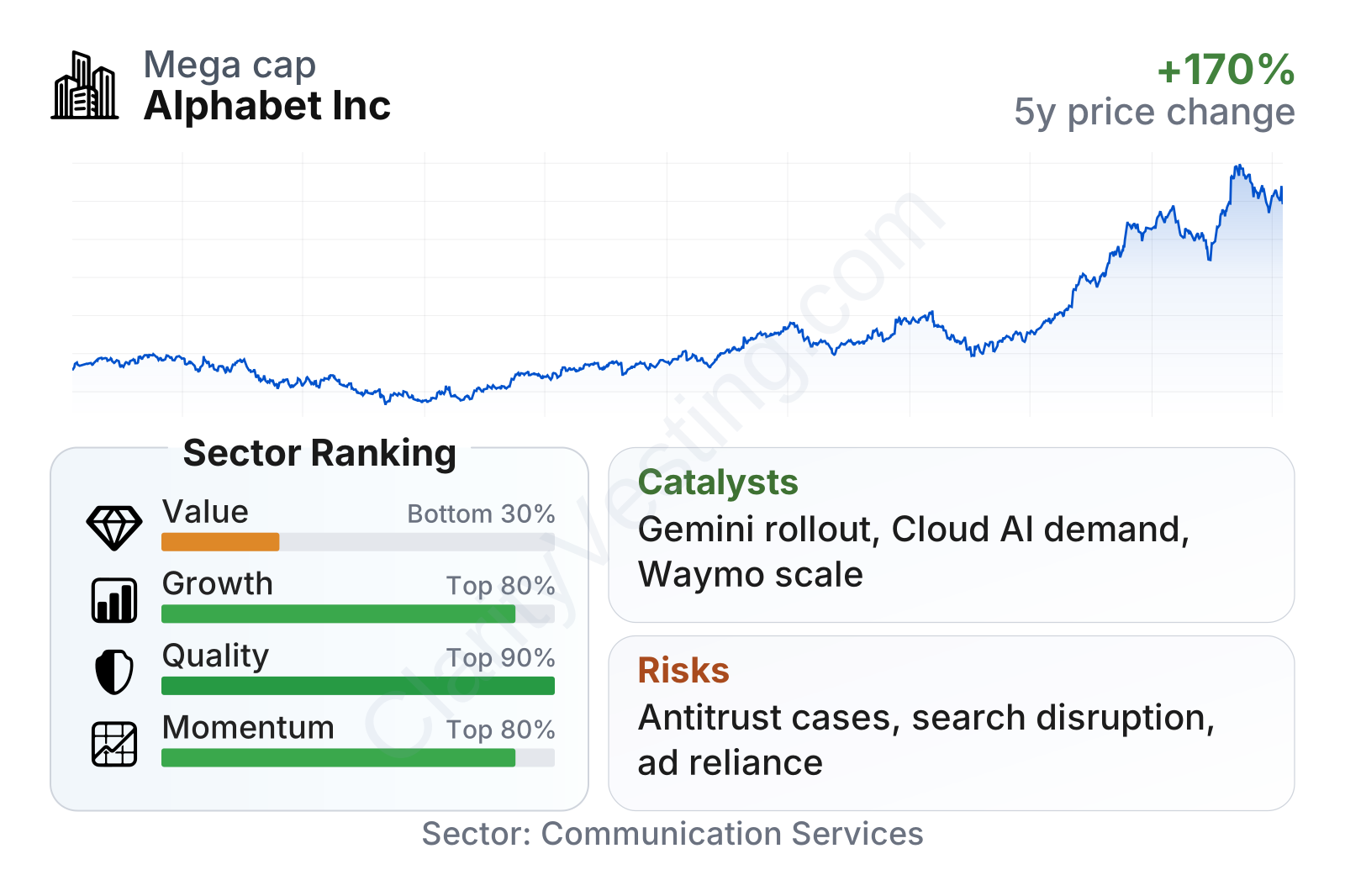
Alphabet is one of the largest listed companies in the world, with a market value above $4 trillion. The overall profile shown by the key metrics is unusual: the company ranks strongly on quality, growth, and momentum, but looks less attractive on simple value measures. In plain terms, the business is producing exceptional profitability and returns on capital, has grown faster than much of its sector, and the stock has performed very well, yet the market is not pricing it as a bargain.
The quality metrics are especially notable. Operating margin and profit margin are far above sector norms, return on invested capital is exceptionally strong, and leverage remains low. Growth indicators are also solid, with recent revenue expansion well ahead of the sector median and a favorable long-term trend in revenue per share. Free cash flow remains very large in absolute terms, even if its growth has been less smooth than revenue growth.
Growth
Alphabet operates in some of the most important long-term areas of the digital economy: online advertising, cloud computing, AI infrastructure, digital video, and mobile ecosystems. These are still expanding markets, although they are maturing at different speeds. Search advertising is no longer an early-stage business, but cloud services and enterprise AI remain in a more dynamic growth phase. That matters because Alphabet is using the cash generated by its mature businesses to fund expansion in newer ones.
The recent revenue trend has reaccelerated after a slowdown in 2022 and early 2023. Growth moved from very low single digits back into the mid-teens and then above 20% in the latest period shown, which is a strong sign for a company of this scale. That recovery suggests Alphabet is not simply relying on cost cuts or financial engineering; demand has also improved across major business lines.
One of the clearest growth pillars is Google Cloud. The segment has become much more important because it gives Alphabet exposure to enterprise technology budgets, not just consumer internet activity. As businesses build and run AI models, demand for computing power, data platforms, cybersecurity, and productivity tools can support further cloud expansion. Alphabet has been tying its Gemini AI models into search, workspace software, cloud tools, and developer platforms, which gives it multiple ways to commercialize the same technology base.
Another major catalyst is the company’s AI distribution advantage. Many firms are building AI models, but Alphabet already controls products used daily by billions of people. That scale can help it introduce AI features into search results, digital assistants, video tools, and enterprise software much faster than smaller rivals. Public company communications during 2025 and 2026 have continued to emphasize AI overviews in search, broader Gemini rollout, cloud AI demand, and Waymo’s expansion in autonomous ride-hailing as notable areas of opportunity.
Cash generation also remains central to the growth case. Free cash flow is still massive even after fluctuations, giving Alphabet room to keep funding data centers, specialized chips, model development, and acquisitions while also supporting shareholder returns. A modest pullback from prior peak free cash flow does not change the broader picture: the company still has exceptional internal funding capacity for long-duration investments.
Risks
This article is for informational purposes only and does not constitute financial advice. Some content is AI-generated. See Disclaimer