Stock Analysis · Entain DRC PLC (GMVHY)
Overview
Entain DRC PLC is an international sports betting and online gaming company. It operates well-known brands such as Ladbrokes, Coral, bwin, Sportingbet, PartyCasino, and PartyPoker. The group serves customers through online platforms and, in some markets, through retail betting shops. It also has an important presence in the United States through BetMGM, its joint venture with MGM Resorts.
The business is built around regulated gambling markets. That matters because the long-term economics of this industry depend heavily on licenses, compliance, marketing efficiency, and brand trust. Entain has spent years building a portfolio that mixes mature cash-generating operations in the U.K. and Europe with expansion opportunities in newer regulated markets such as the U.S. and parts of Latin America.
Revenue is mainly generated from online betting and gaming rather than from physical shops. Exact shares move over time and can vary depending on major sporting events, regulation, and currency movements, but the broad mix is usually understood as follows:
- Online sports betting and gaming: roughly the large majority of group revenue, likely around 75% to 85% combined.
- Retail betting shops: a smaller but still meaningful contribution, mainly from the U.K., generally around 10% to 20%.
- Other and joint-venture related activities: a modest contribution, with strategic importance larger than its direct revenue share because of BetMGM and newer market development.
Over the last several years, the company’s overall revenue has trended upward into the low-$5 billion range, showing that customer demand has remained solid even while profitability has been uneven. The broad financial flow also shows a business with strong gross profit generation, but one that has faced pressure from operating costs, interest expense, and non-cash charges.
The long-term pattern is mixed: revenue has expanded from roughly $3.8 billion in 2021 to above $5.1 billion in 2025, while earnings have been much more volatile. That suggests the central question is not demand, but how efficiently Entain can convert scale into durable profit.
Key Figures
| Metric | Value | Sector ⓘ |
|---|---|---|
| Date | Sep 12, 2026 | |
| Context | ||
| Sector | Consumer Cyclical | |
| Industry | Gambling | |
| Market Cap ⓘ | $4.31B | |
| Beta ⓘ | 0.76 | |
Value (Cheapness) | ||
| P/E Ratio ⓘ | N/A | 17.10 |
| FCF Yield ⓘ | 26.10% | 8.53% |
| EBIT / EV ⓘ | N/A | 6.46% |
| PEG ⓘ | N/A | |
Growth (Business expansion) | ||
| Revenue Growth ⓘ | 7.40% | 5.75% |
| RPS Growth (5Y CAGR) ⓘ | 5.56% | 9.14% |
| EPS Growth (5Y CAGR) ⓘ | -6.22% | -18.21% |
| Margin Growth (5Y Trend) ⓘ | -2.91% | -0.23% |
| FCF Growth (5Y CAGR) ⓘ | 4.24% | 4.91% |
Quality (Business durability) | ||
| ROIC (Latest) ⓘ | 3.58% | 12.61% |
| ROIC (5Y Median) ⓘ | 6.66% | 10.72% |
| Net Debt / EBIT (Latest) ⓘ | 6.32 | 2.10 |
| Net Debt / EBIT (5Y Median) ⓘ | 4.42 | 2.32 |
| Operating Margin (Latest) ⓘ | 5.51% | 9.25% |
| Operating Margin (5Y Median) ⓘ | 10.21% | 9.64% |
| Debt to Equity (Latest) ⓘ | 506.47% | 75.78% |
| Profit Margin (Latest) ⓘ | -10.65% | 5.33% |
| Free Cash Flow (Latest) ⓘ | $1.13B | |
Momentum (Price trend) | ||
| 3Y Return ⓘ | -49.53% | +14.53% |
| 12M Return (excl. last month) ⓘ | -37.94% | +3.08% |
| 6M Return ⓘ | -8.82% | +0.55% |
| Price vs. 200-Day MA ⓘ | -14.07% | -0.54% |
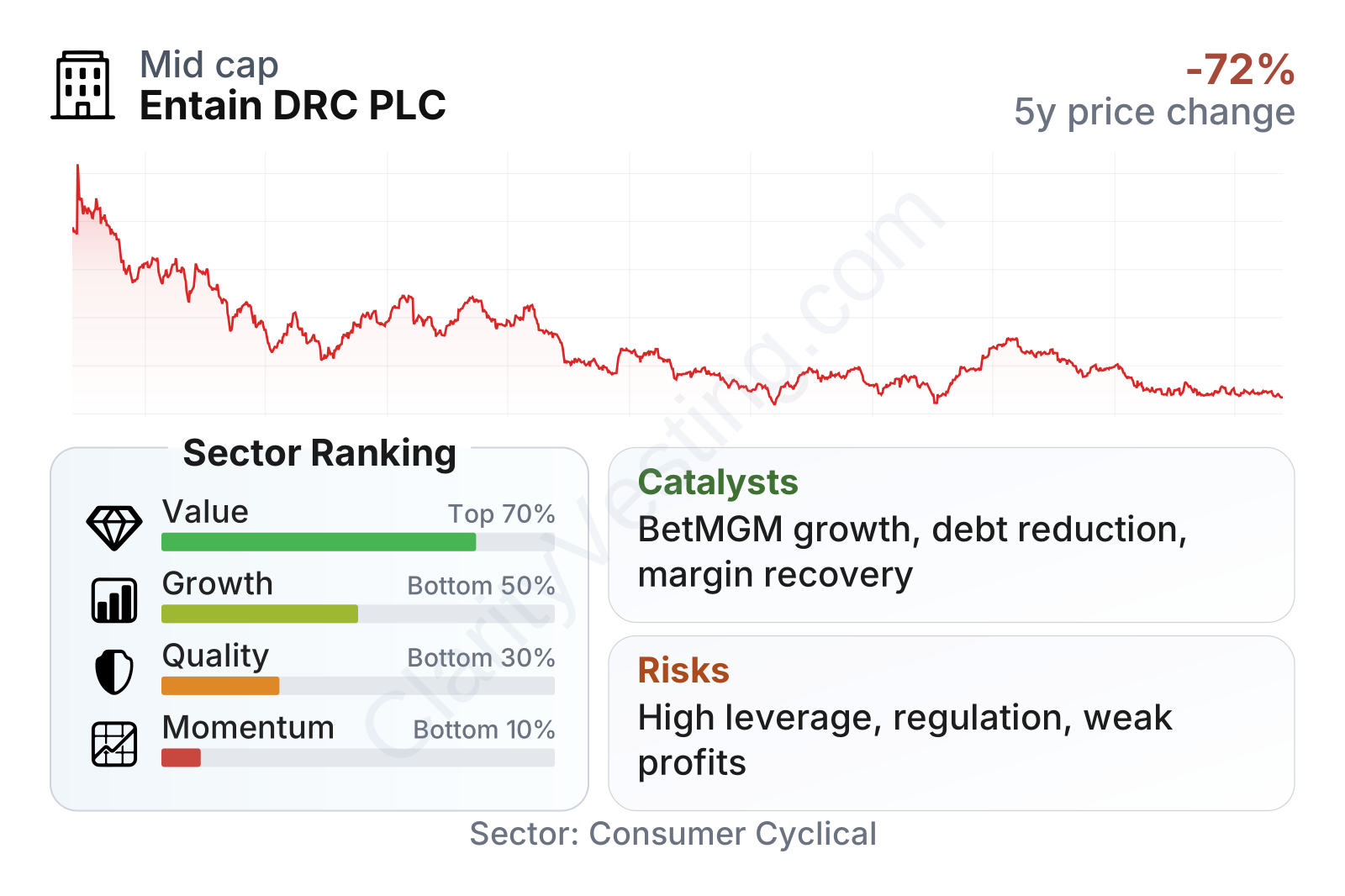
Entain currently sits in a somewhat unusual position. On one hand, cash generation looks strong relative to much of the broader consumer discretionary space, helped by free cash flow yield that screens favorably against the sector median. On the other hand, quality and momentum measures are clearly weaker. Profitability is below typical sector levels, leverage is elevated, and the stock’s multiyear share-price performance has been poor. In simple terms, the market appears to be recognizing the company’s cash-producing ability while still discounting execution risk and balance-sheet pressure.
With a market value around the mid-single-digit billions and a beta below 1, the stock is not behaving like the most volatile names in the sector. However, the weak momentum profile shows that sentiment has remained fragile for a prolonged period.
Growth
Entain operates in a sector that still has room to grow over the long run. The biggest structural driver is the gradual shift from land-based betting to digital platforms, especially mobile. In markets where regulation is becoming clearer, legal online betting can take share from informal or unlicensed operators. That trend generally favors scaled groups with technology, compliance systems, and recognized brands.
Entain’s strategy broadly fits that environment. The company combines established brands in mature markets with exposure to jurisdictions that are still developing. The most important strategic asset here is BetMGM in the United States. While U.S. online sports betting and iGaming remain highly competitive, the market is still developing state by state, and companies with strong partnerships and established platforms have room to deepen their position over time.
Recent revenue growth has been positive but not especially fast compared with the wider sector. That is an important nuance. Entain is still growing, but the pace has been more moderate than many investors typically expect from a digital gambling platform. Over a five-year view, revenue per share has risen, yet not at a standout rate. This points to a company that has scale and demand, but not a clean high-growth profile at this stage.
Free cash flow is one of the stronger parts of the picture. Trailing cash generation has approached the $1 billion mark, and the recent trend has improved. That matters because it gives Entain more flexibility to reduce debt, support technology investment, and navigate regulation without relying entirely on accounting earnings. For a company where reported net income has been volatile, cash flow is a more reassuring indicator of business resilience.
A further catalyst is ongoing industry consolidation and regulation. As smaller operators struggle with rising compliance costs and customer acquisition expenses, larger companies can benefit from scale. Entain’s brand portfolio, trading technology, and experience in regulated environments give it a credible place in that process. Recent company communications have also emphasized operational simplification, sharper capital allocation, and improving performance in core markets, all of which support the case for steadier medium-term progress if execution improves.
Risks
This article is for informational purposes only and does not constitute financial advice. Some content is AI-generated. See Disclaimer


