Stock Analysis · GameStop Corp (GME)
Overview
GameStop Corp is best known as a video game retailer, but the company has been in the middle of a long transition. It sells new and used video game hardware, software, accessories, collectibles, and other entertainment products through stores and e-commerce channels. The business still has a large physical retail footprint, even though the broader gaming market has shifted heavily toward digital downloads, subscription services, and direct-to-consumer distribution.
In practical terms, GameStop is no longer a straightforward growth retailer. It is a restructuring case: a legacy chain trying to stabilize sales, cut costs, preserve liquidity, and find a durable role in a market where customers increasingly buy games digitally and where console makers control large parts of the ecosystem.
Based on recent annual filings, GameStop’s revenue is mainly generated by the following categories, with mix changing by product cycle and consumer demand:
- Hardware and accessories: roughly 45% to 50% of revenue. This includes consoles, controllers, headsets, and related gaming gear.
- Software: roughly 20% to 25% of revenue. This includes new and pre-owned video games, though this category has been under structural pressure from digital distribution.
- Collectibles: roughly 15% to 20% of revenue. This has been one of the more resilient areas, covering figures, trading cards, apparel, and similar merchandise.
- Other: a smaller remainder from areas such as consumer electronics, digital items, and miscellaneous products.
The most visible financial change lately is not top-line expansion but improved efficiency. Over the last several years, revenue has fallen meaningfully, yet operating expenses have been reduced even faster. That has allowed profit and cash flow to recover, at least for now, despite a smaller sales base.
The business mix shows a company that has become leaner. Revenue has shrunk from more than $6 billion a few years ago to closer to the mid-$3 billion range, but selling and administrative costs have been cut sharply, helping turn operating losses into operating profit. That is encouraging from a discipline standpoint, although it also highlights that the recent improvement has depended heavily on cost reduction rather than broad-based sales momentum.
Key Figures
| Metric | Value | Sector ⓘ |
|---|---|---|
| Date | Jul 18, 2026 | |
| Context | ||
| Sector | Consumer Cyclical | |
| Industry | Specialty Retail | |
| Market Cap ⓘ | $9.84B | |
| Beta ⓘ | 1.76 | |
Value (Cheapness) | ||
| P/E Ratio ⓘ | 16.36 | 18.58 |
| FCF Yield ⓘ | 7.53% | 7.99% |
| EBIT / EV ⓘ | 12.05% | 5.91% |
| PEG ⓘ | 0.31 | |
Growth (Business expansion) | ||
| Revenue Growth ⓘ | 14.10% | 5.50% |
| RPS Growth (5Y CAGR) ⓘ | -24.82% | 9.20% |
| EPS Growth (5Y CAGR) ⓘ | N/A | -26.43% |
| Margin Growth (5Y Trend) ⓘ | N/A | -0.18% |
| FCF Growth (5Y CAGR) ⓘ | N/A | 5.02% |
Quality (Business durability) | ||
| ROIC (Latest) ⓘ | 6.53% | 12.03% |
| ROIC (5Y Median) ⓘ | -1.11% | 10.82% |
| Net Debt / EBIT (Latest) ⓘ | -4.37 | 2.12 |
| Net Debt / EBIT (5Y Median) ⓘ | N/A | 2.25 |
| Operating Margin (Latest) ⓘ | 18.74% | 9.28% |
| Operating Margin (5Y Median) ⓘ | -0.56% | 9.64% |
| Debt to Equity (Latest) ⓘ | 74.27% | 75.23% |
| Profit Margin (Latest) ⓘ | 20.45% | 5.28% |
| Free Cash Flow (Latest) ⓘ | $740.80M | |
Momentum (Price trend) | ||
| 3Y Return ⓘ | -5.16% | +10.68% |
| 12M Return (excl. last month) ⓘ | -6.44% | +5.26% |
| 6M Return ⓘ | +2.48% | -2.41% |
| Price vs. 200-Day MA ⓘ | -4.12% | +1.55% |
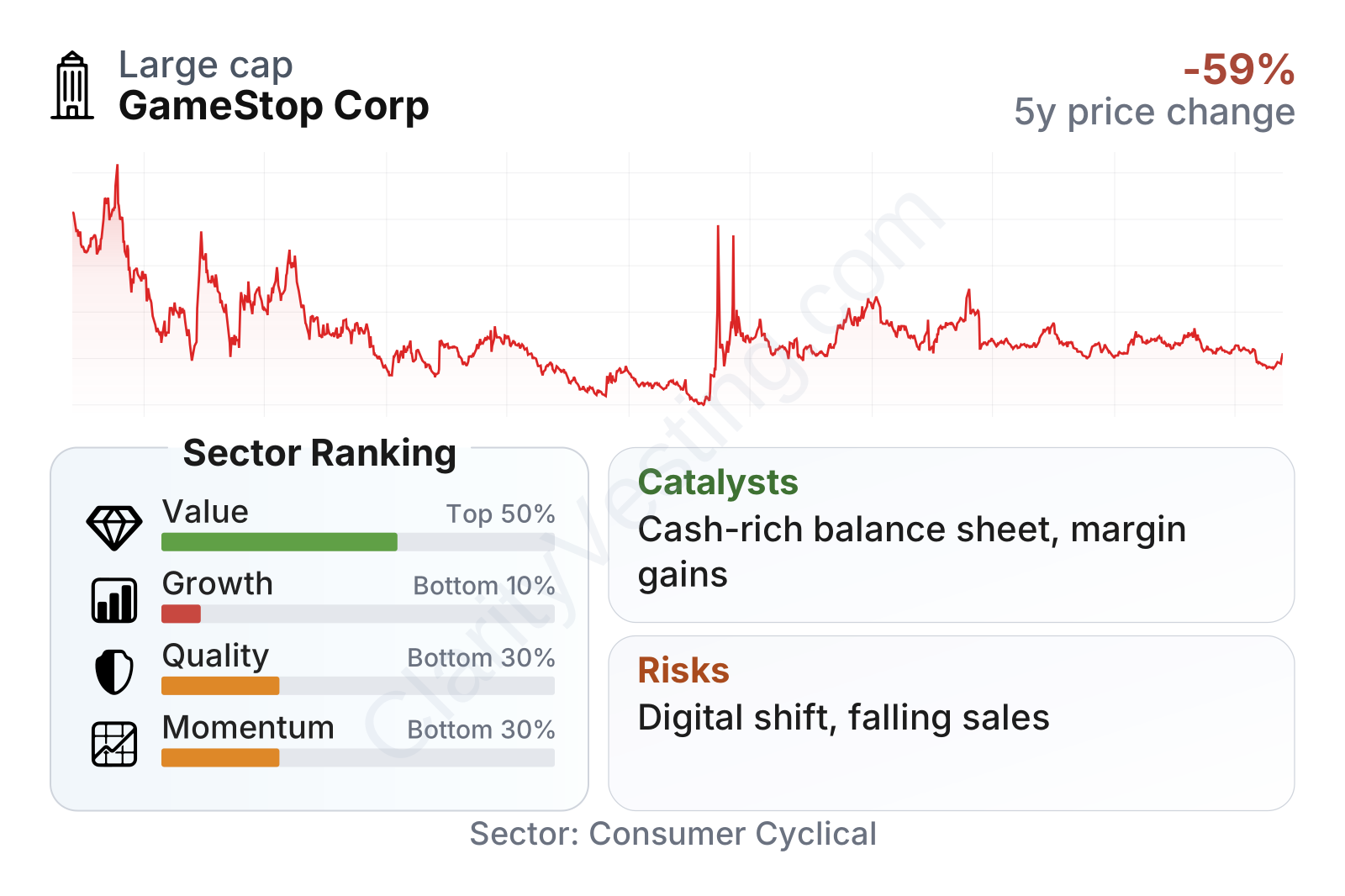
GameStop remains an unusual public company. Its market value is still large relative to the size of its current retail business, and the stock has been highly volatile for years, with a beta well above the market average. The factor summary paints a mixed picture: valuation metrics look broadly middle-of-the-pack to somewhat favorable, while growth, quality consistency, and share-price momentum rank weakly against much of the sector. In short, the balance sheet and recent profitability look better than the long-term operating record.
The stock-price history also shows a business whose market perception has moved far more dramatically than its fundamentals. That gap matters for long-term analysis because it means sentiment can dominate the share price for long stretches, even when underlying retail performance is moving more slowly.
Growth
GameStop operates in gaming, which is unquestionably a large and durable entertainment market. However, that does not automatically make GameStop a growth company. The sector’s strongest trends are digital downloads, online storefronts, subscriptions, in-game spending, and platform ecosystems run by companies such as Sony, Microsoft, Nintendo, Valve, and major publishers. Those trends generally reduce the importance of a physical specialty retailer.
That said, GameStop still has a few possible avenues for relevance. The first is its role in hardware launches and trade-ins, especially around console cycles. The second is collectibles, where shopping can still be more physical and impulse-driven than in pure software sales. The third is cost discipline: management has shown that a smaller company can still produce cash if expenses are tightly controlled.
Recent revenue trends remain uneven. There has been a short-term rebound in year-over-year growth after a period of sharp declines, but the longer pattern is still weak. Over five years, revenue per share has contracted substantially, which suggests the company has not yet proven a stable path back to durable expansion. The latest uptick is notable, but it needs to be viewed against a low and volatile base.
Cash generation has improved much more clearly than sales. Free cash flow has swung from deep negatives to strongly positive territory, which is one of the most important operational developments at GameStop. That gives the company flexibility: it can support operations, preserve optionality, and avoid relying heavily on debt at a time when many retailers are under pressure.
A major catalyst in the current setup is capital allocation flexibility. Public filings in 2025 and 2026 highlighted a much stronger cash position, helped by equity issuance and improved financial results. That does not solve the retail growth challenge by itself, but it gives management more room to reshape the business, pursue selective initiatives, or simply withstand a weak demand environment longer than many stressed retailers could.
Another point worth watching is the company’s increasing emphasis on profitability over scale. That strategy makes sense if management believes the legacy store network cannot return to former revenue levels. In that case, shrinking to a healthier core may be more realistic than chasing growth aggressively in declining categories.
Risks
The central risk is structural: GameStop’s legacy model is exposed to the long-term decline of physical game sales. More players now download titles directly to consoles or PCs, and publishers have stronger direct relationships with customers than they did a decade ago. Even if gaming as an industry grows, GameStop can still lose relevance within it.
A second risk is that recent profitability may overstate the strength of the core business. Margin recovery has been impressive, but much of it appears linked to expense reduction, a leaner footprint, and financial income rather than a broad resurgence in demand. If revenue continues to drift lower, there may be limits to how much additional cost cutting can offset it.
Balance-sheet risk is not the main problem right now. Debt relative to equity is around the sector norm and has improved from prior periods, while net debt versus EBIT is unusually favorable because the company is carrying substantial liquidity. This is a meaningful strength compared with many challenged retailers. The issue is less about solvency and more about finding a business model that can remain relevant.
Profitability has turned from negative to clearly positive, and recent margins stand well above the sector median. That is a major change from the loss-making period of 2021 through 2023. Still, the speed of that improvement calls for caution when judging sustainability. Long-term median returns on invested capital remain weak, which suggests the business has not yet built a strong record of consistently earning attractive returns.
Competition is intense and comes from several directions. GameStop is not the leader in gaming distribution overall. In physical retail it remains one of the most recognized specialist brands, but the most powerful competitors are not just other stores. They include:
- Digital platform owners: Sony PlayStation Store, Microsoft Xbox Store, Nintendo eShop, and Valve’s Steam.
- Mass retailers: Walmart, Target, Best Buy, and Amazon for hardware, accessories, and new release sales.
- Specialty and hobby channels: retailers competing in collectibles, trading cards, and pop-culture merchandise.
GameStop’s competitive advantages are therefore limited. Its brand remains well known among gamers, its trade-in ecosystem is still differentiated, and its store network can help with physical product discovery and local convenience. But these are narrower advantages than they once were, and they are weaker than the ecosystem control held by console makers and digital storefronts.
Another important risk is governance and strategic clarity. The company has gone through repeated strategic shifts in recent years, and public attention around the stock has often focused more on market dynamics than on retail execution. That can create a disconnect between management’s operating priorities and outside expectations. For a long-term business assessment, consistency of strategy matters more than headline attention.
Valuation
GameStop’s valuation is difficult to judge with standard retail comparisons because the company sits between two identities: a shrinking specialty retailer and a cash-rich company with significant optionality. On conventional metrics, the picture is no longer as extreme as it once was. The current P/E is below the sector median in the latest snapshot, and the EV-to-EBIT reading looks relatively strong. Those measures suggest the stock is not obviously stretched if recent earnings power is taken at face value.
The longer history, however, shows how unstable that conclusion can be. The company’s P/E has moved from meaningless levels during loss-making periods to very elevated readings and then down again as profitability improved. That makes valuation especially sensitive to whether current earnings are durable. If the recent profit profile proves repeatable, the stock looks far less expensive than during the speculative spikes of prior years. If margins normalize lower or revenue resumes a deeper decline, today’s valuation becomes harder to defend.
There is also a broader context issue: the market is still assigning GameStop a multibillion-dollar equity value despite its much smaller revenue base and uncertain competitive position. That premium likely reflects its large cash resources, lower financial stress, and the possibility that management can deploy capital effectively. But it also means valuation depends on more than retail fundamentals alone.
Overall, the current price appears easier to justify than in the peak enthusiasm periods, yet it still asks the market to believe that balance-sheet strength and disciplined operations can compensate for a business model facing structural pressure. That is a more credible argument than it was a few years ago, but it is not a simple one.
Conclusion
GameStop today looks less like a collapsing retailer and more like a downsized, financially strengthened company trying to redefine itself. The improvement in profitability, free cash flow, and liquidity is real and significant. Management has cut costs aggressively, reduced financial strain, and created time to work with. Those are meaningful positives.
At the same time, the core challenge has not changed: the company operates in a part of gaming that has been losing importance as digital distribution expands. Sales have not shown the kind of durable long-term growth that would settle the debate around the business. As a result, the most constructive part of the case rests on financial resilience and optionality rather than on clear leadership in an expanding niche.
That leaves GameStop in an unusual position for long-term analysis. The company is stronger than its old reputation suggests, but the business model is still weaker than the balance sheet implies. The valuation no longer looks disconnected in the same way it once did, yet it still leans heavily on the idea that management can turn a stabilized retailer into something more durable. The direction is improved, but the underlying franchise remains difficult to classify as fundamentally robust.
Sources:
- GameStop Corp. — Annual Report on Form 10-K for fiscal year ended February 1, 2025
- GameStop Corp. — Quarterly Report on Form 10-Q filed in 2026
- GameStop Corp. — Current Reports on Form 8-K filed in 2026
- SEC EDGAR — GameStop Corp filings database
- GameStop Investor Relations — press releases and shareholder materials
- Wikipedia — GameStop basic company history and business description
This article is for informational purposes only and does not constitute financial advice. Some content is AI-generated. See Disclaimer


