Stock Analysis · General Motors Company (GM)
Overview
General Motors is one of the largest car manufacturers in the world. It designs, builds, and sells vehicles under well-known brands including Chevrolet, GMC, Cadillac, and Buick. Its business also extends beyond traditional car sales through financing, software-enabled services, commercial fleet solutions, and autonomous driving development. For a long-term reader, the simplest way to view GM is as a legacy auto company that is trying to reshape itself around electric vehicles, connected vehicles, and higher-margin recurring revenue.
Most of GM’s revenue still comes from selling vehicles, parts, and related automotive services, while a smaller but important portion comes from financing operations through GM Financial. Based on recent annual reporting, the revenue mix is approximately structured as follows:
- Automotive sales and other automotive revenue: roughly 85% to 90% of total revenue. This includes vehicle sales in North America and international markets, parts, aftersales, and related activities.
- GM Financial: roughly 10% to 15% of total revenue. This unit provides auto loans, leases, and related financing products.
- Emerging activities: still small in revenue terms, but strategically important. These include software and subscription features, commercial services such as BrightDrop-related operations, and autonomous vehicle efforts tied to Cruise.
Revenue has grown meaningfully over the last several years, but the more important point is that the business remains heavily tied to the economics of vehicle manufacturing: large sales volumes, high production costs, and sensitivity to consumer demand and pricing. That explains why even a company with enormous revenue can still show uneven profitability from one year to the next.
The long-term pattern shows a business that expanded sales strongly from 2021 through 2024, but with costs absorbing most of that growth. Research and development spending has remained substantial, reflecting GM’s push into electrification, software, and new vehicle platforms. More recently, earnings conversion has weakened, which suggests that scale alone is not enough; execution and margins matter far more than raw revenue size.
Key Figures
| Metric | Value | Sector ⓘ |
|---|---|---|
| Date | Jul 18, 2026 | |
| Context | ||
| Sector | Consumer Cyclical | |
| Industry | Auto Manufacturers | |
| Market Cap ⓘ | $70.08B | |
| Beta ⓘ | 1.31 | |
Value (Cheapness) | ||
| P/E Ratio ⓘ | 28.36 | 18.58 |
| FCF Yield ⓘ | 17.81% | 7.99% |
| EBIT / EV ⓘ | 1.42% | 5.91% |
| PEG ⓘ | 0.34 | |
Growth (Business expansion) | ||
| Revenue Growth ⓘ | -0.90% | 5.50% |
| RPS Growth (5Y CAGR) ⓘ | 21.76% | 9.20% |
| EPS Growth (5Y CAGR) ⓘ | -18.61% | -26.43% |
| Margin Growth (5Y Trend) ⓘ | -8.68% | -0.18% |
| FCF Growth (5Y CAGR) ⓘ | N/A | 5.02% |
Quality (Business durability) | ||
| ROIC (Latest) ⓘ | 1.15% | 12.03% |
| ROIC (5Y Median) ⓘ | 4.77% | 10.82% |
| Net Debt / EBIT (Latest) ⓘ | 43.78 | 2.12 |
| Net Debt / EBIT (5Y Median) ⓘ | 11.16 | 2.25 |
| Operating Margin (Latest) ⓘ | 1.34% | 9.28% |
| Operating Margin (5Y Median) ⓘ | 5.41% | 9.64% |
| Debt to Equity (Latest) ⓘ | 203.89% | 75.23% |
| Profit Margin (Latest) ⓘ | 1.38% | 5.28% |
| Free Cash Flow (Latest) ⓘ | $12.48B | |
Momentum (Price trend) | ||
| 3Y Return ⓘ | +100.47% | +10.68% |
| 12M Return (excl. last month) ⓘ | +66.34% | +5.26% |
| 6M Return ⓘ | -5.56% | -2.41% |
| Price vs. 200-Day MA ⓘ | +0.35% | +1.55% |
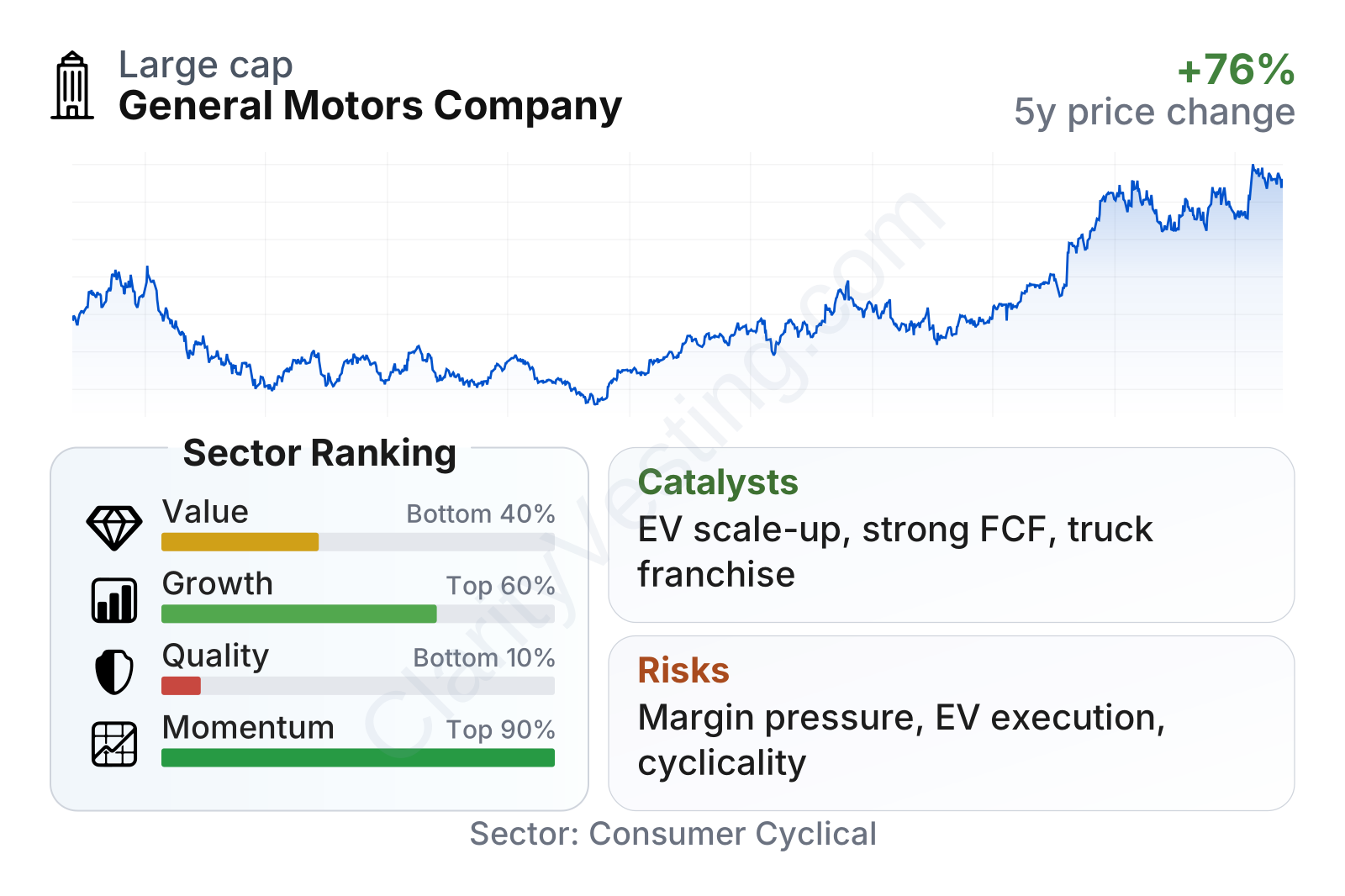
GM is a large-cap company with a market value around the low-$70 billions and a share price history that has been notably volatile, which fits a cyclical manufacturer rather than a steady compounder. The factor profile is mixed. Growth and market momentum look better than much of the sector over multi-year periods, and free cash flow generation has recently improved sharply. On the other hand, profitability, returns on capital, and balance-sheet quality rank weakly versus peers. The result is a company that looks operationally powerful in scale, but less impressive in efficiency and consistency.
Growth
The automotive sector is in the middle of a long transition rather than a simple expansion cycle. Demand for vehicles remains large globally, but the real growth pockets are moving toward electric vehicles, software-enabled features, connected services, advanced driver assistance, and commercial fleet modernization. GM is clearly trying to position itself for that future. Its strategy centers on protecting its strong North American truck and SUV franchise while building new profit pools in EVs, batteries, software, and fleet-related services.
A major strength in that strategy is that it makes industrial sense. GM already has manufacturing scale, dealer reach, supplier relationships, and recognized brands. If it can convert those advantages into attractive EV offerings and recurring software or service revenue, it has a path to remain relevant well beyond the traditional combustion-engine era. The company has also emphasized platform sharing, battery partnerships, and disciplined capital allocation after earlier phases of more aggressive spending.
Top-line growth has cooled recently after a stronger stretch in 2022 through 2024. That slowdown matters, but it should be read in context: auto demand is cyclical, and GM is now operating from a much higher revenue base than it did a few years ago. Over a five-year view, revenue per share has still advanced at a pace well above the sector median, which suggests the company has delivered meaningful scale growth even if the latest year has been softer.
One of the most encouraging recent developments is cash generation. Free cash flow had been negative or uneven in several earlier periods, but it has turned strongly positive on a trailing basis, reaching well above $10 billion. For a capital-intensive business, that is significant because cash is what funds factory upgrades, new product programs, debt management, and shareholder returns. Stronger free cash flow can become a real catalyst if it proves sustainable rather than temporary.
Another potential catalyst comes from GM’s higher-margin core products. Full-size pickups and SUVs remain crucial earnings drivers, especially in North America, where GM has strong brand positioning. In parallel, the company continues to expand its EV lineup and battery manufacturing footprint, while also developing software-based features and services that could improve economics per vehicle over time. Public company updates in 2026 have continued to point to a focus on profitability, EV execution, and capital discipline rather than growth at any cost. That is an important distinction for long-term analysis.
Recent company communications also suggest management is prioritizing areas where GM already has an edge: commercial vehicles, financing, premium vehicles, and technology that can be added to a broad installed base. The broad opportunity is not just selling more cars, but earning more from each customer relationship across financing, maintenance, subscriptions, and business fleet services.
Risks
GM’s biggest risk is that it operates in one of the hardest major industries in the market. Auto manufacturing requires huge fixed costs, constant product reinvestment, and exposure to economic slowdowns, commodity prices, labor costs, recalls, regulation, and changing consumer preferences. Even a well-run automaker can see margins drop quickly when pricing weakens or production costs rise.
The balance sheet remains an area that deserves attention. Debt-to-equity is above 200%, far higher than the sector median. Part of this is explained by GM Financial, since financing businesses naturally carry more debt than pure manufacturers. Still, leverage is elevated, and net debt relative to EBIT is also far above typical sector levels. That makes the company more sensitive to earnings pressure and credit conditions than a simpler industrial business would be.
Profitability has also weakened materially. Net profit margin has fallen from healthy mid-single-digit to high-single-digit levels a few years ago to around 1% to 2% recently, well below the sector median. That drop helps explain why the market has become more cautious even as revenue remains very large. In plain terms, GM is still selling a lot, but it is keeping far less of each dollar of sales than it used to.
Competition is intense and comes from several directions. In traditional vehicles, GM competes with Ford, Toyota, Stellantis, Honda, and other global manufacturers. In electric vehicles, it faces Tesla as well as a growing list of established and newer brands. In China and other international markets, local manufacturers can be especially aggressive on price and speed of product rollout. GM is not the global leader across the whole industry, but it remains one of the strongest players in North American full-size trucks and large SUVs, which is one of the most profitable segments in autos. That is a meaningful competitive advantage, even if it does not fully offset weakness elsewhere.
The company also faces execution risk in newer businesses. Cruise and autonomous vehicle ambitions offer upside, but they have also brought scrutiny, investment demands, and uncertain timelines. EV adoption can create growth opportunities, yet it also pressures margins because battery costs, price competition, and ramp-up inefficiencies can weigh on returns. The key long-term question is whether GM can build future businesses without damaging the cash economics of its current core operations.
On governance and reputation, the main issues to monitor are product quality, recalls, labor relations, and any setbacks tied to advanced driving systems or autonomous programs. None of these risks are unique to GM, but in autos they can become expensive very quickly and can affect both brand perception and regulatory attention.
Valuation
GM’s valuation is not as straightforward as it may first appear. For years, traditional automakers often traded at low earnings multiples because the market discounted their cyclicality and capital intensity. GM’s own history shows that clearly: its price-to-earnings ratio spent a long period well below the broader sector median. More recently, however, the multiple has risen sharply.
The current earnings multiple is now above the sector median, which is unusual for a company with weak quality scores, low current margins, and elevated leverage. On the surface, that makes the shares look less obviously cheap than the company’s reputation might suggest. At the same time, valuation cannot be judged on P/E alone here. GM’s free cash flow yield remains very high, and its PEG ratio points to a much more moderate valuation if earnings recover and strategic initiatives deliver.
The market seems to be weighing two competing narratives. One is cautious: GM is a cyclical manufacturer with pressured margins, financing-related leverage, and major execution challenges in EVs and new technologies. The other is more constructive: the business has strong scale, valuable truck and SUV franchises, large cash generation potential, and several future growth levers that are still not fully reflected in traditional auto comparisons.
Given that tension, the current price looks easier to justify through cash flow and strategic optionality than through present-day profitability. In other words, the valuation appears to assume that recent margin weakness is not the permanent earnings power of the company. If that assumption proves right, the stock’s current level makes more sense; if margins remain structurally low, the valuation looks harder to defend.
Conclusion
General Motors remains a very large and strategically important automaker with real strengths: dominant positions in profitable North American vehicle categories, a meaningful financing arm, large-scale manufacturing capabilities, and the resources to invest in electrification, software, and new mobility platforms. Over a multi-year period, revenue expansion and recent free cash flow improvement show that the company still has substantial operating weight and the capacity to generate cash when conditions cooperate.
At the same time, the business is carrying clear pressure points. Profitability has deteriorated sharply, returns on capital trail much of the sector, and leverage remains high. That combination limits the margin for error, especially in an industry already exposed to economic cycles and fierce competition. GM’s long-term profile is therefore not defined by a lack of opportunity, but by the challenge of turning scale and ambition into durable, efficient earnings.
The overall picture is that of a company with credible assets and visible catalysts, but also with a financial profile that still needs improvement to fully support a stronger valuation case. The direction is cautiously constructive on business potential, yet that potential remains highly dependent on management’s ability to restore margins while funding the transition to the next generation of vehicles and services.
Sources:
- General Motors — Annual Report 2025
- General Motors — Quarterly Report 2026 Q1
- General Motors Investor Relations — 2026 earnings materials and shareholder updates
- U.S. Securities and Exchange Commission — General Motors Company filings on EDGAR
- Wikipedia — General Motors
This article is for informational purposes only and does not constitute financial advice. Some content is AI-generated. See Disclaimer


