Stock Analysis · Corning Incorporated (GLW)
Overview
Corning Incorporated is a specialty materials and glass technology company. It makes advanced glass, ceramics, and optical products used in consumer electronics, communications networks, vehicles, life sciences, and industrial applications. In simple terms, Corning supplies the highly engineered materials that sit inside many modern devices and systems, from smartphone covers and fiber-optic cables to laboratory equipment and auto glass.
Its business is spread across several reporting segments, which helps reduce dependence on a single end market, although some areas remain more cyclical than others. Based on Corning’s recent annual reporting, revenue is mainly generated from the following sources:
- Optical Communications: about 34% — fiber, cable, connectivity products, and related hardware used by telecom carriers, data centers, enterprises, and broadband networks.
- Display Technologies: about 23% — glass substrates for LCD displays used in televisions, monitors, laptops, and other screens.
- Specialty Materials: about 18% — cover glass and advanced materials, including Gorilla Glass and products used in mobile devices, wearables, and other electronics.
- Environmental Technologies: about 14% — ceramic substrates and filters that help control vehicle emissions, mainly for gasoline and diesel applications.
- Life Sciences: about 10% — laboratory products such as vessels, surfaces, bioprocess tools, and consumables used in research and pharmaceutical manufacturing.
- Hemlock and other: low single-digit share — includes polysilicon-related activities and smaller corporate items.
That mix matters for long-term analysis. Optical Communications gives Corning exposure to broadband and data infrastructure, Display Technologies provides scale and cash generation, Specialty Materials connects the company to premium device design, and the rest adds industrial and healthcare diversification.
Corning’s revenue path over the last several years also shows a clear cycle: sales and profits weakened in 2023, then recovered meaningfully through 2024 and 2025. The business model still carries high manufacturing and research intensity, but it also shows that when demand improves, earnings can rebound sharply because many of Corning’s products are difficult to replace.
The financial flow over time highlights that revenue and gross profit recovered strongly after the 2023 downturn. Research and development spending has stayed above $1 billion annually, showing that Corning continues to fund product development even through weaker periods, while the rebound in operating income in 2025 suggests better utilization and pricing conditions.
Key Figures
| Metric | Value | Sector ⓘ |
|---|---|---|
| Date | Sep 12, 2026 | |
| Context | ||
| Sector | Technology | |
| Industry | Electronic Components | |
| Market Cap ⓘ | $143.34B | |
| Beta ⓘ | 1.15 | |
Value (Cheapness) | ||
| P/E Ratio ⓘ | 76.68 | 29.51 |
| FCF Yield ⓘ | 1.67% | 4.25% |
| EBIT / EV ⓘ | 1.91% | 2.85% |
| PEG ⓘ | 0.98 | |
Growth (Business expansion) | ||
| Revenue Growth ⓘ | 16.60% | 15.40% |
| RPS Growth (5Y CAGR) ⓘ | 2.16% | 8.56% |
| EPS Growth (5Y CAGR) ⓘ | -9.40% | -11.88% |
| Margin Growth (5Y Trend) ⓘ | -4.08% | 0.46% |
| FCF Growth (5Y CAGR) ⓘ | -5.54% | 9.80% |
Quality (Business durability) | ||
| ROIC (Latest) ⓘ | 11.81% | 9.44% |
| ROIC (5Y Median) ⓘ | 8.41% | 8.30% |
| Net Debt / EBIT (Latest) ⓘ | 2.45 | 0.54 |
| Net Debt / EBIT (5Y Median) ⓘ | 3.64 | 0.44 |
| Operating Margin (Latest) ⓘ | 16.55% | 9.58% |
| Operating Margin (5Y Median) ⓘ | 14.72% | 8.25% |
| Debt to Equity (Latest) ⓘ | 74.67% | 33.33% |
| Profit Margin (Latest) ⓘ | 11.20% | 7.14% |
| Free Cash Flow (Latest) ⓘ | $2.40B | |
Momentum (Price trend) | ||
| 3Y Return ⓘ | +464.45% | +45.48% |
| 12M Return (excl. last month) ⓘ | +157.45% | +23.48% |
| 6M Return ⓘ | +28.67% | +20.93% |
| Price vs. 200-Day MA ⓘ | +14.72% | +7.43% |
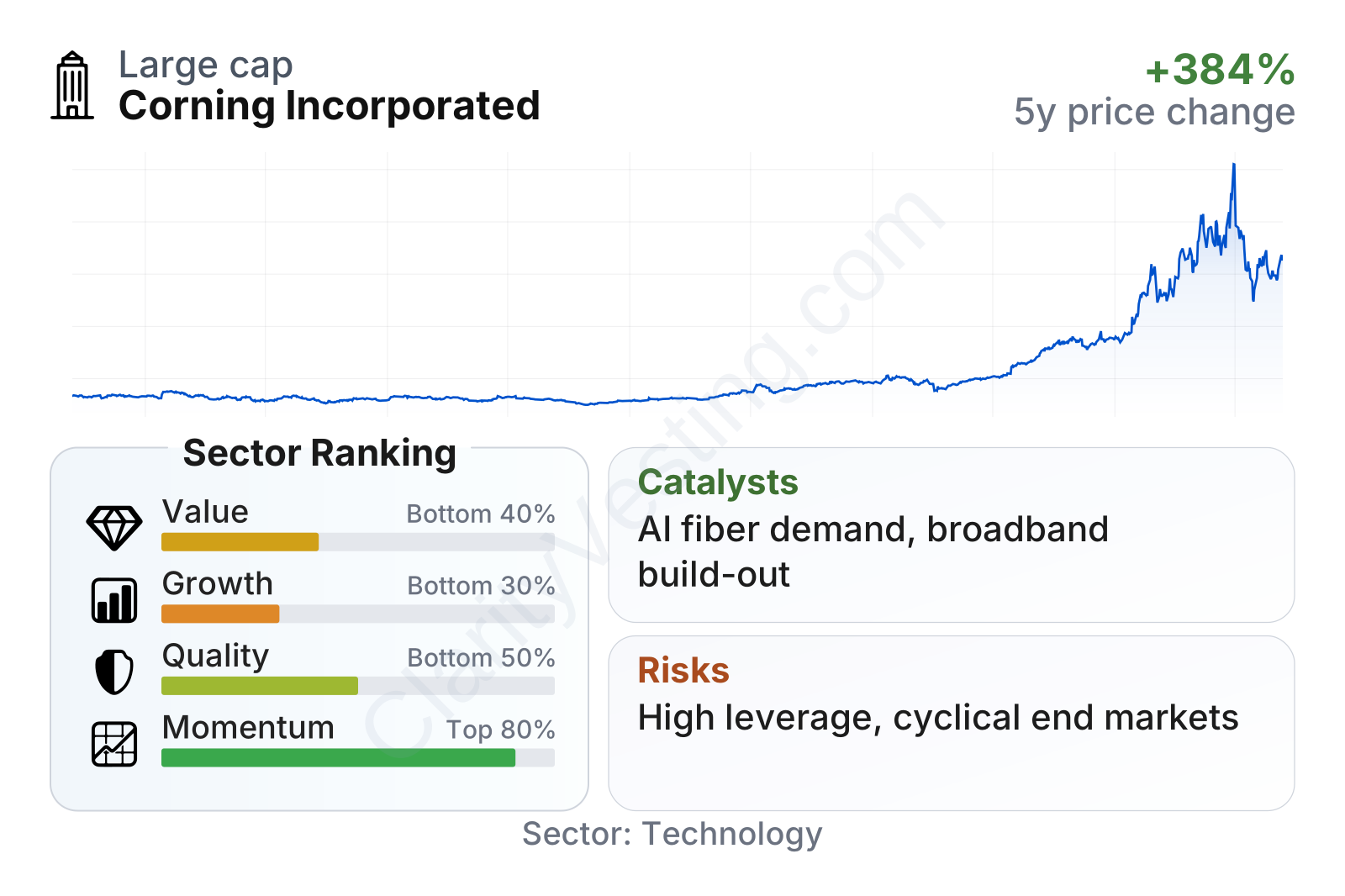
Corning is a very large company with moderate share-price volatility for the sector. The broad picture from the latest metrics is mixed: profitability is better than the sector median, returns on invested capital are solid, and recent stock momentum has been exceptionally strong. On the other hand, valuation looks demanding, leverage is notably above the sector median, and longer-term growth measures remain weaker than the recent rebound might suggest.
The stock-price chart reflects a major rerating since late 2024. That move appears to be tied less to a stable multi-year compounding pattern and more to a sharp improvement in business conditions and market expectations. This distinction matters because a fast repricing can make future upside more dependent on execution.
Growth
Corning operates in several markets that still have structural growth drivers, especially optical connectivity and advanced materials. The strongest long-term tailwind is the need for more bandwidth. Fiber deployment, data center upgrades, cloud infrastructure, and AI-related network expansion all require higher-performance optical components. Corning is well positioned here because it already has scale in fiber, cable, and connectivity solutions.
The company’s strategy also makes sense in practical terms. Rather than relying on one breakthrough product, Corning combines manufacturing know-how, materials science, and customer relationships across multiple industries. That approach can support future growth because the same technical capabilities can be applied to adjacent markets, especially where durability, precision, light transmission, heat resistance, or miniaturization matter.
Recent revenue growth has clearly improved. After several quarters of contraction in 2023, growth turned positive in 2024 and accelerated into the high-teens to roughly 20% range through much of 2025 and into 2026. That is stronger than the sector median recently, but the five-year picture is less impressive, which suggests Corning is still in a recovery and expansion phase rather than showing uninterrupted long-term growth.
Cash generation has also recovered. Free cash flow dropped sharply during the downturn, then rebuilt steadily and now stands around the low-to-mid $2 billion range on a trailing basis. For a capital-intensive manufacturer, that improvement is important because it supports debt management, dividends, and reinvestment without needing a perfect demand environment.
A meaningful catalyst is the continued build-out of communications infrastructure in North America and other markets, especially where broadband expansion and data center connectivity remain priorities. Corning has also been emphasizing a larger opportunity tied to generative AI-related network demand, where denser fiber and interconnect requirements could support sales in Optical Communications. In addition, consumer electronics demand and premium glass adoption can help Specialty Materials when device cycles improve.
Recent company updates have pointed to stronger demand in optical connectivity and an improving earnings profile. That does not remove cyclicality, but it does indicate that Corning is participating in markets with real spending momentum rather than relying only on cost cutting.
Risks
This article is for informational purposes only and does not constitute financial advice. Some content is AI-generated. See Disclaimer


