Stock Analysis · Globant SA (GLOB)
Overview
Globant S.A. is a digital services company that helps large organizations design, build, and improve software, digital products, cloud systems, data platforms, and artificial intelligence tools. In simple terms, it is a technology partner for businesses that want to modernize how they operate and how they interact with customers. The company was founded in Argentina, operates globally, and serves clients across industries such as media, finance, healthcare, retail, and travel.
Its business model is mainly based on selling professional services. Clients pay Globant for teams of engineers, designers, consultants, and AI specialists that work on digital transformation projects, ongoing software development, and operational support. The company also organizes its expertise through industry-focused and capability-focused offerings, often branded as “Studios,” to package skills in areas like AI, cloud, data, user experience, and enterprise platforms.
Public filings show that revenue is disclosed primarily by geography rather than by detailed product line, which is common for IT services firms. Based on recent annual reporting, the main revenue sources are approximately:
- North America: about 55% to 60% — largely work for U.S.-based clients across digital engineering, application development, cloud, AI, and consulting.
- Latin America: about 20% to 25% — regional enterprise technology projects and digital modernization services.
- Europe: about 15% to 20% — consulting and software delivery for companies expanding digital capabilities.
- Other regions: low single-digit percentage — smaller contributions from the rest of the world.
By nature of service mix rather than formal segment reporting, most of Globant’s revenue still appears to come from core digital transformation and software engineering work, with growing emphasis on AI-related services, cloud migration, platform implementation, and business process reinvention.
Over the last several years, the company expanded revenue from roughly $1.3 billion in 2021 to about $2.45 billion in 2025. That shows the business has become much larger, but the more recent picture is less smooth: revenue growth slowed sharply by 2025, and profitability came under pressure even as sales kept edging higher.
The business has scaled meaningfully since 2021, but the recent pattern is more mixed than the top-line increase alone suggests. Revenue rose strongly through 2024, while operating income and net income weakened in 2025, indicating that costs and pricing pressure became more important.
Key Figures
| Metric | Value | Sector ⓘ |
|---|---|---|
| Date | Sep 12, 2026 | |
| Context | ||
| Sector | Technology | |
| Industry | Information Technology Services | |
| Market Cap ⓘ | $1.58B | |
| Beta ⓘ | 0.98 | |
Value (Cheapness) | ||
| P/E Ratio ⓘ | 14.34 | 29.51 |
| FCF Yield ⓘ | 20.10% | 4.25% |
| EBIT / EV ⓘ | 9.87% | 2.85% |
| PEG ⓘ | 0.90 | |
Growth (Business expansion) | ||
| Revenue Growth ⓘ | N/A | 15.40% |
| RPS Growth (5Y CAGR) ⓘ | 15.33% | 8.56% |
| EPS Growth (5Y CAGR) ⓘ | -18.73% | -11.88% |
| Margin Growth (5Y Trend) ⓘ | -4.77% | 0.46% |
| FCF Growth (5Y CAGR) ⓘ | 26.71% | 9.80% |
Quality (Business durability) | ||
| ROIC (Latest) ⓘ | 5.39% | 9.44% |
| ROIC (5Y Median) ⓘ | 9.85% | 8.30% |
| Net Debt / EBIT (Latest) ⓘ | 1.48 | 0.54 |
| Net Debt / EBIT (5Y Median) ⓘ | -0.13 | 0.44 |
| Operating Margin (Latest) ⓘ | 7.39% | 9.58% |
| Operating Margin (5Y Median) ⓘ | 10.43% | 8.25% |
| Debt to Equity (Latest) ⓘ | 24.50% | 33.33% |
| Profit Margin (Latest) ⓘ | 4.63% | 7.14% |
| Free Cash Flow (Latest) ⓘ | $318.49M | |
Momentum (Price trend) | ||
| 3Y Return ⓘ | -80.73% | +45.48% |
| 12M Return (excl. last month) ⓘ | -48.95% | +23.48% |
| 6M Return ⓘ | -16.54% | +20.93% |
| Price vs. 200-Day MA ⓘ | -19.91% | +7.43% |
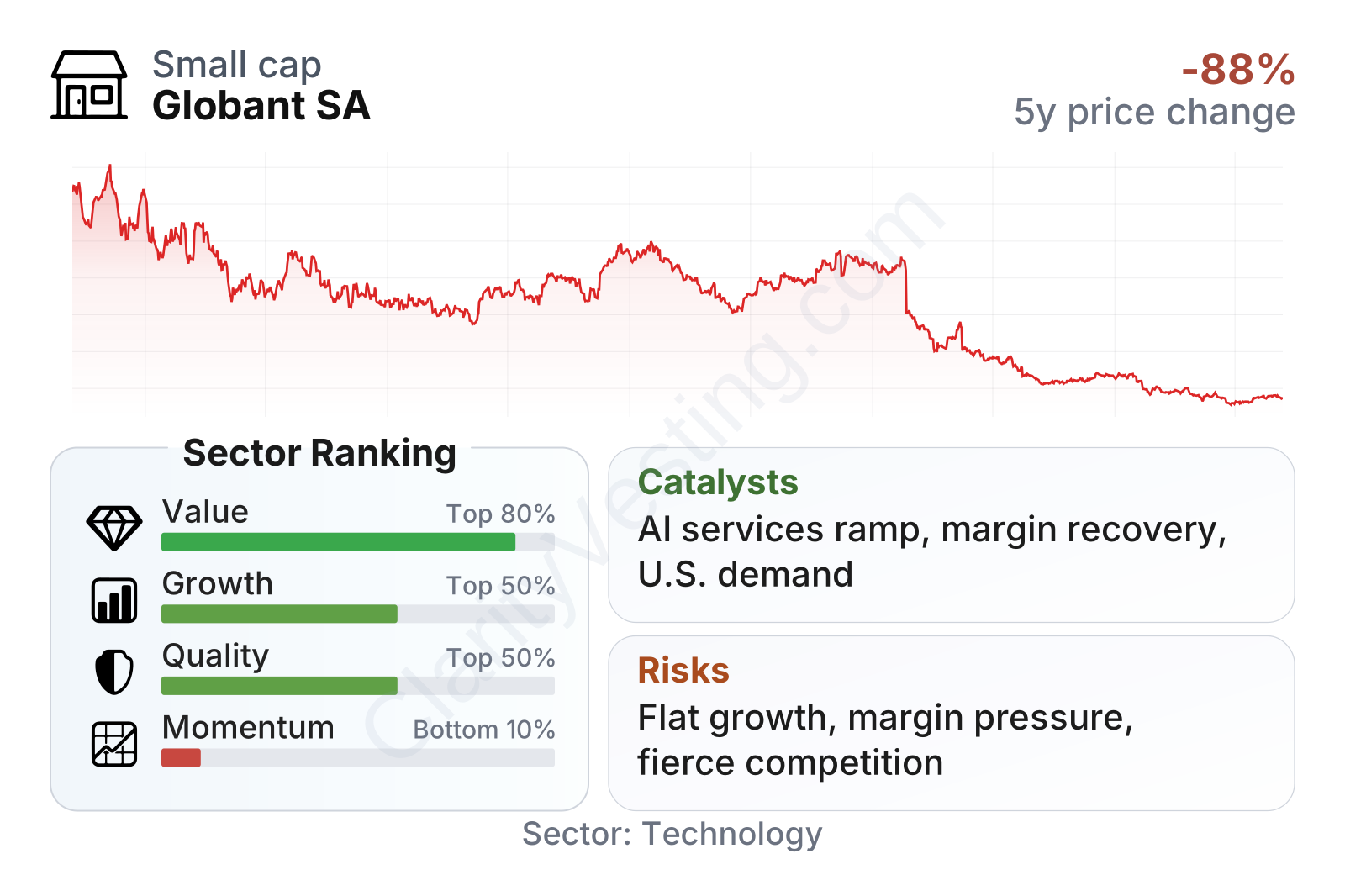
Globant currently screens as relatively strong on valuation compared with much of the technology services sector, mainly because the share price has fallen much faster than the business has deteriorated. Growth and quality look closer to the middle of the pack: long-term revenue and cash flow expansion remain solid, but recent margins, earnings, and market performance have weakened sharply. Momentum is the clearest weak point, reflecting a severe multi-year stock decline.
The stock chart shows how dramatically market expectations have reset. After trading above $300 in late 2021, the shares fell to below $40 by mid-2026. That kind of move usually signals more than a broad market swing; it reflects concerns about slower client spending, pressure on margins, and lower confidence in future growth.
At the same time, the company still generates meaningful cash. Free cash flow over the last twelve months is around $300 million, which is notable for a company of this size and helps explain why some valuation measures now look much lower than they did during the high-growth years.
Growth
Globant operates in a sector with attractive long-term demand drivers. Large companies continue shifting budgets toward cloud computing, software modernization, cybersecurity, data analytics, automation, and artificial intelligence. Those trends are structural rather than temporary. Even when corporate budgets tighten, many organizations still need to update legacy systems and improve digital efficiency.
Globant’s strategy broadly fits that environment. It combines software engineering talent with consulting, design, and increasingly AI-focused offerings. That makes sense because clients often want fewer vendors and broader solutions: not just code, but also product design, workflow redesign, and integration into existing systems. The company’s branded expert groups and industry specialization also help it position itself as more than a generic outsourcing provider.
The problem is timing. Growth was extremely strong in 2021 and 2022, remained healthy in 2023 and much of 2024, and then slowed to roughly flat by 2026. That does not invalidate the long-term industry opportunity, but it does show that Globant is exposed to swings in enterprise technology spending. For a services company, demand can cool quickly when clients delay projects.
Cash generation has held up better than earnings. Free cash flow has climbed materially over the last five years and is now around the low-$300 million range on a trailing basis. That matters because it suggests the business still converts a meaningful portion of revenue into cash even during a slower period. In a long-term analysis, this is one of the more encouraging signs.
A key catalyst is the expansion of AI work. Across the industry, customers are moving from experimentation toward implementation in areas such as coding assistance, workflow automation, customer service, and data tools. Globant has been pushing its AI capabilities and partnerships as a way to capture that spending. If companies accelerate real AI deployment rather than pilot projects, that could support both new revenue and deeper client relationships.
Another potential growth driver is market share gains from traditional consulting firms and legacy IT vendors. Globant has historically positioned itself as more digitally native and more agile than older large-scale providers. In a market where clients want modernization without the cost structure of the biggest consulting houses, that positioning can still be relevant.
Risks
This article is for informational purposes only and does not constitute financial advice. Some content is AI-generated. See Disclaimer