Stock Analysis · Global-E Online Ltd (GLBE)
Overview
Global-E Online Ltd operates a cross-border e-commerce platform. In simple terms, it helps brands and retailers sell to shoppers in other countries without having to build all the local pieces themselves. Its service can handle localized pricing, currency conversion, language, duties and taxes calculation, local payment methods, fraud management, compliance, shipping coordination, and returns. That makes it easier for a merchant in one country to offer a smoother checkout and delivery experience to customers in many other markets.
The company mainly earns revenue from the transaction flow running through its platform and from related services tied to those sales. Based on company disclosures, its revenue mix can be described approximately as follows:
- Service fees from merchants and transactions: the largest source, estimated at roughly 70% to 80% of revenue. This includes fees for enabling and managing cross-border online sales through Global-e’s platform.
- Fulfillment, shipping, and other transaction-related services: estimated at roughly 20% to 30% of revenue. This incorporates logistics coordination, delivery-related services, and other operational elements attached to orders.
- Other revenue streams: a small remainder, likely below 10%, including ancillary services and partner-related arrangements where applicable.
Another useful way to understand the business is that it sits between large brands and international consumers, acting as an infrastructure layer. That position can be attractive because once a merchant integrates the platform, switching away may create operational friction across payments, compliance, logistics, and customer experience.
The business model has also been improving. Over the last several years, revenue has risen sharply, gross profit has expanded, and the company moved from sizable operating losses to positive operating income by 2025. Research and development spending remains meaningful, which suggests management is still investing heavily in technology while becoming more efficient overall.
The financial flow shows a business that has scaled materially: revenue grew from roughly $245 million in 2021 to about $962 million in 2025, while operating results turned positive after several loss-making years. Costs are still substantial, but expense growth has become more controlled relative to revenue.
Key Figures
| Metric | Value | Sector ⓘ |
|---|---|---|
| Date | Sep 12, 2026 | |
| Context | ||
| Sector | Consumer Cyclical | |
| Industry | Internet Retail | |
| Market Cap ⓘ | $6.13B | |
| Beta ⓘ | 1.00 | |
Value (Cheapness) | ||
| P/E Ratio ⓘ | 41.01 | 17.10 |
| FCF Yield ⓘ | 4.73% | 8.53% |
| EBIT / EV ⓘ | 1.96% | 6.46% |
| PEG ⓘ | N/A | |
Growth (Business expansion) | ||
| Revenue Growth ⓘ | 39.10% | 5.75% |
| RPS Growth (5Y CAGR) ⓘ | 22.72% | 9.14% |
| EPS Growth (5Y CAGR) ⓘ | 32.86% | -18.21% |
| Margin Growth (5Y Trend) ⓘ | N/A | -0.23% |
| FCF Growth (5Y CAGR) ⓘ | 107.07% | 4.91% |
Quality (Business durability) | ||
| ROIC (Latest) ⓘ | 13.21% | 12.61% |
| ROIC (5Y Median) ⓘ | -11.23% | 10.72% |
| Net Debt / EBIT (Latest) ⓘ | -1.21 | 2.10 |
| Net Debt / EBIT (5Y Median) ⓘ | N/A | 2.32 |
| Operating Margin (Latest) ⓘ | 12.18% | 9.25% |
| Operating Margin (5Y Median) ⓘ | -23.12% | 9.64% |
| Debt to Equity (Latest) ⓘ | 2.81% | 75.78% |
| Profit Margin (Latest) ⓘ | 13.87% | 5.33% |
| Free Cash Flow (Latest) ⓘ | $290.03M | |
Momentum (Price trend) | ||
| 3Y Return ⓘ | -7.54% | +14.53% |
| 12M Return (excl. last month) ⓘ | +19.37% | +3.08% |
| 6M Return ⓘ | +7.67% | +0.55% |
| Price vs. 200-Day MA ⓘ | +4.42% | -0.54% |
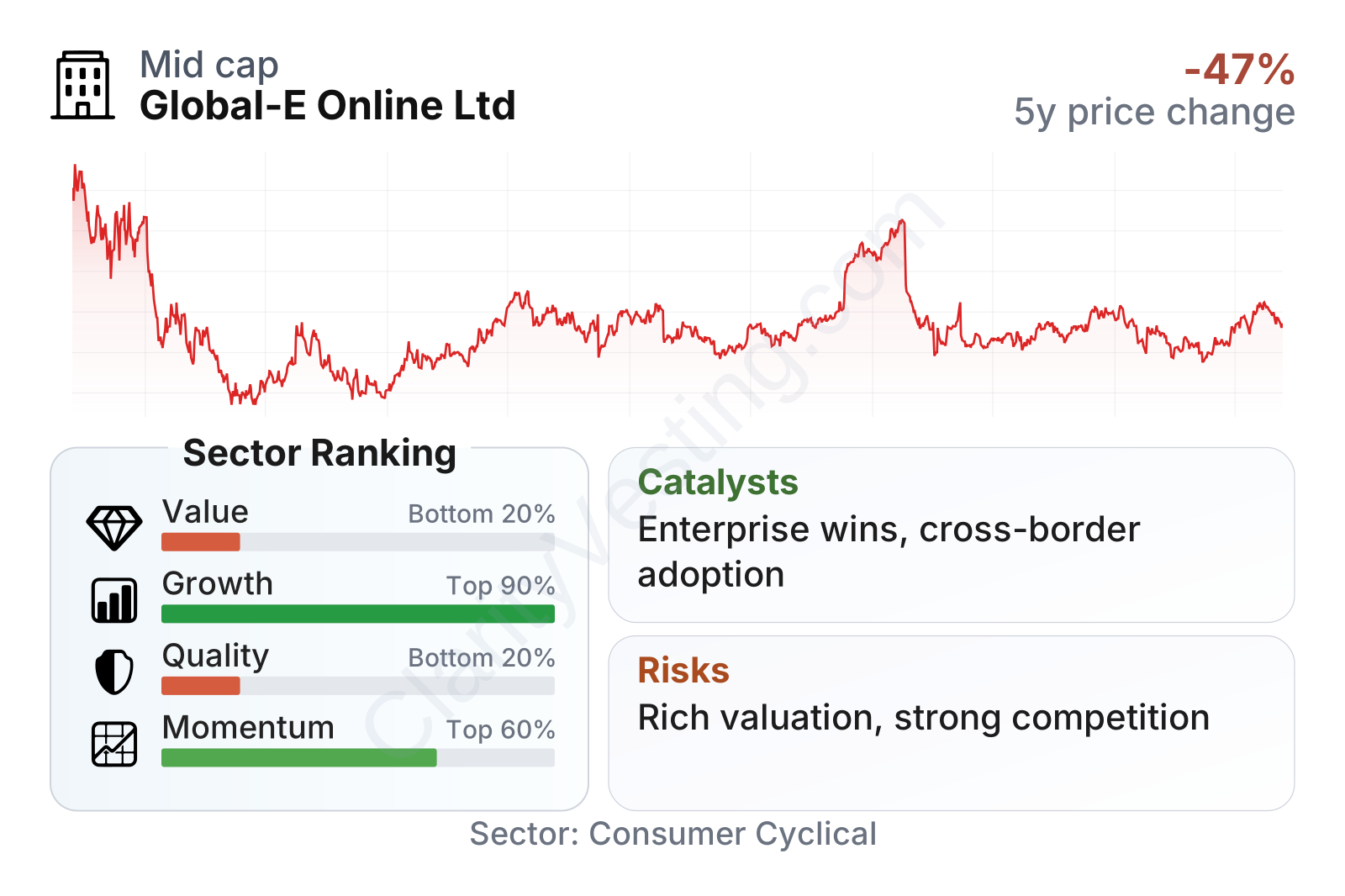
Global-e is now a mid-sized public company with a market value around the multi-billion-dollar range and a stock volatility close to the broader market. The latest factor profile is mixed but easy to read: growth stands out as one of the strongest parts of the case, momentum has been favorable in more recent periods, while value ranks weakly because the stock trades at a much richer earnings multiple than the sector median. Quality looks uneven on a long-term lens because the company spent years in investment mode, but its current profitability, cash generation, and very low leverage are notably stronger than that long history suggests.
Growth
Global-e operates in a sector with a long runway. Cross-border e-commerce remains a structural growth market because more brands want direct access to international customers, and consumers are increasingly comfortable buying from overseas merchants if checkout, pricing, duties, and shipping are transparent. That trend plays directly into Global-e’s platform.
The company’s strategy also makes sense for future expansion. Rather than trying to become a retailer itself, it provides the infrastructure that merchants need to internationalize. This can scale well because each additional merchant, market, and transaction can deepen the network around payments, localization, logistics, and data. Partnerships are particularly important here, because integration with major commerce platforms and large enterprise brands can lower customer acquisition friction and widen reach.
Revenue growth has remained unusually strong for a company of this size. Growth rates were extremely high in earlier years, naturally cooled as the business became larger, and then stayed well above the broader sector. Most recently, year-over-year revenue growth was close to 40%, versus about 6% for the sector median, which shows that the company is still taking share rather than simply following industry demand.
Cash generation has improved even faster than revenue. Free cash flow rose from a modest level a few years ago to roughly $280 million on a trailing basis by early 2026, and the latest table shows trailing free cash flow around $290 million. That matters because it suggests growth is no longer dependent on constant external financing. The company appears to be reaching a more mature phase where scale is translating into real financial flexibility.
A major catalyst is the continued expansion of direct-to-consumer international selling by global brands. Another is the possibility of larger enterprise wins and deeper partner integration, which can add volume efficiently. Recent company communications have also emphasized profitability improvement alongside strong top-line growth, a combination that tends to matter more once a fast-growing platform moves beyond its early buildout phase.
Risks
This article is for informational purposes only and does not constitute financial advice. Some content is AI-generated. See Disclaimer


