Stock Analysis · Gildan Activewear Inc (GIL)
Overview
Gildan Activewear is a large apparel manufacturer focused on basic everyday clothing rather than fashion-driven collections. The company is best known for blank T-shirts, fleece, underwear, socks, and hosiery that are sold to wholesalers, retailers, printers, and brands. Its products are used in several channels: activewear for screen printing and promotional merchandise, basic apparel sold through retailers, and private-label programs for large customers. This makes Gildan less dependent on fashion trends than many apparel companies, but more exposed to volume demand, retailer inventory cycles, and cotton and manufacturing costs.
Its business is organized mainly around two product categories. Based on recent annual reporting, revenue is approximately distributed as follows:
- Activewear: about 88% to 90% of revenue. This includes blank T-shirts, fleece, sport shirts, and related basics sold under brands such as Gildan, American Apparel, Comfort Colors, GoldToe, and through private-label programs. This is the company’s core profit engine and the part most tied to printwear, promotional products, and everyday basics.
- Hosiery and underwear: about 10% to 12% of revenue. This includes socks, underwear, and related essentials sold through retail and mass-market channels, including private-label business.
Geographically, the company earns most of its sales in North America, while manufacturing is concentrated in low-cost regions such as Central America, the Caribbean Basin, and Bangladesh. That integrated model matters: Gildan controls much of the production process, which helps on cost, scale, and product consistency. Over the last several years, revenue has moved from roughly $2.9 billion in 2021 to about $3.7 billion in 2025, while gross profit has also expanded, although net income has not kept pace because interest, taxes, and operating expenses have taken a larger share of the total.
The operating picture shows a business that has grown sales and gross profit over time, but the earnings conversion has become less efficient than it was a few years ago. In simple terms, more dollars are coming in, yet a smaller portion is reaching the bottom line than during the company’s strongest post-pandemic years.
Key Figures
| Metric | Value | Sector ⓘ |
|---|---|---|
| Date | Sep 12, 2026 | |
| Context | ||
| Sector | Consumer Cyclical | |
| Industry | Apparel Manufacturing | |
| Market Cap ⓘ | $8.97B | |
| Beta ⓘ | 1.08 | |
Value (Cheapness) | ||
| P/E Ratio ⓘ | 37.56 | 17.10 |
| FCF Yield ⓘ | 5.46% | 8.53% |
| EBIT / EV ⓘ | 3.82% | 6.46% |
| PEG ⓘ | 0.38 | |
Growth (Business expansion) | ||
| Revenue Growth ⓘ | 72.30% | 5.75% |
| RPS Growth (5Y CAGR) ⓘ | 12.91% | 9.14% |
| EPS Growth (5Y CAGR) ⓘ | -15.72% | -18.21% |
| Margin Growth (5Y Trend) ⓘ | -5.62% | -0.23% |
| FCF Growth (5Y CAGR) ⓘ | -0.52% | 4.91% |
Quality (Business durability) | ||
| ROIC (Latest) ⓘ | 6.55% | 12.61% |
| ROIC (5Y Median) ⓘ | 20.42% | 10.72% |
| Net Debt / EBIT (Latest) ⓘ | 8.78 | 2.10 |
| Net Debt / EBIT (5Y Median) ⓘ | 1.62 | 2.32 |
| Operating Margin (Latest) ⓘ | 11.07% | 9.25% |
| Operating Margin (5Y Median) ⓘ | 18.37% | 9.64% |
| Debt to Equity (Latest) ⓘ | 145.29% | 75.78% |
| Profit Margin (Latest) ⓘ | 1.28% | 5.33% |
| Free Cash Flow (Latest) ⓘ | $490.32M | |
Momentum (Price trend) | ||
| 3Y Return ⓘ | +78.64% | +14.53% |
| 12M Return (excl. last month) ⓘ | +18.57% | +3.08% |
| 6M Return ⓘ | -17.22% | +0.55% |
| Price vs. 200-Day MA ⓘ | -17.15% | -0.54% |
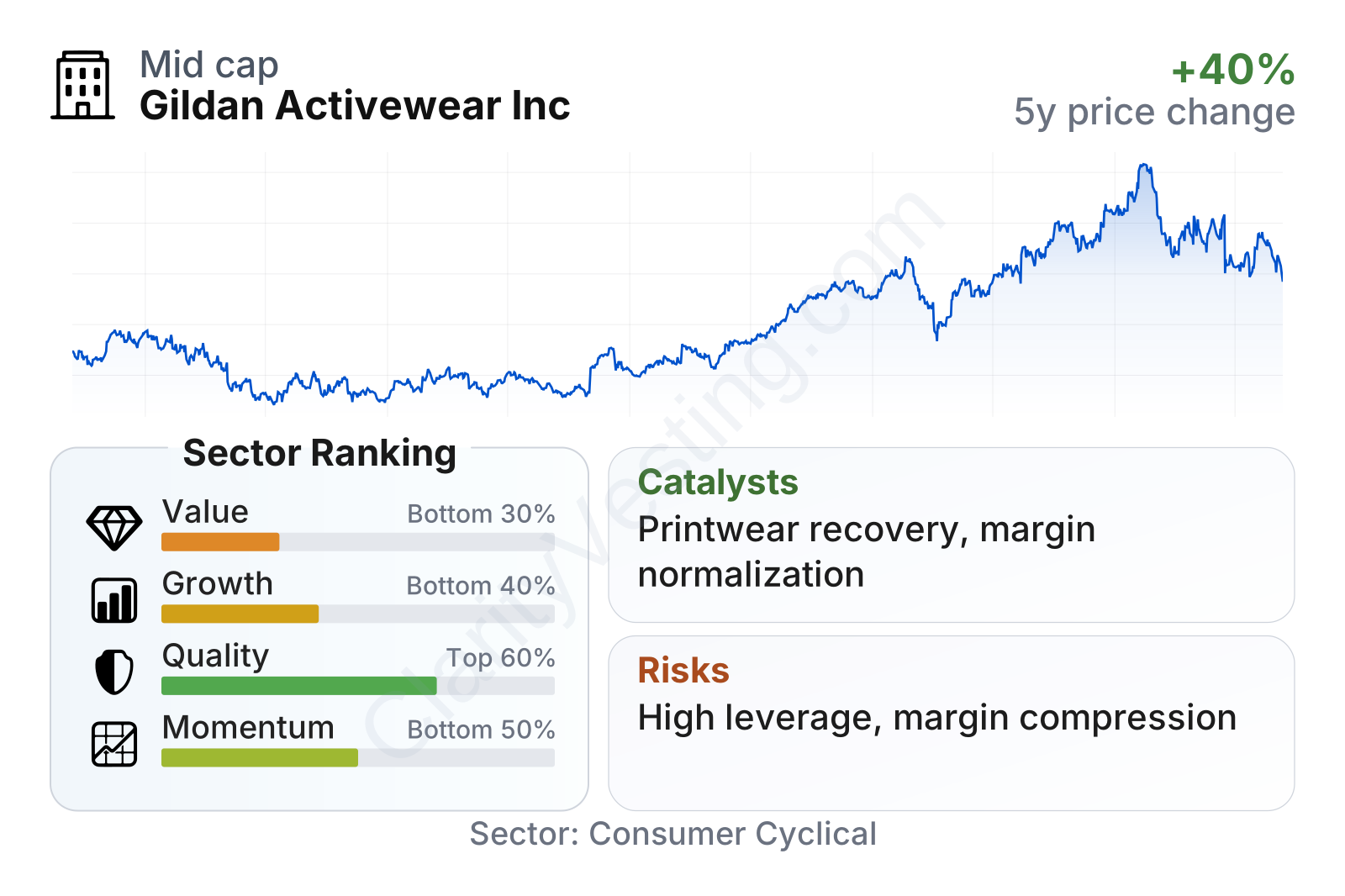
Gildan sits in the large-cap range within apparel manufacturing and has shown strong long-term share price performance, but the current profile is mixed. Growth indicators are uneven, quality remains respectable thanks to historically solid margins and returns, and the balance sheet has become more stretched. On valuation, the stock stands in the weaker part of the sector ranking because earnings multiples are well above the sector median while cash flow yield is lower. That combination suggests the market is paying up for resilience and future execution rather than for deeply discounted current fundamentals.
The stock’s path over the past five years also helps frame expectations. Shares were relatively subdued through 2022 and 2023, then rerated sharply from late 2024 into early 2026 before pulling back. That pattern often reflects a company moving from recovery to optimism, followed by a period where the market asks for stronger proof in margins, debt control, and earnings quality.
Growth
Gildan operates in a mature but durable segment of the apparel industry: basic clothing essentials. This is not a fast-changing niche, but it benefits from steady replacement demand. T-shirts, socks, fleece, and underwear are recurring purchases, and blank garments used for decoration and promotional products create a business that is tied not only to consumers but also to schools, organizations, events, and businesses. That gives the company a wider demand base than many fashion-led brands.
The company’s strategy for growth is sensible because it builds on areas where it already has scale: low-cost manufacturing, high-volume basics, and broad distribution. Recent years also included portfolio moves designed to strengthen the brand mix and enlarge the product offering. In particular, the integration of new brands and categories can improve shelf space, customer reach, and pricing flexibility if managed well. This matters because Gildan’s future growth is likely to come more from market share gains, product mix improvement, and operational efficiency than from explosive industry expansion.
Revenue growth has been volatile, which is common in apparel manufacturing because customer orders can swing with inventory cycles. The recent trend, however, points to a meaningful acceleration after a softer period in 2023 and early 2024. That rebound suggests demand has improved and that recent portfolio and channel actions are starting to show up in reported sales.
Free cash flow remains one of the most important parts of the case. It has been positive over time, but not smooth. After a sharp drop in 2023, it recovered strongly, then moderated again before improving. For a company in basics apparel, this matters because steady cash generation supports capital spending, debt management, dividends, and share repurchases. A business like Gildan does not need to grow like a technology company to be attractive over the long run, but it does need to convert sales into durable cash with consistency.
A practical catalyst is the company’s vertically integrated manufacturing network. If management can keep utilization high, manage cotton and input costs well, and improve product mix, margins could recover from recent pressure. Another positive factor is that essentials apparel tends to be more resilient than discretionary fashion categories during weaker consumer periods. Recent company updates have also emphasized capacity optimization, brand development, and efficiency initiatives, all of which support the view that growth is being pursued through disciplined operations rather than through risky expansion.
Risks
This article is for informational purposes only and does not constitute financial advice. Some content is AI-generated. See Disclaimer


