Stock Analysis · Gen Digital Inc (GEN)
Overview
Gen Digital Inc is a consumer cybersecurity company best known for brands such as Norton, Avast, LifeLock, Avira, AVG, CCleaner, and ReputationDefender. Its products are designed to help individuals and families protect their devices, identities, privacy, and online activity. In simple terms, the company sells digital safety tools rather than hardware: antivirus, identity protection, VPN, privacy tools, device security, and related subscription services.
The business model is largely subscription-based, which gives Gen Digital a recurring revenue base. The company reports its operations as one main consumer security platform rather than many separate public segments, so the exact revenue split is not disclosed in a very detailed way in standard filings. Based on company disclosures, the main sources of revenue can be described as follows:
- Consumer cybersecurity subscriptions: the clear majority of revenue. This includes antivirus, malware protection, device security, VPN, privacy, and performance tools sold under Norton, Avast, AVG, Avira, and CCleaner.
- Identity and personal information protection: a meaningful secondary source. This includes LifeLock and related services that monitor identity risks, alerts, restoration support, and broader cyber safety bundles.
- Other smaller revenue streams: a limited contribution from partner-related arrangements, legacy offerings, and ancillary services tied to the consumer platform.
What stands out is the economics of the model. Revenue has expanded from about $2.8 billion in fiscal 2022 to about $5.0 billion in fiscal 2026, while gross profit remained very high in each period. That suggests a software business with strong pricing power and a customer base that continues to renew, even though growth can vary from quarter to quarter.
At the same time, the company is not a pure high-growth startup. It is a mature platform built through well-known brands, bundling, and acquisitions. That makes it easier to understand: Gen Digital is essentially a scaled digital protection provider for consumers, monetized through recurring subscriptions.
The business flow highlights a high-margin software model: revenue and gross profit have both grown materially over the past few years, while operating costs rose much more slowly than sales. One item to watch is interest expense, which remains substantial and reflects the company’s leveraged balance sheet.
Key Figures
| Metric | Value | Sector ⓘ |
|---|---|---|
| Date | Sep 12, 2026 | |
| Context | ||
| Sector | Technology | |
| Industry | Software - Infrastructure | |
| Market Cap ⓘ | $18.11B | |
| Beta ⓘ | 1.22 | |
Value (Cheapness) | ||
| P/E Ratio ⓘ | 17.70 | 29.51 |
| FCF Yield ⓘ | 8.55% | 4.25% |
| EBIT / EV ⓘ | 7.08% | 2.85% |
| PEG ⓘ | 1.51 | |
Growth (Business expansion) | ||
| Revenue Growth ⓘ | 6.30% | 15.40% |
| RPS Growth (5Y CAGR) ⓘ | 14.31% | 8.56% |
| EPS Growth (5Y CAGR) ⓘ | -27.38% | -11.88% |
| Margin Growth (5Y Trend) ⓘ | -22.93% | 0.46% |
| FCF Growth (5Y CAGR) ⓘ | 12.00% | 9.80% |
Quality (Business durability) | ||
| ROIC (Latest) ⓘ | 11.62% | 9.44% |
| ROIC (5Y Median) ⓘ | 12.08% | 8.30% |
| Net Debt / EBIT (Latest) ⓘ | 4.20 | 0.54 |
| Net Debt / EBIT (5Y Median) ⓘ | 7.00 | 0.44 |
| Operating Margin (Latest) ⓘ | 35.66% | 9.58% |
| Operating Margin (5Y Median) ⓘ | 35.69% | 8.25% |
| Debt to Equity (Latest) ⓘ | 307.83% | 33.33% |
| Profit Margin (Latest) ⓘ | 20.73% | 7.14% |
| Free Cash Flow (Latest) ⓘ | $1.55B | |
Momentum (Price trend) | ||
| 3Y Return ⓘ | +64.65% | +45.48% |
| 12M Return (excl. last month) ⓘ | -8.32% | +23.48% |
| 6M Return ⓘ | +45.51% | +20.93% |
| Price vs. 200-Day MA ⓘ | +23.65% | +7.43% |
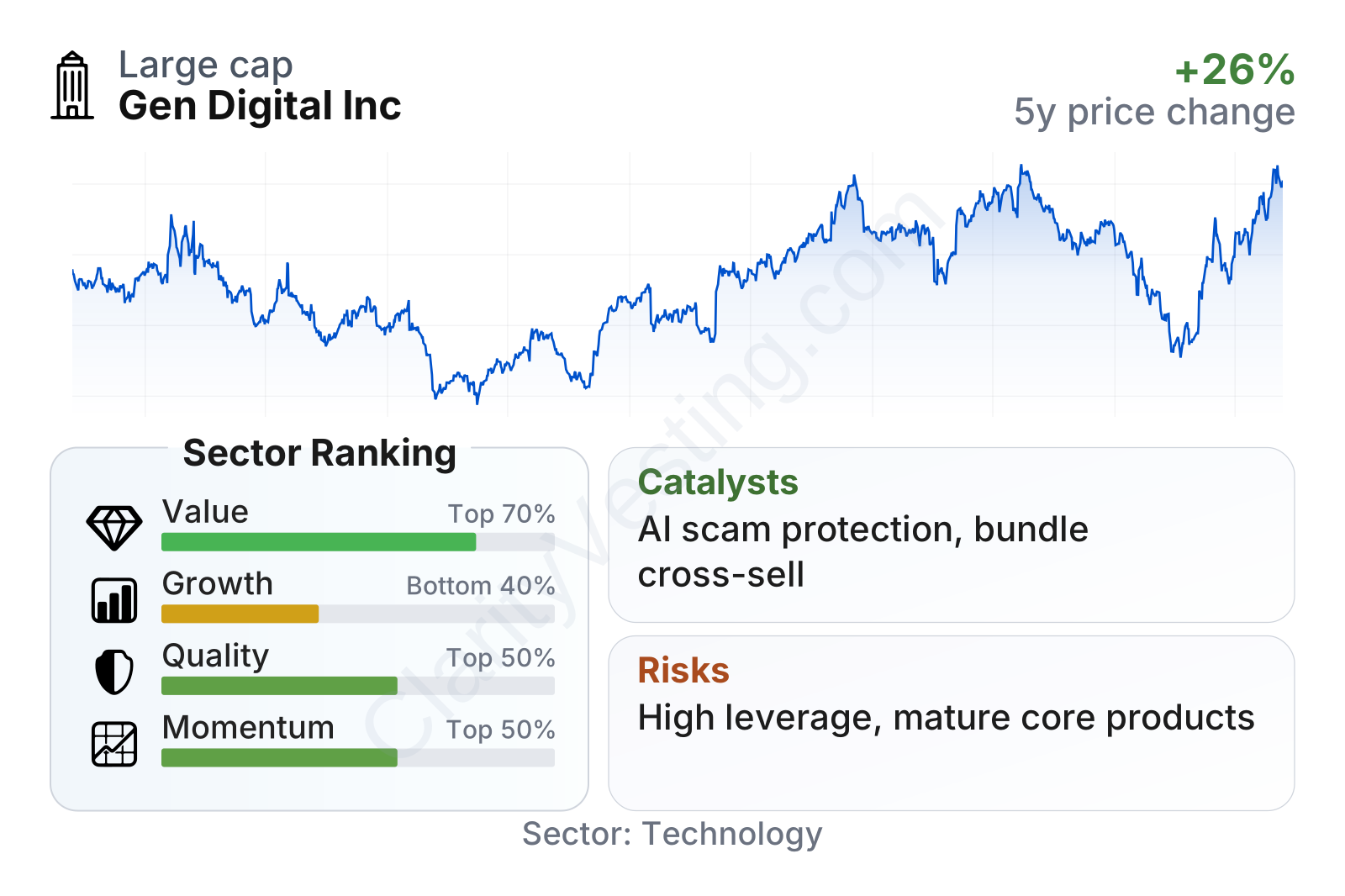
Gen Digital sits in the large-cap range and shows a mixed profile. On valuation and cash generation, it compares favorably with much of the software sector, helped by a free cash flow yield and earnings multiple that are both stronger than sector medians. Profitability is also a real strength, with margins and returns on invested capital above many peers. The weaker area is growth: recent revenue expansion has been positive but slower than the sector median, and earnings growth over a multi-year period has been less consistent. Balance sheet leverage remains the main financial constraint despite recent improvement.
Growth
Cybersecurity remains a structurally growing market because the number of connected devices, online identities, digital payments, and consumer data risks continues to rise. Importantly, Gen Digital operates in the consumer side of this market, which is different from the enterprise cybersecurity space dominated by corporate network vendors. Consumer demand can be steadier and easier to monetize through subscriptions, especially when products are bundled into broader protection packages.
Gen Digital’s strategy appears logical for long-term expansion. The company has assembled a portfolio of widely recognized brands and can cross-sell services such as device security, identity monitoring, VPN, and privacy tools to the same household. That matters because a mature antivirus product alone may not deliver fast growth, but a broader digital safety membership can increase revenue per user and improve retention.
The recent pattern shows that growth has not been linear. There were periods of very strong expansion, partly influenced by acquisitions and portfolio integration, followed by slower normalization. Most recently, year-over-year revenue growth has moved back into the single-digit range, which is below many technology peers. For a long-term view, that means the company’s appeal depends less on rapid top-line expansion and more on durable subscriptions, cross-selling, and margin discipline.
Cash generation is one of the strongest parts of the case. Free cash flow has moved around from year to year, but it has remained substantial and recently recovered to roughly the mid-$1 billion range on a trailing basis. That gives the company flexibility to reduce debt, repurchase shares, invest in product development, and support ongoing platform integration.
A notable catalyst is the company’s increasing focus on AI-related threats and AI-enabled protection. As scams, impersonation, phishing, and synthetic identity attacks become more sophisticated, consumer awareness may rise. That could help companies like Gen Digital sell broader protection bundles rather than standalone antivirus software. Recent company communications have also emphasized product innovation, cyber safety bundles, and deeper use of its large installed base across brands.
Another supportive factor is scale. With millions of customers across several established brands, Gen Digital has a lower-cost route to upselling than a smaller rival that must spend heavily to acquire each new user. If management continues improving bundle penetration and retention, modest revenue growth can still translate into meaningful cash output.
Risks
This article is for informational purposes only and does not constitute financial advice. Some content is AI-generated. See Disclaimer


