Stock Analysis · Greif Bros Corporation (GEF)
Overview
Greif Bros Corporation is a global industrial packaging company. Its products are used to store, protect, and transport goods such as chemicals, food ingredients, lubricants, agricultural products, paints, pharmaceuticals, and other industrial materials. In simple terms, Greif makes the containers and packaging systems that many manufacturers need before they can ship their own products. The company also has a paper packaging and recycling business, which gives it exposure to both industrial packaging and containerboard-based products.
Greif organizes its business mainly around rigid industrial packaging, paper packaging, and land management. Based on recent company reporting, revenue is concentrated in a few core activities.
- Customized Polymer Solutions: about 35% to 40% of revenue. This includes plastic drums, intermediate bulk containers, jerrycans, and other customized polymer packaging used by industrial customers.
- Durable Metal Solutions: about 20% to 25% of revenue. This business includes steel drums and related rigid metal packaging products.
- Sustainable Fiber Solutions: about 20% to 25% of revenue. This includes containerboard, corrugated products, and other fiber-based packaging solutions.
- Containerboard and Paper Services: about 10% to 15% of revenue. This covers recycled paperboard activities, packaging services, and related paper operations.
- Integrated Solutions, Services, and Land Management: less than 10% combined. These activities include filling, logistics, reconditioning, and income from timberland and land management assets.
What stands out is the mix: Greif is not a pure commodity paper producer and not only a drum manufacturer. It has a broad portfolio across metal, plastic, fiber, and services, which helps diversify customer demand across multiple end markets and geographies.
The long-term pattern shows that revenue has come down from the post-pandemic peak, while margins have been more uneven. Gross profit has stayed meaningful even as sales declined, but operating income has been less stable, showing how sensitive results can be to volumes, costs, and business mix.
Key Figures
| Metric | Value | Sector ⓘ |
|---|---|---|
| Date | Sep 12, 2026 | |
| Context | ||
| Sector | Consumer Cyclical | |
| Industry | Packaging & Containers | |
| Market Cap ⓘ | $4.68B | |
| Beta ⓘ | 0.76 | |
Value (Cheapness) | ||
| P/E Ratio ⓘ | 34.59 | 17.10 |
| FCF Yield ⓘ | -4.87% | 8.53% |
| EBIT / EV ⓘ | 5.74% | 6.46% |
| PEG ⓘ | 0.77 | |
Growth (Business expansion) | ||
| Revenue Growth ⓘ | 3.50% | 5.75% |
| RPS Growth (5Y CAGR) ⓘ | -5.74% | 9.14% |
| EPS Growth (5Y CAGR) ⓘ | -14.79% | -18.21% |
| Margin Growth (5Y Trend) ⓘ | -6.04% | -0.23% |
| FCF Growth (5Y CAGR) ⓘ | N/A | 4.91% |
Quality (Business durability) | ||
| ROIC (Latest) ⓘ | 5.57% | 12.61% |
| ROIC (5Y Median) ⓘ | 11.74% | 10.72% |
| Net Debt / EBIT (Latest) ⓘ | 3.12 | 2.10 |
| Net Debt / EBIT (5Y Median) ⓘ | 4.19 | 2.32 |
| Operating Margin (Latest) ⓘ | 8.95% | 9.25% |
| Operating Margin (5Y Median) ⓘ | 9.24% | 9.64% |
| Debt to Equity (Latest) ⓘ | 41.13% | 75.78% |
| Profit Margin (Latest) ⓘ | 24.74% | 5.33% |
| Free Cash Flow (Latest) ⓘ | -$228.10M | |
Momentum (Price trend) | ||
| 3Y Return ⓘ | +33.14% | +14.53% |
| 12M Return (excl. last month) ⓘ | +34.33% | +3.08% |
| 6M Return ⓘ | +25.01% | +0.55% |
| Price vs. 200-Day MA ⓘ | +15.26% | -0.54% |
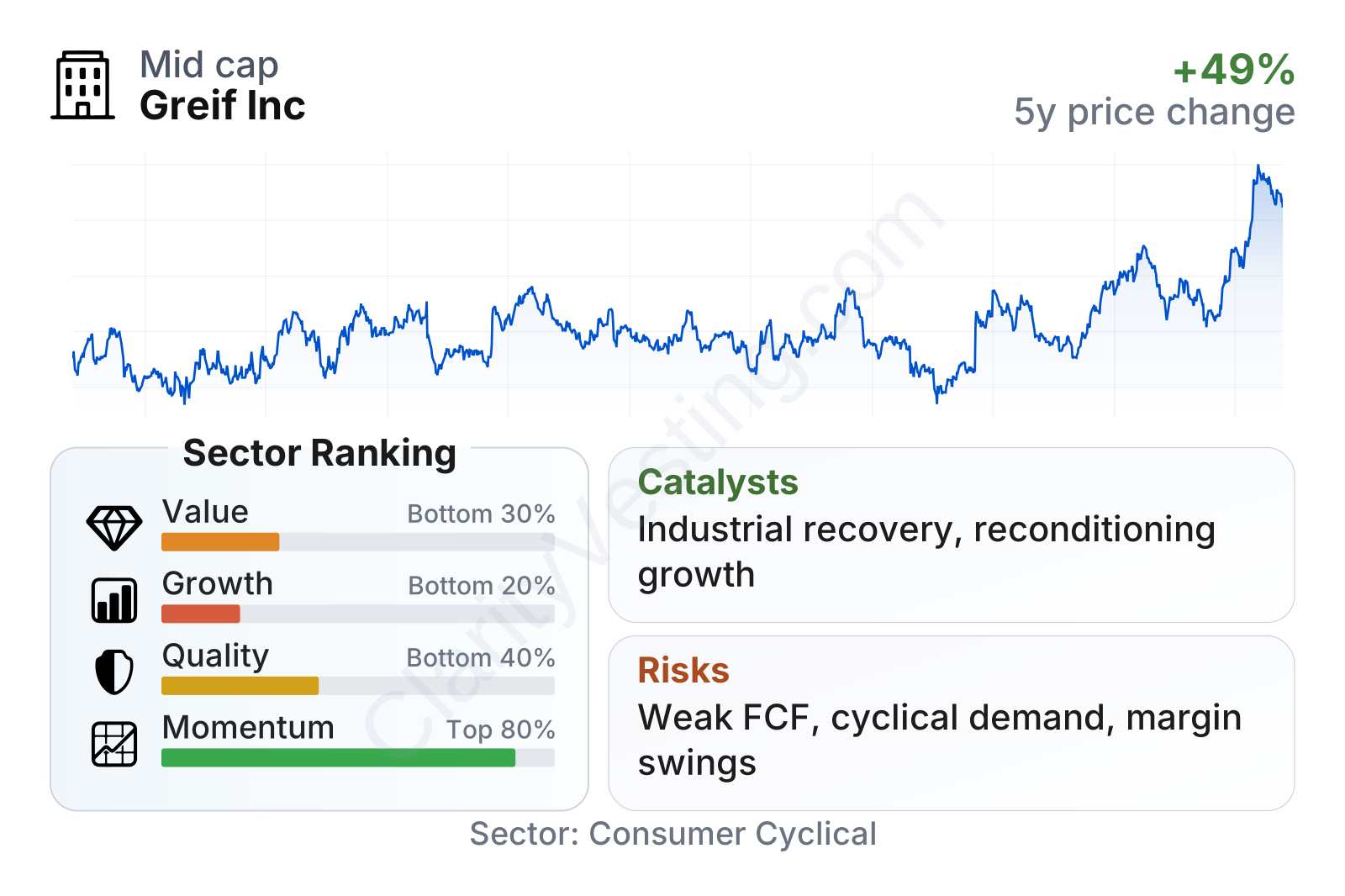
Greif is a mid-sized packaging company with a market value around $5 billion and a stock that has been less volatile than the broader market, as suggested by a beta below 1. In the factor breakdown, momentum looks strong relative to the sector, but value, growth, and quality are weaker. The biggest points to notice are a currently elevated earnings multiple, negative trailing free cash flow, modest recent revenue growth, and leverage that is still heavier than many peers when measured against operating earnings.
The stock price history shows a business that has not moved in a straight line. Shares have experienced meaningful swings over the last several years, reflecting cyclical demand, changes in earnings expectations, and the market’s reaction to one-time items in reported profit.
Growth
Packaging is generally a durable sector for long-term analysis because products still need to be moved safely through supply chains in almost every economic environment. Within that broad market, Greif is exposed to areas that have structural support: industrial shipping, reuse and reconditioning, recycled paper, and more sustainable packaging formats. These themes are not high-growth in the way software or semiconductors can be, but they are relevant and persistent.
Greif’s strategy also makes industrial sense. The company has been building a more integrated packaging platform by combining containers, recycling, reconditioning, and service offerings. That can deepen customer relationships because buyers often prefer a supplier that can handle several packaging needs at once. It also supports sustainability goals, especially in reconditioned containers and fiber-based products, where corporate customers increasingly want lower-waste solutions.
Recent growth has been uneven rather than consistently upward. After a strong rebound period earlier in the cycle, year-over-year revenue turned volatile and often negative, which is typical of a company tied to industrial activity and pricing conditions. The latest growth reading is still positive on a trailing basis in the metrics summary, but the broader trend shows that top-line expansion has not been steady enough to rank well against the sector.
Cash generation is another important part of the growth picture. Greif produced solid free cash flow in earlier years, but that has weakened sharply and recently turned negative. For a packaging business, this matters because future growth often depends on plant upgrades, efficiency projects, and disciplined capital allocation. If free cash flow remains under pressure, growth initiatives become more dependent on tighter cost control and operating recovery rather than financial flexibility alone.
A meaningful catalyst is Greif’s exposure to normalization in industrial demand. If volumes improve in chemicals, lubricants, agriculture, and other end markets, the company could benefit across several product lines at once. Another catalyst is continued portfolio improvement: packaging companies often create value by closing weaker assets, optimizing mill networks, improving procurement, and emphasizing higher-value specialty products over purely commodity output. Greif’s service and reconditioning capabilities also position it well if customers put more weight on circular packaging systems.
Risks
This article is for informational purposes only and does not constitute financial advice. Some content is AI-generated. See Disclaimer


