Stock Analysis · Godaddy Inc (GDDY)
Overview
GoDaddy is a technology company best known for domain name registration, website creation tools, hosting, email, and digital commerce services aimed primarily at small businesses, entrepreneurs, and independent professionals. Its core role is to help customers establish an online presence, attract traffic, communicate with customers, and increasingly sell products or services online. In practical terms, GoDaddy tries to be the central platform for a very large group of smaller customers that often prefer an all-in-one provider rather than stitching together several separate tools.
The business is now organized around two main revenue streams, with the Applications and Commerce segment becoming more important over time as GoDaddy expands beyond domains into higher-value software and services.
- Applications and Commerce: about 45% of revenue in 2025. This includes website builder tools, managed WordPress, productivity applications, email, payments, commerce features, digital marketing tools, and other software that helps customers run their businesses online.
- Core Platform: about 55% of revenue in 2025. This includes domain registration, domain aftermarket products, hosting infrastructure, and related foundational web presence services.
That mix matters because the newer software-oriented activities can deepen customer relationships and support stronger monetization than a basic domain registration alone. Over the last several years, total revenue has risen steadily, while operating income has expanded faster than revenue, showing that GoDaddy has been improving efficiency as it scales. The company also generates unusually strong cash flow for a business of its size, which gives it flexibility for product investment, debt reduction, and share repurchases.
The long-term pattern is notable: revenue has moved from roughly $3.8 billion in 2021 to nearly $5.0 billion in 2025, while operating income rose much faster over the same period. Research and development remains a meaningful expense, which fits a company trying to move customers toward more software-rich subscriptions rather than relying only on domains.
Key Figures
| Metric | Value | Sector ⓘ |
|---|---|---|
| Date | Sep 12, 2026 | |
| Context | ||
| Sector | Technology | |
| Industry | Software - Infrastructure | |
| Market Cap ⓘ | $12.21B | |
| Beta ⓘ | 0.94 | |
Value (Cheapness) | ||
| P/E Ratio ⓘ | 13.91 | 29.51 |
| FCF Yield ⓘ | 13.95% | 4.25% |
| EBIT / EV ⓘ | 9.01% | 2.85% |
| PEG ⓘ | 2.14 | |
Growth (Business expansion) | ||
| Revenue Growth ⓘ | 6.60% | 15.40% |
| RPS Growth (5Y CAGR) ⓘ | 12.09% | 8.56% |
| EPS Growth (5Y CAGR) ⓘ | -1.69% | -11.88% |
| Margin Growth (5Y Trend) ⓘ | 13.70% | 0.46% |
| FCF Growth (5Y CAGR) ⓘ | 28.60% | 9.80% |
Quality (Business durability) | ||
| ROIC (Latest) ⓘ | 26.26% | 9.44% |
| ROIC (5Y Median) ⓘ | 23.68% | 8.30% |
| Net Debt / EBIT (Latest) ⓘ | 2.05 | 0.54 |
| Net Debt / EBIT (5Y Median) ⓘ | 5.97 | 0.44 |
| Operating Margin (Latest) ⓘ | 25.68% | 9.58% |
| Operating Margin (5Y Median) ⓘ | 13.70% | 8.25% |
| Debt to Equity (Latest) ⓘ | 57334.33% | 33.33% |
| Profit Margin (Latest) ⓘ | 17.83% | 7.14% |
| Free Cash Flow (Latest) ⓘ | $1.70B | |
Momentum (Price trend) | ||
| 3Y Return ⓘ | +31.39% | +45.48% |
| 12M Return (excl. last month) ⓘ | -34.61% | +23.48% |
| 6M Return ⓘ | +21.45% | +20.93% |
| Price vs. 200-Day MA ⓘ | +2.61% | +7.43% |
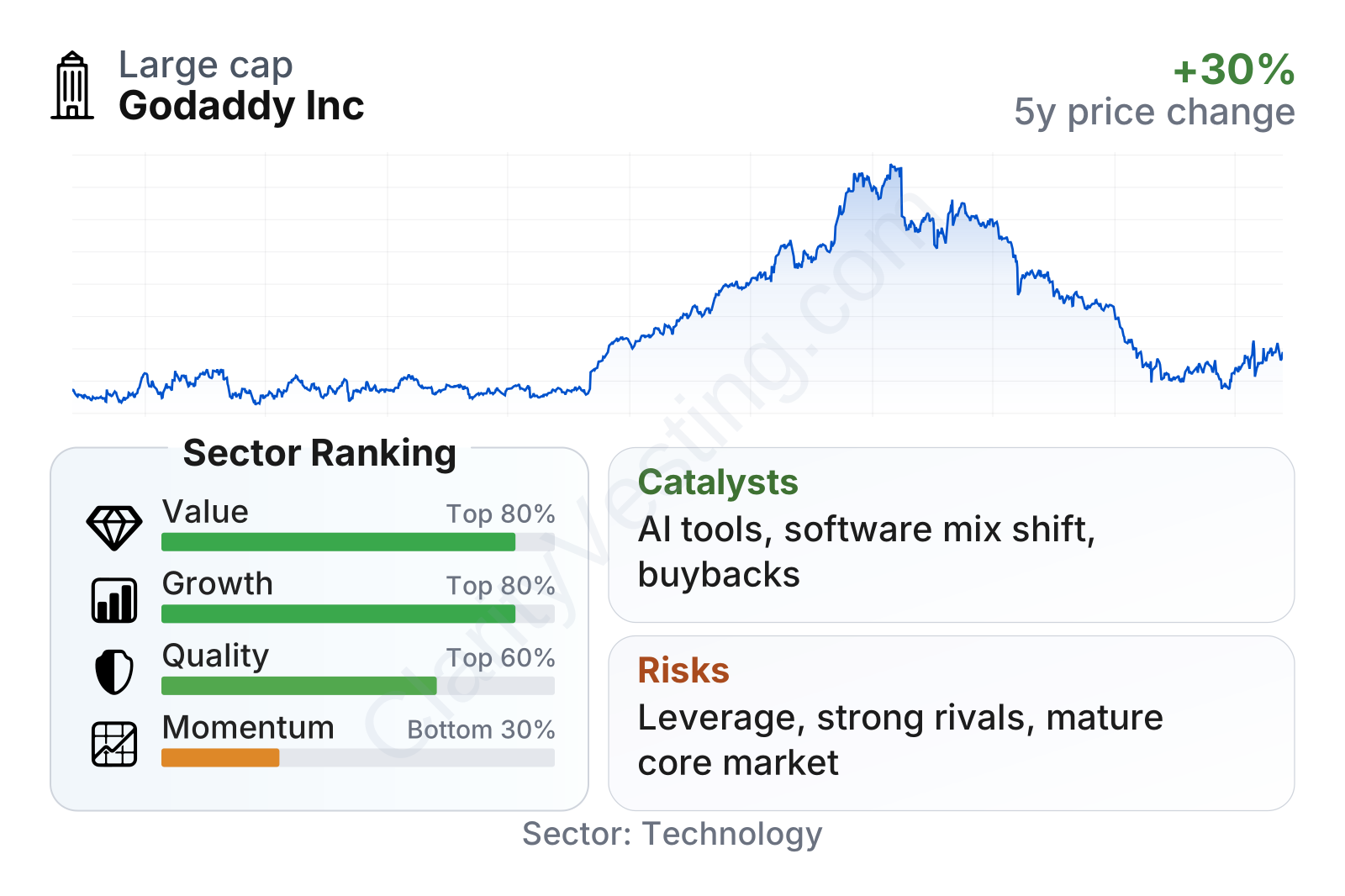
GoDaddy stands out more on profitability and cash generation than on near-term share price momentum. Valuation measures are strong relative to much of the software infrastructure group, with a P/E ratio around the low teens and free cash flow yield far above the sector median. Quality is also supported by return on invested capital above 25% and operating margins around the mid-20% range. Growth is more mixed: recent revenue growth is in the mid-single digits, below the sector median, but the five-year record for revenue per share, free cash flow growth, and margin expansion is clearly stronger. The weak point in the profile is leverage and equity structure, which make debt-based ratios look extreme and require closer interpretation.
Growth
GoDaddy operates in a large and still relevant market: small businesses continue to move online, and many need domains, websites, email, booking tools, marketing support, and commerce features in one place. This is not the fastest-growing corner of technology, but it is durable. The company’s opportunity is less about a single breakthrough product and more about increasing the value captured from each customer over time. That strategy makes sense because domains are often the starting point of a long digital relationship.
The company’s current growth path depends on cross-selling and product expansion. A customer who starts with a domain can later add a website, business email, commerce features, appointment tools, payments, security, and marketing services. That broadening of services can lift average revenue per user and reduce churn, especially among small businesses that prefer convenience over technical complexity. GoDaddy has also been emphasizing AI-enabled tools to simplify website creation, customer engagement, and workflow tasks for non-technical users, which fits its customer base well.
Revenue growth has normalized after the stronger post-pandemic period, but it has remained positive and fairly consistent, recently running around 6% to 7% year over year. That is not a hypergrowth profile, yet it is respectable for a mature platform with a very large installed customer base. More importantly, growth has been accompanied by better operating leverage, suggesting that GoDaddy has been improving the economics of the business rather than chasing revenue at any cost.
Free cash flow is one of the clearest positive signals in the business. Over the last several years, trailing twelve-month free cash flow climbed from roughly $0.6 billion to more than $1.6 billion. That kind of expansion gives GoDaddy room to keep investing in product development while also supporting capital returns. For a long-term business assessment, this is meaningful because strong cash generation can make moderate revenue growth more valuable than it first appears.
A recent catalyst is the continued push toward software-led products and AI-assisted customer tools, which can improve conversion rates and customer retention if execution remains strong. Another important element is the company’s ongoing focus on share repurchases, which can amplify per-share growth when backed by durable cash flow. These are not short-lived catalysts; they are part of the operating model.
Risks
This article is for informational purposes only and does not constitute financial advice. Some content is AI-generated. See Disclaimer


