Stock Analysis · GigaCloud Technology Inc (GCT)
Overview
GigaCloud Technology Inc operates a business-to-business marketplace focused on large parcel merchandise such as furniture, home appliances, and fitness equipment. Instead of simply listing products online, the company combines a digital marketplace with warehousing, transportation, and fulfillment services. This makes it easier for sellers, including manufacturers, to reach resellers and retailers, especially for bulky goods that are harder and more expensive to move than standard e-commerce items.
The company’s model is built around connecting suppliers, mainly in Asia, with buyers in the United States, Europe, and other markets. In practice, GigaCloud handles both the transaction layer and much of the logistics layer. That combination is central to the business, because large-item commerce often depends on reliable storage, shipping, and delivery rather than software alone.
Based on recent annual disclosures, revenue is heavily concentrated in product sales, with service revenue representing a smaller share. The broad revenue mix can be summarized as follows:
- Product revenue: approximately 88% to 92% — sales of inventory through the marketplace and first-party transactions, including furniture and other large merchandise.
- Service revenue: approximately 8% to 12% — marketplace commissions, freight, warehousing, fulfillment, and related logistics services provided to platform participants.
There is also meaningful concentration by merchandise category. Furniture is the company’s core activity and has represented the large majority of revenue in recent filings, while home appliances and other categories contribute a smaller portion. The business therefore has a clear specialization rather than a broad, fully diversified retail mix.
What stands out financially is that revenue has scaled quickly while profitability has remained positive. Over the last several years, gross profit, operating income, and net income have all expanded materially, showing that growth has not come only from spending more to acquire sales. Operating costs have risen much more slowly than revenue, which suggests that scale has improved efficiency.
The business has moved from a smaller platform into a mid-sized, profitable commerce infrastructure company. Revenue has more than tripled since 2021, while operating income and net income have increased even faster, helped by better gross profit and relatively disciplined overhead.
Key Figures
| Metric | Value | Sector ⓘ |
|---|---|---|
| Date | Sep 12, 2026 | |
| Context | ||
| Sector | Technology | |
| Industry | Software - Infrastructure | |
| Market Cap ⓘ | $1.85B | |
| Beta ⓘ | 1.65 | |
Value (Cheapness) | ||
| P/E Ratio ⓘ | 12.35 | 29.51 |
| FCF Yield ⓘ | 8.51% | 4.25% |
| EBIT / EV ⓘ | 9.30% | 2.85% |
| PEG ⓘ | 0.37 | |
Growth (Business expansion) | ||
| Revenue Growth ⓘ | 27.60% | 15.40% |
| RPS Growth (5Y CAGR) ⓘ | 34.56% | 8.56% |
| EPS Growth (5Y CAGR) ⓘ | 47.28% | -11.88% |
| Margin Growth (5Y Trend) ⓘ | 3.33% | 0.46% |
| FCF Growth (5Y CAGR) ⓘ | 128.28% | 9.80% |
Quality (Business durability) | ||
| ROIC (Latest) ⓘ | 31.53% | 9.44% |
| ROIC (5Y Median) ⓘ | 33.55% | 8.30% |
| Net Debt / EBIT (Latest) ⓘ | 0.93 | 0.54 |
| Net Debt / EBIT (5Y Median) ⓘ | 0.56 | 0.44 |
| Operating Margin (Latest) ⓘ | 12.56% | 9.58% |
| Operating Margin (5Y Median) ⓘ | 12.13% | 8.25% |
| Debt to Equity (Latest) ⓘ | 94.80% | 33.33% |
| Profit Margin (Latest) ⓘ | 10.65% | 7.14% |
| Free Cash Flow (Latest) ⓘ | $157.64M | |
Momentum (Price trend) | ||
| 3Y Return ⓘ | +291.47% | +45.48% |
| 12M Return (excl. last month) ⓘ | +68.00% | +23.48% |
| 6M Return ⓘ | +25.17% | +20.93% |
| Price vs. 200-Day MA ⓘ | +26.11% | +7.43% |
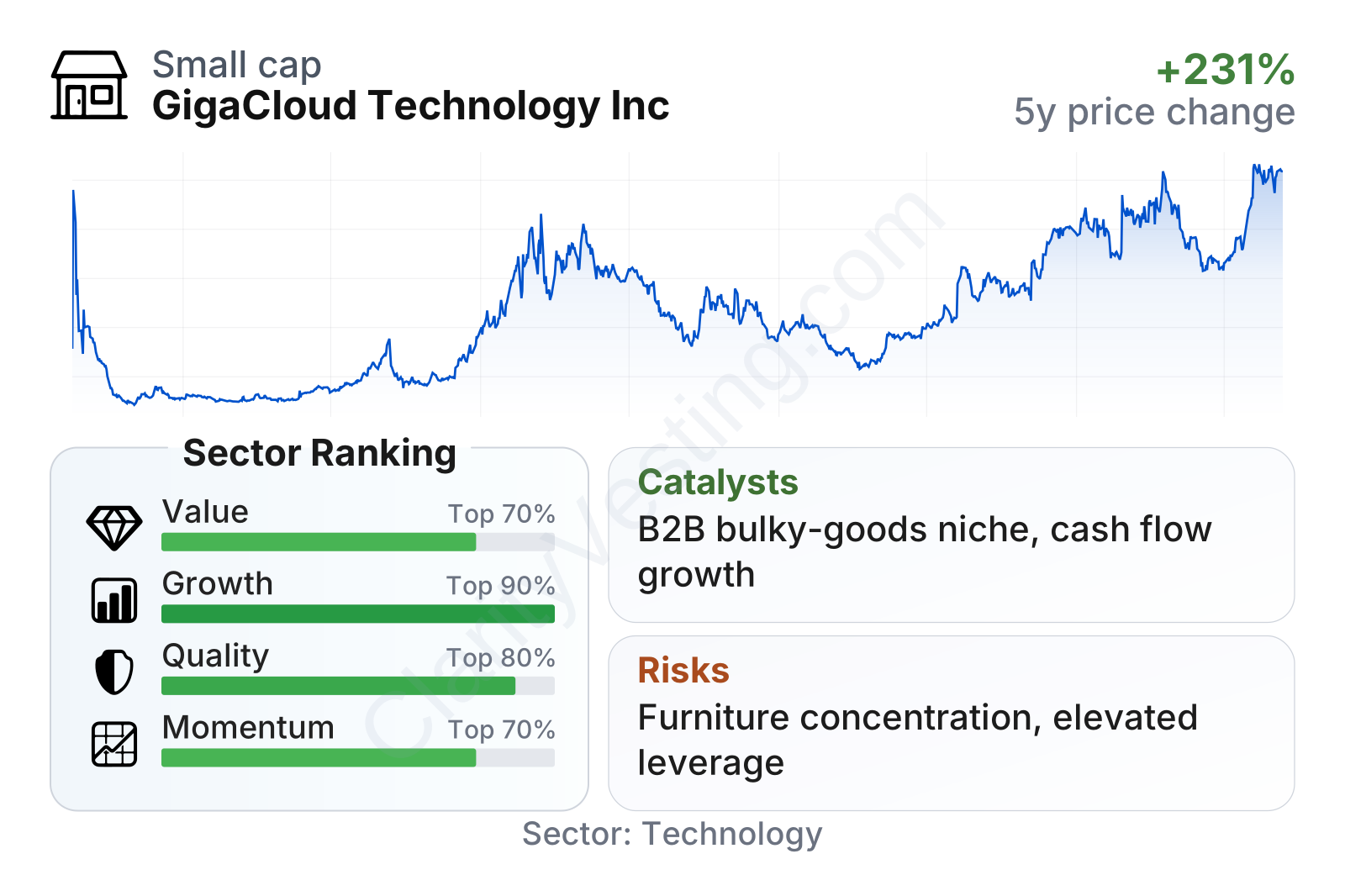
GigaCloud combines unusually strong growth and profitability for a company of its size, and that is reflected in its ranking versus much of the technology sector. Growth measures are particularly strong, with revenue, earnings, and cash flow trends well above sector norms. Quality is also solid, supported by returns on invested capital above 30% and operating margins above the sector median. On valuation, the stock trades on a much lower earnings multiple than the sector while also showing a stronger free cash flow yield, which helps explain why it screens attractively on several fundamental measures. The main area that looks less comfortable is leverage, where debt relative to equity remains noticeably higher than the sector median.
Growth
GigaCloud is operating in a part of commerce that still has room for structural growth. Large-parcel e-commerce has historically been harder to digitize than small-package retail because shipping, returns, and inventory placement are more complex. That difficulty creates an opening for companies that can simplify the full chain from sourcing to delivery. As more furniture and bulky goods sales move online, the need for integrated marketplace and fulfillment solutions should remain relevant.
The company’s strategy also makes sense in that context. Rather than competing as a general online retailer, it focuses on a specific operational pain point: cross-border and domestic distribution for oversized goods. That narrower focus may be a real advantage because execution matters more than brand awareness in this niche. Warehousing footprint, supplier relationships, fulfillment coordination, and marketplace liquidity can reinforce one another over time.
Revenue growth has been volatile from quarter to quarter, which is normal after a period of very rapid expansion, but the bigger picture still points to strong momentum. Growth surged to exceptionally high levels during 2024, cooled sharply in 2025, and then reaccelerated into 2026 to the high-20% to low-30% range. That pattern suggests the business is no longer in its earliest breakout phase, but it is still expanding at a pace well above many peers.
Cash generation supports that growth profile. Free cash flow has climbed steadily over the last several years and now sits comfortably above earlier levels. That matters because it indicates the company is not relying entirely on accounting profits; the business is also converting operations into real cash while continuing to scale.
A major strategic catalyst has been the company’s push to broaden both product categories and platform reach following the Noble House acquisition, which increased its furniture exposure and added scale in sourcing and distribution. Management has also continued investing in fulfillment centers and marketplace capabilities. If this expansion keeps improving network density between sellers, buyers, and logistics assets, the platform could become harder to replicate.
Recent company communications have also highlighted efforts to deepen the B2B marketplace ecosystem rather than simply grow direct merchandise sales. That is important because service and platform-driven revenue can potentially become more efficient and durable over time than pure product reselling.
Risks
This article is for informational purposes only and does not constitute financial advice. Some content is AI-generated. See Disclaimer


