Stock Analysis · Genpact Limited (G)
Overview
Genpact Limited is a business services and digital operations company that helps large enterprises run finance, accounting, supply chain, procurement, customer service, data, analytics, and technology workflows more efficiently. The company started as a General Electric unit and now works across many industries, combining process outsourcing, consulting, analytics, and software-oriented services. In simple terms, Genpact is hired by corporations that want to lower costs, automate repetitive tasks, improve decision-making, and modernize back-office and operational systems.
Its revenue mainly comes from long-term services contracts rather than one-time software sales. Based on company reporting, Genpact’s business is primarily organized by client group and industry rather than by a large number of separate product lines, so exact percentages by service are limited. The clearest and most reliable revenue split is by customer concentration and industry exposure.
- Core enterprise services contracts: the vast majority of revenue, generated from multi-year work in finance and accounting, supply chain, procurement, risk, customer operations, data, and technology services for global companies.
- Data-Tech-AI and transformation services: a growing portion embedded across client engagements, including analytics, automation, cloud, and artificial intelligence deployment. The company highlights these capabilities as a major commercial focus, but it does not disclose a precise full-company revenue percentage for them.
- Client concentration: General Electric remains meaningful but no longer dominant. In recent annual reporting, GE represented roughly 11% of revenue, while the rest came from a broad base of other clients.
- Industry mix: Genpact serves sectors such as financial services, consumer goods, retail, life sciences and healthcare, manufacturing, and high tech. Financial services has historically been one of the largest verticals, though the exact current percentage can vary by year and is not always broken out in detail.
- Geographic revenue: North America is the company’s largest market, followed by Europe and the rest of the world, reflecting where many of its multinational clients are headquartered.
Genpact’s economics are typical of a scaled services company: revenue is built on people, delivery centers, and recurring client relationships. Over the last several years, revenue has moved upward steadily, gross profit has expanded, and operating income has improved, showing that growth has not come purely from adding more volume but also from better execution and pricing.
The business mix shows a company with rising revenue from about $4.0 billion in 2021 to just over $5.0 billion in 2025, while operating profit has generally improved as well. That points to a model with decent scalability, even if labor costs still absorb a large share of sales, which is normal for IT and process services.
Key Figures
| Metric | Value | Sector ⓘ |
|---|---|---|
| Date | Sep 12, 2026 | |
| Context | ||
| Sector | Technology | |
| Industry | Information Technology Services | |
| Market Cap ⓘ | $5.78B | |
| Beta ⓘ | 0.58 | |
Value (Cheapness) | ||
| P/E Ratio ⓘ | 10.36 | 29.51 |
| FCF Yield ⓘ | 9.89% | 4.25% |
| EBIT / EV ⓘ | 11.49% | 2.85% |
| PEG ⓘ | 1.16 | |
Growth (Business expansion) | ||
| Revenue Growth ⓘ | 7.10% | 15.40% |
| RPS Growth (5Y CAGR) ⓘ | 8.38% | 8.56% |
| EPS Growth (5Y CAGR) ⓘ | -10.44% | -11.88% |
| Margin Growth (5Y Trend) ⓘ | 1.89% | 0.46% |
| FCF Growth (5Y CAGR) ⓘ | 3.63% | 9.80% |
Quality (Business durability) | ||
| ROIC (Latest) ⓘ | 15.16% | 9.44% |
| ROIC (5Y Median) ⓘ | 15.32% | 8.30% |
| Net Debt / EBIT (Latest) ⓘ | 1.16 | 0.54 |
| Net Debt / EBIT (5Y Median) ⓘ | 1.46 | 0.44 |
| Operating Margin (Latest) ⓘ | 14.78% | 9.58% |
| Operating Margin (5Y Median) ⓘ | 14.09% | 8.25% |
| Debt to Equity (Latest) ⓘ | 54.31% | 33.33% |
| Profit Margin (Latest) ⓘ | 11.10% | 7.14% |
| Free Cash Flow (Latest) ⓘ | $572.11M | |
Momentum (Price trend) | ||
| 3Y Return ⓘ | +0.97% | +45.48% |
| 12M Return (excl. last month) ⓘ | -20.16% | +23.48% |
| 6M Return ⓘ | -6.39% | +20.93% |
| Price vs. 200-Day MA ⓘ | -4.98% | +7.43% |
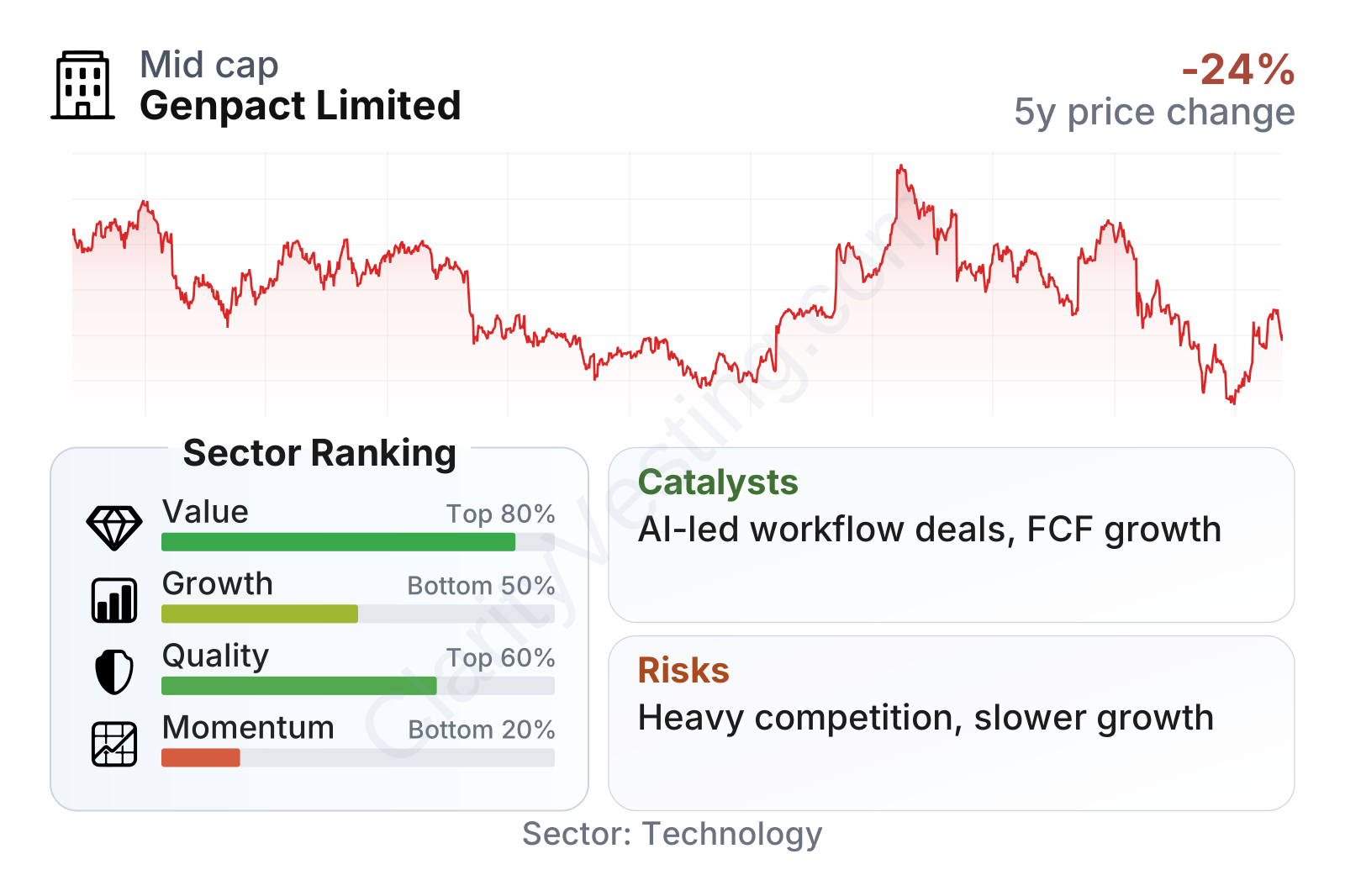
Genpact sits in the mid-cap range and has shown relatively low share-price volatility, with a beta well below 1. On valuation, it stands out as inexpensive versus much of the technology services sector: its earnings multiple is far below the sector median, and its free cash flow yield is notably stronger. Profitability and returns on invested capital are also better than typical peers, while growth and share-price momentum have been weaker. In short, the current profile is that of a profitable and cash-generative company that the market is valuing conservatively because its growth pace is not especially strong.
Growth
Genpact operates in a sector with long-term structural demand. Large companies continue to outsource complex processes, move workloads to digital platforms, use analytics more deeply, and adopt artificial intelligence to improve productivity. Those trends support demand for firms that can combine domain expertise with technology implementation. Genpact is positioned in that lane rather than in traditional low-value outsourcing alone, which matters because clients increasingly want end-to-end transformation rather than simple labor arbitrage.
The company’s strategy also makes sense in the current environment. Management has been emphasizing AI, data, and technology-led transformation while keeping its strong base in finance, operations, and industry-specific processes. That combination can be attractive because many enterprises do not just need AI tools; they need those tools embedded into real workflows such as claims processing, financial reconciliation, supply planning, and customer operations. Genpact’s existing client relationships can give it a practical route to expand these services without starting from zero.
Revenue growth has not been fast compared with many technology companies, but it has been steady. After slowing materially in 2023, the growth rate recovered and has recently been running around the mid-single-digit to high-single-digit range. That is not explosive expansion, yet it does suggest the company regained traction after a softer period.
Cash generation is one of the more convincing parts of the picture. Free cash flow has trended higher over time and recently reached a much stronger level than it showed a few years ago. That matters because it gives the company flexibility to invest in capabilities, fund acquisitions, reduce debt, and return capital without depending heavily on external financing.
A meaningful catalyst is the broader push by enterprises to use generative AI and workflow automation in cost-sensitive operating areas. Genpact’s value proposition fits that demand well: it already sits inside many clients’ day-to-day operations, which can make it easier to deploy AI where there is a measurable return. Recent company communications have also continued to stress partnerships, AI-enabled offerings, and a larger transformation pipeline, all of which point to a potentially better mix of work over time if execution remains solid.
Risks
This article is for informational purposes only and does not constitute financial advice. Some content is AI-generated. See Disclaimer


