Stock Analysis · Fortive Corp (FTV)
Overview
Fortive is an industrial technology company focused on essential tools, software, and connected systems used in professional and mission-critical work. Its products help customers test equipment, monitor operations, improve productivity, manage facilities, and support healthcare workflows. The company was originally separated from Danaher and has built a portfolio around recurring service, software, and instrumentation businesses rather than consumer products.
Fortive’s revenue has recently come mainly from two operating segments. Based on the latest annual reporting before the major portfolio change completed in 2025, the mix was approximately:
- Intelligent Operating Solutions: about 53% of revenue. This segment included connected workflow, facility and asset management, productivity software, and sensing technologies used in industrial and commercial environments.
- Advanced Healthcare Solutions: about 47% of revenue. This segment included sterilization indicators, instrument tracking, biomedical test tools, and other products supporting hospitals, laboratories, and regulated care settings.
That mix has changed meaningfully after Fortive completed the spin-off of its Precision Technologies segment into Ralliant in 2025. As a result, the current Fortive is more concentrated around connected workflow solutions and healthcare-related technologies than it was a few years ago. This matters for long-term analysis because the company now has a narrower but more focused profile, with more emphasis on recurring revenue, software, compliance-heavy applications, and operational improvement tools.
Fortive’s business model is attractive when it works well: sell specialized tools and software into professional workflows, add services and consumables, and use acquisitions to expand into adjacent niches where customers value reliability more than the lowest upfront price. The earnings profile also shows a business with healthy gross profit and a consistent ability to turn sales into cash, although recent restructuring has made year-to-year comparisons less straightforward.
Over the last several years, revenue and gross profit generally moved upward through 2024, while operating income stayed solid. The visible break in 2025 reflects the portfolio reshaping rather than a simple collapse in underlying demand, so recent figures need to be read with that context in mind.
Key Figures
| Metric | Value | Sector ⓘ |
|---|---|---|
| Date | Sep 12, 2026 | |
| Context | ||
| Sector | Technology | |
| Industry | Scientific & Technical Instruments | |
| Market Cap ⓘ | $16.46B | |
| Beta ⓘ | 0.97 | |
Value (Cheapness) | ||
| P/E Ratio ⓘ | 28.84 | 29.51 |
| FCF Yield ⓘ | 5.80% | 4.25% |
| EBIT / EV ⓘ | 3.74% | 2.85% |
| PEG ⓘ | 1.29 | |
Growth (Business expansion) | ||
| Revenue Growth ⓘ | 7.90% | 15.40% |
| RPS Growth (5Y CAGR) ⓘ | 1.93% | 8.56% |
| EPS Growth (5Y CAGR) ⓘ | -20.06% | -11.88% |
| Margin Growth (5Y Trend) ⓘ | 2.15% | 0.46% |
| FCF Growth (5Y CAGR) ⓘ | 1.79% | 9.80% |
Quality (Business durability) | ||
| ROIC (Latest) ⓘ | 6.52% | 9.44% |
| ROIC (5Y Median) ⓘ | 6.36% | 8.30% |
| Net Debt / EBIT (Latest) ⓘ | 3.88 | 0.54 |
| Net Debt / EBIT (5Y Median) ⓘ | 2.79 | 0.44 |
| Operating Margin (Latest) ⓘ | 17.05% | 9.58% |
| Operating Margin (5Y Median) ⓘ | 17.00% | 8.25% |
| Debt to Equity (Latest) ⓘ | 57.90% | 33.33% |
| Profit Margin (Latest) ⓘ | 12.38% | 7.14% |
| Free Cash Flow (Latest) ⓘ | $954.90M | |
Momentum (Price trend) | ||
| 3Y Return ⓘ | -3.72% | +45.48% |
| 12M Return (excl. last month) ⓘ | +29.86% | +23.48% |
| 6M Return ⓘ | -0.04% | +20.93% |
| Price vs. 200-Day MA ⓘ | -5.73% | +7.43% |
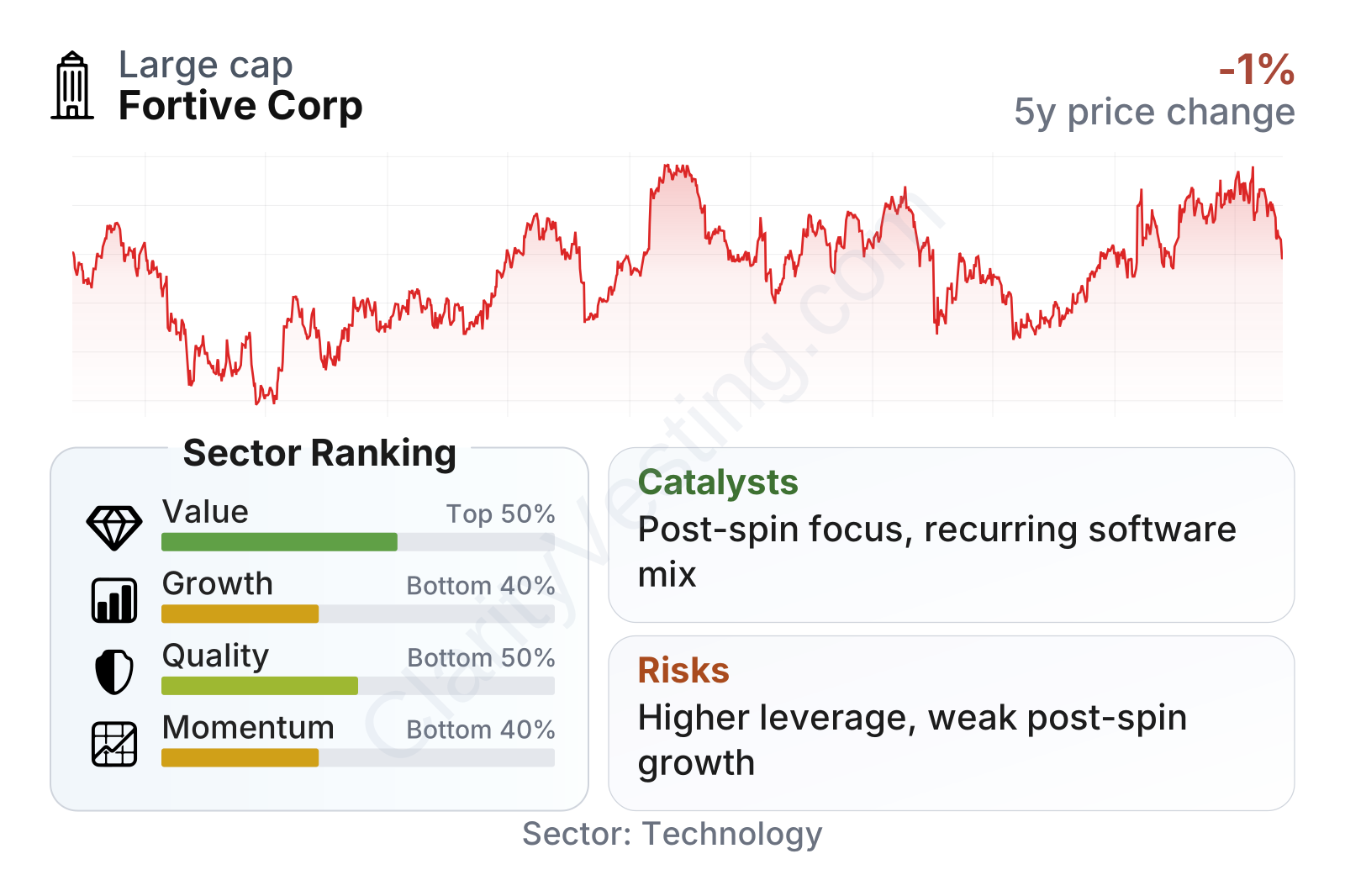
Fortive sits in the large-cap range and has share-price volatility close to the broader market. The overall profile is mixed: valuation is near the sector median on earnings, cash-flow-based measures look somewhat stronger than average, margins are clearly better than many peers, but growth and balance-sheet metrics are less favorable. In other words, the company looks more like a mature, efficient operator than a fast-growing technology name.
The stock history also reflects that balance. The share price has moved through several swings over the last five years without establishing a strong long-term upward trend relative to many technology peers. That usually signals that the market sees Fortive as a steady execution business rather than a company expected to compound at very high rates.
Growth
Fortive operates in markets with durable long-term demand. Industrial automation, connected workflow software, facility digitization, quality control, and healthcare compliance are not temporary themes. Companies and hospitals continue to invest in efficiency, traceability, uptime, and safer operations. Those are favorable end markets because customers often need these capabilities even in slower economies.
The company’s strategy also makes industrial sense. Fortive tends to focus on niche categories where precision, reliability, and workflow integration matter. That can support pricing power and recurring revenue, especially when products are tied to software, calibration, compliance, consumables, or installed equipment bases. The portfolio reshaping completed in 2025 appears designed to make Fortive simpler and more focused, which can help management allocate capital more effectively and present a clearer operating identity.
Recent reported revenue growth looks weak and even sharply negative in the latest periods, but that needs careful interpretation because Fortive’s portfolio changed significantly after the spin-off. The longer pattern before that change showed modest rather than rapid expansion. So the central growth question is not whether Fortive can produce headline growth every quarter, but whether the reshaped company can return to steadier organic growth once comparisons normalize.
Cash generation remains one of the more important positives. Free cash flow had been trending upward for several years before dropping back recently. Even with that decline, Fortive still produces substantial cash relative to its size. That gives the company flexibility to invest in software, fund bolt-on acquisitions, reduce debt over time, and continue returning capital where appropriate. For a long-term business, dependable cash creation often matters more than short bursts of revenue growth.
A meaningful catalyst is the company’s continued emphasis on recurring and regulated revenue streams. Healthcare workflow, sterilization assurance, asset management, and connected industrial software are areas where switching costs can become meaningful once systems are integrated into daily operations. Another catalyst is operational simplification after the portfolio separation, which may allow management to improve execution, sharpen strategic priorities, and make future acquisitions easier to integrate.
Recent company communications in 2026 have continued to emphasize productivity initiatives, software-enabled offerings, and disciplined capital deployment. None of that guarantees a step-change in growth, but it does support the idea that Fortive is trying to evolve toward a steadier, more focused mix with better quality of revenue.
Risks
This article is for informational purposes only and does not constitute financial advice. Some content is AI-generated. See Disclaimer


