Stock Analysis · Fortinet Inc (FTNT)
Overview
Fortinet is a cybersecurity company that helps organizations protect their networks, users, applications, cloud environments, and connected devices. Its best-known products are firewalls, but the business is broader than that. Fortinet sells an integrated security platform built around its FortiOS operating system, specialized security hardware, subscription-based security services, and management tools that help companies run security across on-premise systems, branch offices, data centers, and the cloud.
For a long-term view, an important point is that Fortinet is not just a one-product company. It combines hardware, software, and recurring services, which gives it both upfront product revenue and ongoing subscription income. Based on recent company reporting, revenue is mainly split into two segments:
- Services revenue: about 70% of total revenue. This includes security subscriptions, software support, maintenance, cloud-delivered security, and other recurring services tied to Fortinet’s installed base.
- Product revenue: about 30% of total revenue. This mainly includes physical and virtual security appliances such as firewalls and related equipment.
Within that mix, the larger strategic engine is services. Product sales help place Fortinet equipment inside customer environments, while subscriptions and support deepen the relationship and usually carry attractive economics over time. This also means the business is becoming more recurring as the installed base expands.
Another useful feature of the model is scale. Fortinet serves enterprises, governments, service providers, and mid-sized organizations across many regions. That broad customer reach can reduce dependence on any single buyer or industry. Over the last several years, revenue, gross profit, operating income, and net income have all moved higher, while research and development spending also increased, showing that the company has been expanding without stepping back from product investment.
The business mix shows a favorable pattern: revenue has grown steadily, gross profit has risen faster than direct costs, and operating income has expanded materially over time. Fortinet has also kept investing in research and development while still improving profitability, which is usually a strong sign for a security platform company.
Key Figures
| Metric | Value | Sector ⓘ |
|---|---|---|
| Date | Sep 12, 2026 | |
| Context | ||
| Sector | Technology | |
| Industry | Software - Infrastructure | |
| Market Cap ⓘ | $116.55B | |
| Beta ⓘ | 1.06 | |
Value (Cheapness) | ||
| P/E Ratio ⓘ | 55.54 | 29.51 |
| FCF Yield ⓘ | 2.67% | 4.25% |
| EBIT / EV ⓘ | 2.34% | 2.85% |
| PEG ⓘ | 1.72 | |
Growth (Business expansion) | ||
| Revenue Growth ⓘ | 25.60% | 15.40% |
| RPS Growth (5Y CAGR) ⓘ | 22.78% | 8.56% |
| EPS Growth (5Y CAGR) ⓘ | 9.15% | -11.88% |
| Margin Growth (5Y Trend) ⓘ | 14.76% | 0.46% |
| FCF Growth (5Y CAGR) ⓘ | 16.61% | 9.80% |
Quality (Business durability) | ||
| ROIC (Latest) ⓘ | 113.83% | 9.44% |
| ROIC (5Y Median) ⓘ | 79.19% | 8.30% |
| Net Debt / EBIT (Latest) ⓘ | -0.92 | 0.54 |
| Net Debt / EBIT (5Y Median) ⓘ | -0.65 | 0.44 |
| Operating Margin (Latest) ⓘ | 35.07% | 9.58% |
| Operating Margin (5Y Median) ⓘ | 23.40% | 8.25% |
| Debt to Equity (Latest) ⓘ | 32.04% | 33.33% |
| Profit Margin (Latest) ⓘ | 28.17% | 7.14% |
| Free Cash Flow (Latest) ⓘ | $3.12B | |
Momentum (Price trend) | ||
| 3Y Return ⓘ | +145.78% | +45.48% |
| 12M Return (excl. last month) ⓘ | +104.97% | +23.48% |
| 6M Return ⓘ | +84.92% | +20.93% |
| Price vs. 200-Day MA ⓘ | +39.82% | +7.43% |
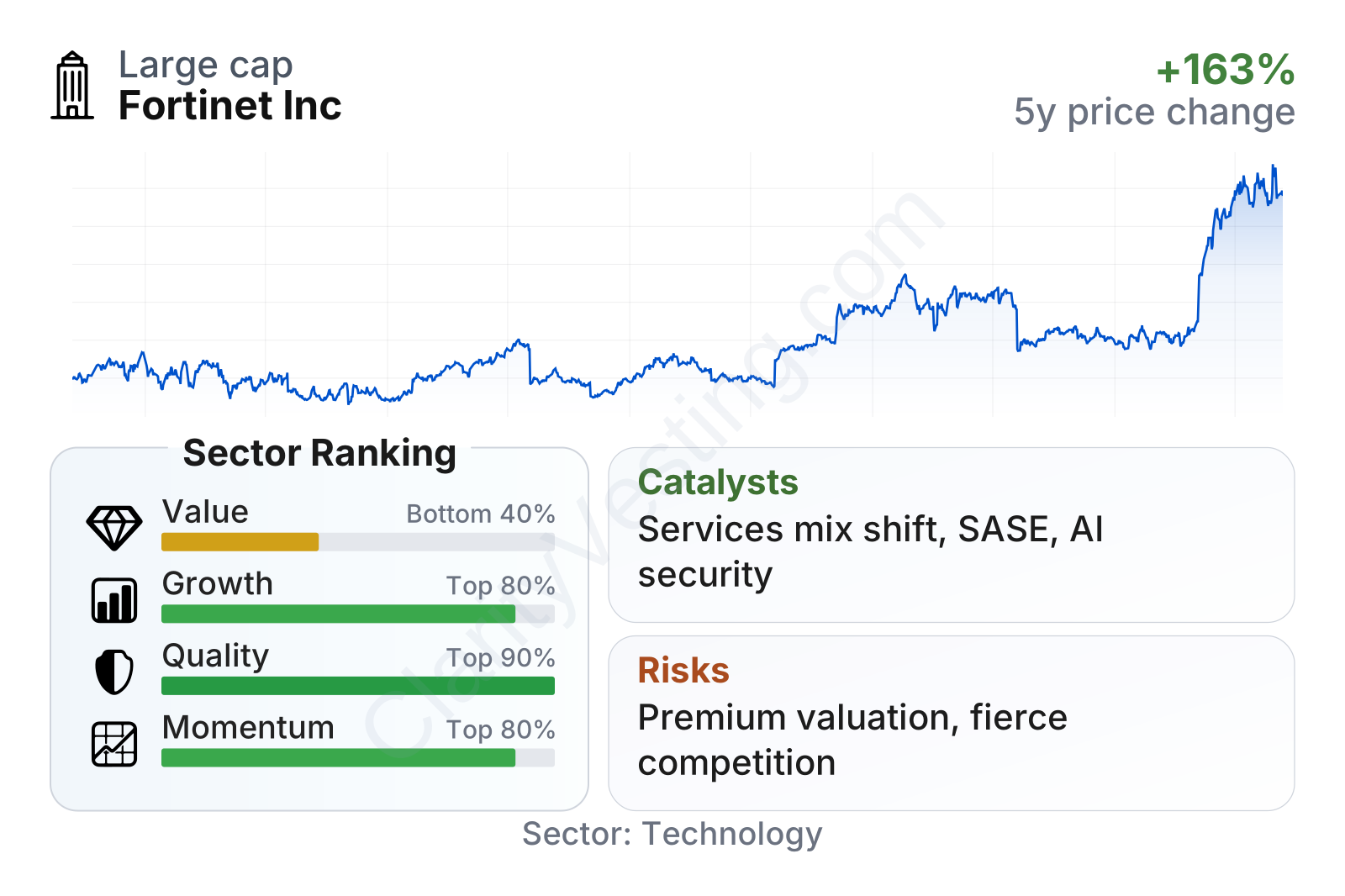
Fortinet stands out for quality and growth, with especially strong profitability and balance sheet characteristics compared with much of the software infrastructure group. Revenue growth is above the sector median, operating margins are unusually high for this industry, and the company holds a net cash position rather than being weighed down by debt. The weaker area is valuation: earnings and cash flow multiples are above typical sector levels, which means the market is already recognizing many of these strengths.
Growth
Cybersecurity remains a growing sector because digital systems are becoming more complex, more distributed, and more exposed to attack. Companies now have to secure office networks, remote workers, cloud workloads, applications, identity systems, and a rising number of connected devices. That creates long-term demand for vendors that can offer broad protection without forcing customers to stitch together too many separate tools.
Fortinet’s strategy fits that trend well. Its main pitch is platform consolidation: instead of using many disconnected security products, customers can run more of their security through one architecture. This can matter in cybersecurity because complexity itself becomes a risk. A company that can lower complexity, improve performance, and still control costs has a practical advantage, especially for large distributed networks and branch environments.
Fortinet also has a meaningful hardware-performance angle through its custom security processing technology. That differentiates it from vendors that rely more heavily on general-purpose computing. In areas where speed, throughput, and cost efficiency matter, this can be a real growth driver. At the same time, the company has been pushing further into higher-growth categories such as secure access service edge, security operations, zero trust network access, cloud security, and AI-related security capabilities.
Recent growth has not been perfectly smooth, but the trend has improved again. Revenue growth slowed materially during 2023 and early 2024, then reaccelerated into 2026, reaching the mid-20% range year over year in the latest period shown. That matters because it suggests demand recovered after a softer phase, rather than pointing to a structural slowdown in the business.
Cash generation has also strengthened over time, with trailing free cash flow rising from a little above $1.2 billion in 2022 to roughly $2.4 billion by early 2026, and the latest quality snapshot points even higher on a trailing basis. Strong cash production gives Fortinet flexibility to invest in product development, data center capacity, sales expansion, and share repurchases without relying heavily on external financing.
As a recent catalyst, Fortinet has continued to emphasize unified security operations, cloud-delivered services, and AI-enhanced security tools in its public communications. Those themes line up with where customer budgets are increasingly moving. The company’s expanding service mix is also important: if recurring services continue to outgrow products, future revenue could become more stable and margins could remain strong.
Risks
This article is for informational purposes only and does not constitute financial advice. Some content is AI-generated. See Disclaimer


