Stock Analysis · Frontdoor Inc (FTDR)
Stock Analysis · Frontdoor Inc (FTDR)

Overview

Frontdoor Inc is a home services company best known for selling home warranties and related repair-and-maintenance plans. In simple terms, customers pay a recurring fee, and when key household systems or appliances break, Frontdoor arranges service through its contractor network and covers eligible repair or replacement costs under the plan. Its best-known brands include American Home Shield, HSA, OneGuard, Landmark, and the newer on-demand platform Streem.

The business is tied to a basic consumer need: unexpected home repairs are expensive, inconvenient, and hard to coordinate. Frontdoor sits in the middle of that problem. It collects membership fees, manages claims, dispatches contractors, and increasingly uses digital tools to improve diagnosis and customer service. That makes it part insurance-like subscription business, part home-services platform.

Revenue is mainly generated from recurring service plan fees, with a smaller contribution from other customer charges and business-to-business relationships. Based on company disclosures, the mix is broadly concentrated as follows:

  • Home service plan revenue: the large majority of sales, roughly 85% to 90%, coming from annual or monthly contract fees paid by homeowners.
  • Service-related and claims-related customer fees: roughly 8% to 12%, including trade service call fees paid when a contractor visit is requested.
  • Other revenue: a small remainder, roughly 2% to 5%, including ancillary services and newer offerings such as on-demand digital home repair support.

There is also customer concentration by channel rather than by product. A meaningful portion of plan originations historically comes from real estate transactions, where a warranty is sold during a home sale, but the company has been putting more emphasis on direct-to-consumer relationships and renewals, which tend to be more durable and potentially more profitable over time.

The business model has shown improving economics in recent years. Revenue has climbed steadily, while gross profit and operating income have grown faster than sales, suggesting that pricing, claims management, and operating discipline have improved the earnings profile.

One notable pattern is that revenue has risen from roughly $1.6 billion to just above $2.0 billion over the last several years, while operating income and net income expanded much faster. That points to a company that is not only getting larger, but also extracting more profit from each dollar of sales.

Key Figures

MetricValueSector
DateJul 18, 2026
Context
SectorConsumer Cyclical
IndustryPersonal Services
Market Cap $5.33B
Beta 1.46
Value
(Cheapness)
P/E Ratio 21.6718.58
FCF Yield 7.23%7.99%
EBIT / EV 7.11%5.91%
PEG 2.38
Growth
(Business expansion)
Revenue Growth 5.90%5.50%
RPS Growth (5Y CAGR) 10.66%9.20%
EPS Growth (5Y CAGR) -14.45%-26.43%
Margin Growth (5Y Trend) 7.63%-0.18%
FCF Growth (5Y CAGR) 26.07%5.02%
Quality
(Business durability)
ROIC (Latest) 21.76%12.03%
ROIC (5Y Median) 22.05%10.82%
Net Debt / EBIT (Latest) 1.382.12
Net Debt / EBIT (5Y Median) 1.942.25
Operating Margin (Latest) 19.82%9.28%
Operating Margin (5Y Median) 15.39%9.64%
Debt to Equity (Latest) 514.78%75.23%
Profit Margin (Latest) 12.23%5.28%
Free Cash Flow (Latest) $385.00M
Momentum
(Price trend)
3Y Return +119.01%+10.68%
12M Return (excl. last month) +21.15%+5.26%
6M Return +24.70%-2.41%
Price vs. 200-Day MA +22.55%+1.55%
Better than sector median
Slightly worse than sector median
More than 20% worse than sector median

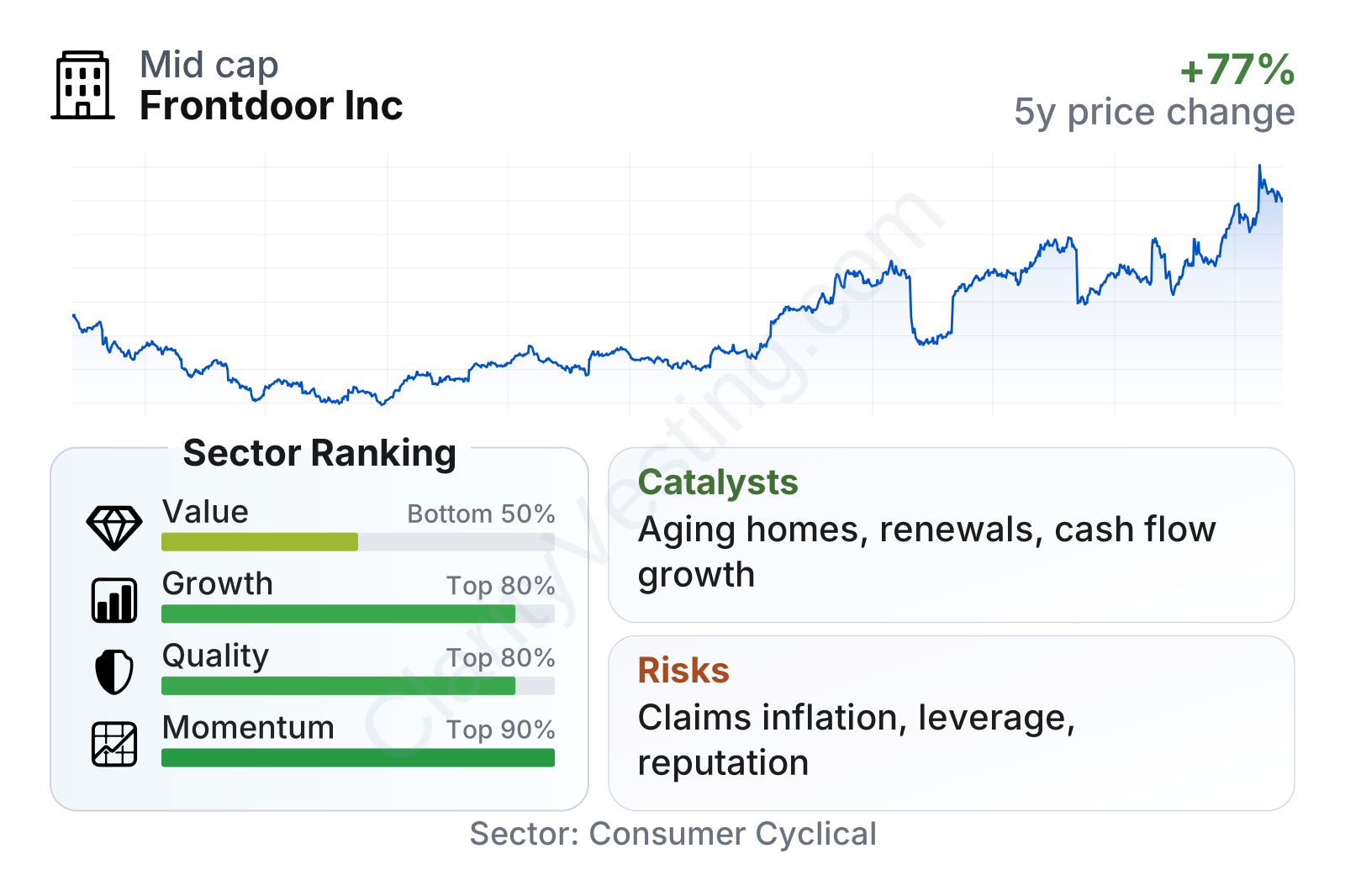
Frontdoor stands out more for business quality and execution than for deep-value pricing. Profitability measures are well above sector medians, returns on invested capital are strong, and cash generation has improved sharply. Growth indicators are also favorable, especially over a multiyear view, although the valuation is no longer notably cheap relative to the broader consumer discretionary group. The main weak spot in the table is leverage on an equity basis, which looks high and needs to be interpreted alongside the company’s strong cash flow and manageable net debt relative to earnings.

With a market value around the mid-single-digit billions, Frontdoor is no longer a small niche company, but it is still much smaller than many national consumer service platforms. The stock has also been more volatile than the market overall, which fits a company exposed to consumer behavior, housing turnover, and sentiment around recurring-service businesses.

Growth

Frontdoor operates in a segment that should remain relevant for a long time: homeowners need repairs regardless of the economic cycle. That does not make the business immune to downturns, but it does support long-term demand. The broader backdrop is also constructive. The U.S. housing stock is aging, repair costs remain high, and many homeowners prefer predictable monthly expenses over sudden large bills. Those conditions support the appeal of service plans.

The company’s strategy appears coherent. It is trying to grow through a mix of member count expansion, higher revenue per customer, better retention, and broader service offerings. That is a sensible formula in this industry because recurring subscription-like revenue is typically more valuable than one-time transactions, and better retention can meaningfully improve lifetime economics.

Revenue growth has not been perfectly smooth, but the longer pattern is positive. Growth slowed at points in 2022 and 2024, then accelerated strongly through much of 2025 before moderating again in early 2026. That suggests Frontdoor can still grow, but not in a straight line. It is more of a steady compounder than a hyper-growth company.

Cash generation is one of the strongest parts of the thesis. Free cash flow has moved up sharply over the past few years, rising from a relatively modest level in 2022 to a much larger figure in the latest trailing period. That matters because cash gives the company flexibility: it can reduce debt, invest in technology, support marketing, or return capital to shareholders without relying heavily on outside financing.

A notable catalyst is the company’s push to modernize home repair interactions through digital tools, including video-based diagnostics and easier service coordination. If those tools improve first-time fix rates, reduce unnecessary truck rolls, or shorten claim resolution times, they can strengthen both margins and customer satisfaction. Another catalyst is continued migration toward direct-to-consumer relationships and renewals, which can reduce dependence on housing transactions and improve revenue visibility.

Recent company updates have also pointed to continued operational focus on pricing, claims management, and customer retention. For Frontdoor, these are not minor details. Small improvements in claims cost, service efficiency, or renewal rates can have a meaningful impact on profit because the company operates at scale across a large membership base.

Risks

The biggest business risk is execution around claims and customer satisfaction. Home warranties can be frustrating products when repairs take too long, coverage disputes arise, or contractor availability is tight. A company in this category can report healthy profits and still face reputational pressure if customers feel service quality is inconsistent. Since Frontdoor’s value proposition depends heavily on trust, poor service experiences can hurt renewals and brand perception.

Another risk is that the business is more operationally complex than it first appears. Frontdoor must price contracts correctly, forecast claim frequency, manage inflation in labor and parts, and maintain a reliable contractor network across many local markets. If repair costs rise faster than plan pricing, margins can come under pressure.

The balance sheet deserves a nuanced reading. Debt-to-equity remains far above sector norms, even though it has improved substantially from much more extreme levels in prior years. That ratio can look distorted when a company has a relatively small equity base, so it should not be read in isolation. The more reassuring counterpoint is that net debt relative to EBIT appears manageable, but leverage still adds risk if operations weaken unexpectedly.

Profit margins have improved materially and now sit well above the sector median. That is a strength, but it also raises the bar. Once margins reach a clearly above-average level, the market starts expecting them to stay there. If claims severity, marketing spending, or customer acquisition costs move the wrong way, even a modest margin decline could change how the business is viewed.

Competition is real, though Frontdoor remains one of the most established names in the U.S. home warranty market and is widely viewed as the category leader by scale and brand recognition. Main competitors include companies such as Cinch Home Services, First American Home Warranty, 2-10 Home Buyers Warranty, and regional providers. There is also indirect competition from self-insuring homeowners, local contractors, and newer digital home-services platforms. Frontdoor’s advantages are its national scale, longstanding brand presence, contractor network, customer data, and experience managing claims at high volume. The trade-off is that category leaders are often the main target of consumer scrutiny.

No major scandal stands out in recent public company materials, but the business carries recurring reputation and regulatory risk. Consumer-protection complaints, state-level scrutiny of contract terms, or legal disputes over coverage practices are all structural risks in this industry. These issues do not need to become catastrophic to matter; they can chip away at retention and increase compliance costs over time.

Valuation

Frontdoor’s valuation sits in a middle ground rather than an obvious extreme. On earnings, the stock trades somewhat above the sector median in the latest snapshot, while its cash flow yield is a bit less generous than the group median. That means the market is assigning some premium for stronger margins, solid returns on capital, and much better free cash flow growth.

The longer P/E history is useful here. Frontdoor’s multiple has moved from clearly elevated levels a few years ago toward a range that is now close to, and recently even slightly below, sector norms. In other words, the business has improved while the valuation has become more grounded than it once was. That is a healthier setup than a case where both operating performance and the valuation multiple are being stretched at the same time.

Even so, the stock does not screen as plainly cheap if growth cools meaningfully from the stronger periods seen in 2025. A PEG ratio above 2 suggests the market is already recognizing a fair amount of the company’s quality and growth progress. The current price appears easier to justify when emphasizing margin strength, recurring revenue characteristics, and cash generation; it appears less forgiving if customer growth slows, retention weakens, or claims costs rise.

Overall, the valuation reflects a company that has earned a better reputation through execution. It looks more like a quality compounder with cyclical and operational risks than a mispriced turnaround.

Conclusion

Frontdoor has built a distinctive position in an unglamorous but durable corner of consumer services: helping homeowners deal with expensive, unpredictable repair problems through recurring protection plans. The business is not driven by cutting-edge technology or explosive end-market growth, yet it has become more compelling because its economics have improved noticeably. Revenue has trended upward, margins have expanded, returns on capital are strong, and free cash flow has grown at an impressive pace.

The main challenge is that this is still a trust-sensitive service business. Customer frustration, contractor network issues, inflation in repair costs, and regulatory scrutiny can all disrupt performance. Leverage is also higher than ideal on an equity basis, even if cash generation provides some support.

In context, Frontdoor looks like a stronger company than its simple home-warranty label might suggest. It appears to be moving from a transactional, housing-linked model toward a more resilient membership and service platform with improving operating discipline. The valuation no longer signals a clear bargain, but it remains understandable given the company’s stronger profitability and cash profile. The overall direction is constructive, with the caveat that service execution and balance-sheet discipline remain central to the long-term picture.

Sources:

  • Frontdoor, Inc. – Annual Report on Form 10-K for fiscal year 2025
  • Frontdoor, Inc. – Quarterly Report on Form 10-Q for quarter ended March 31, 2026
  • SEC EDGAR – Frontdoor, Inc. filings
  • Frontdoor Investor Relations – earnings releases and shareholder materials
  • Frontdoor Investor Relations – company overview and brand information
  • Wikipedia – Frontdoor, Inc.

This article is for informational purposes only and does not constitute financial advice. Some content is AI-generated. See Disclaimer
Sign up for exclusive research and insights.

Unsubscribe anytime.