Stock Analysis · Fisher & Paykel Healthcare Corporation Limited (FSPKF)
Overview
Fisher & Paykel Healthcare Corporation Limited is a New Zealand-based medical device company focused on products used in hospitals and at home for respiratory care, acute care, surgery, and obstructive sleep apnea. In simple terms, it makes equipment and consumables that help patients breathe more comfortably and safely, whether they are in an intensive care unit, during surgery, or using therapy at home.
The business is mainly built around repeat-use consumables and device platforms. That matters because once a hospital or patient starts using a system, ongoing purchases of masks, breathing circuits, humidification chambers, and related accessories can continue for years. Based on the latest company reporting, revenue is centered on two broad segments:
- Hospital products: about 80% of revenue — includes respiratory support systems, humidification products, noninvasive ventilation interfaces, nasal high flow therapy consumables, and products used in intensive care, emergency care, and operating rooms.
- Homecare products: about 20% of revenue — mainly masks and accessories for treating obstructive sleep apnea, sold for use with home therapy devices.
Geographically, the company sells globally, with North America and Europe representing major markets, alongside Asia-Pacific and other international regions. Its model combines direct sales in some countries with distributor networks in others, helping it reach hospitals and sleep therapy providers across many healthcare systems.
One notable feature of the business is its strong profitability despite continued spending on research, product development, and commercial expansion. The financial flow over recent years also shows a clear rebound into fiscal 2026, with revenue, gross profit, and operating income recovering strongly after a weaker prior period.
The profit profile appears attractive for a medical equipment company: research and development spending has remained meaningful while operating income and net income improved sharply in the latest fiscal year, suggesting that scale and product mix are supporting margins rather than growth relying only on cost cutting.
Key Figures
| Metric | Value | Sector ⓘ |
|---|---|---|
| Date | Nov 21, 2026 | |
| Context | ||
| Sector | Healthcare | |
| Industry | Medical Instruments & Supplies | |
| Market Cap ⓘ | $15.88B | |
| Beta ⓘ | 0.93 | |
Value (Cheapness) | ||
| P/E Ratio ⓘ | 57.43 | 25.50 |
| P/B Ratio ⓘ | N/A | 4.14 |
| FCF Yield ⓘ | 3.91% | 2.68% |
| Dividend Yield ⓘ | 1.93% | 1.52% |
| EBIT / EV ⓘ | 4.92% | 2.99% |
| PEG ⓘ | 43.70 | |
Growth (Business expansion) | ||
| Revenue Growth ⓘ | 14.00% | 7.10% |
| RPS Growth (5Y CAGR) ⓘ | 9.00% | 8.61% |
| EPS Growth (5Y CAGR) ⓘ | -6.93% | -10.82% |
| BVPS Growth (5Y CAGR) ⓘ | 5.70% | 3.59% |
| Margin Growth (5Y Trend) ⓘ | -2.48% | -0.63% |
| FCF Growth (5Y CAGR) ⓘ | N/A | 1.59% |
| DPS Growth (5Y CAGR) ⓘ | 2.69% | 6.65% |
Quality (Business durability) | ||
| ROIC (Latest) ⓘ | N/A | 5.62% |
| ROA (Latest) ⓘ | 37.61% | 2.70% |
| ROIC (5Y Median) ⓘ | 20.14% | 4.51% |
| ROA (5Y Median) ⓘ | 15.61% | 1.78% |
| Net Debt / EBIT (Latest) ⓘ | -0.23 | 1.33 |
| Net Debt / EBIT (5Y Median) ⓘ | 0.03 | 2.00 |
| Net Debt / EBITDA (Latest) ⓘ | -0.19 | 0.99 |
| Net Debt / Assets ⓘ | -11.09% | 6.14% |
| EBITDA / Interest ⓘ | 68.85 | 9.65 |
| Operating Margin (Latest) ⓘ | 30.43% | 9.28% |
| Operating Margin (5Y Median) ⓘ | 28.52% | 7.24% |
| Debt to Equity (Latest) ⓘ | 6.84% | 28.47% |
| Profit Margin (Latest) ⓘ | 20.30% | 3.67% |
| Free Cash Flow (Latest) ⓘ | $621.32M | |
Momentum (Price trend) | ||
| 3Y Return ⓘ | +96.18% | +38.93% |
| 12M Return (excl. last month) ⓘ | +23.89% | +13.18% |
| 6M Return ⓘ | +31.34% | +10.51% |
| Price vs. 200-Day MA ⓘ | +20.98% | +3.72% |
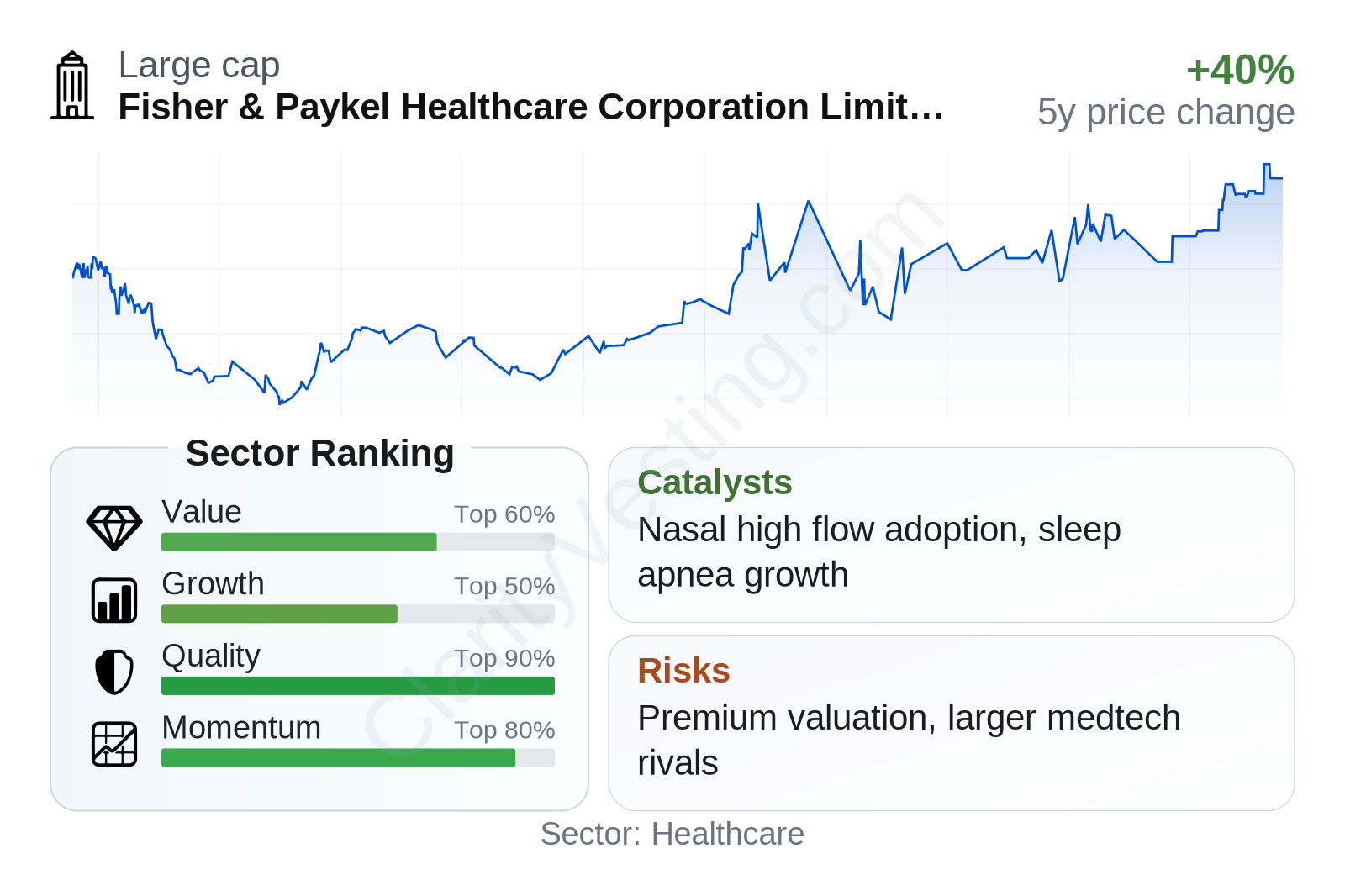
Fisher & Paykel Healthcare stands out most on business quality. Profitability metrics are far above the sector median, with operating margin around 30% and profit margin around 20%, while returns on assets and invested capital are unusually strong for healthcare equipment. The balance sheet is also conservative, with very low leverage and net cash rather than meaningful net debt.
Growth is solid rather than explosive. Recent revenue growth is ahead of the sector median, and five-year revenue-per-share growth has been slightly better than the broader peer group. However, earnings growth over five years has been uneven because margins compressed after the pandemic-era demand spike and then rebuilt. Price performance has been strong over the last six months, one year, and three years relative to the sector, which helps explain why valuation multiples now sit well above typical healthcare equipment levels.
Growth
The company operates in a part of healthcare with durable long-term demand drivers. Respiratory disease, aging populations, broader use of noninvasive respiratory support, rising surgical volumes, and increased diagnosis of sleep-disordered breathing all support demand over time. These are not short-lived themes, and they fit well with Fisher & Paykel Healthcare’s specialization in airway management, humidification, and patient interfaces.
Its strategy also makes sense for long-term expansion. The company continues to invest in product development, manufacturing capacity, and geographic reach. That is important because hospitals are often slow to switch suppliers once a product is integrated into clinical workflows. A company that can place devices and then generate recurring sales from associated consumables can build a durable installed base.
A particularly important catalyst is the continued adoption of nasal high flow therapy and related respiratory support tools across more care settings. If hospitals expand use beyond intensive care into emergency departments, general wards, and post-operative care, the addressable market becomes meaningfully larger. The homecare segment also has room to grow as sleep apnea diagnosis and treatment rates improve globally.
Recent company reporting for fiscal 2026 points to strong momentum. Revenue rose to roughly $1.3 billion, with earnings and operating profit also recovering sharply. That matters because it suggests the business has moved past the post-pandemic normalization phase and is again showing the operating strength that long-term followers typically look for in medical technology companies.
Another useful sign is that the company kept investing through weaker periods rather than protecting short-term profit at the expense of future products. Research and development spending has continued to rise in absolute terms, which supports the view that management is trying to deepen its clinical relevance rather than simply defend existing products.
Risks
This article is for informational purposes only and does not constitute financial advice. Some content is AI-generated. See Disclaimer