Stock Analysis · Fastly Inc (FSLY)
Overview
Fastly is a cloud platform company focused on moving, securing, and processing internet traffic closer to end users. In simple terms, it helps websites, apps, streaming services, and digital businesses deliver content faster, improve reliability, and add security features without sending every request back to a distant central server. Its platform is commonly described through three main capabilities: content delivery, security, and edge computing.
The company sells mainly to enterprise customers that run important digital services. These customers use Fastly for tasks such as accelerating websites and video delivery, protecting applications from cyberattacks, balancing traffic loads, and running certain software logic at the network edge. Fastly’s 2025 annual filing shows that no single customer represented 10% or more of revenue, which is useful because it lowers customer concentration risk compared with earlier periods in the company’s history.
Fastly does not break out revenue in a highly detailed public segment table, but its filings and investor materials make the business mix clear enough to describe the major sources.
- Network services and content delivery: approximately 50% to 60% of revenue. This includes CDN services, traffic delivery, image optimization, video and application acceleration, and related usage-based services.
- Security products: approximately 25% to 35% of revenue. This includes web application and API protection, DDoS mitigation, bot management, and services tied to the Signal Sciences product family.
- Compute and other platform services: approximately 10% to 20% of revenue. This includes edge compute offerings and other add-on platform capabilities, which are strategically important even if still smaller than delivery and security.
What stands out in Fastly’s financial structure is that revenue has risen steadily over the last several years, while gross profit has also expanded. Operating losses remain significant, but they have narrowed from earlier levels. Research and development is still a large spending category, showing that the company is continuing to invest in product depth rather than simply harvesting mature infrastructure revenue.
Revenue has grown from the mid-$300 million range in 2021 to above $600 million in 2025, while gross profit has improved meaningfully. The main bottleneck is not demand at the top line, but the company’s ability to turn that scale into durable operating profit.
Key Figures
| Metric | Value | Sector ⓘ |
|---|---|---|
| Date | Sep 12, 2026 | |
| Context | ||
| Sector | Technology | |
| Industry | Software - Application | |
| Market Cap ⓘ | $3.69B | |
| Beta ⓘ | 0.36 | |
Value (Cheapness) | ||
| P/E Ratio ⓘ | N/A | 29.51 |
| FCF Yield ⓘ | 1.14% | 4.25% |
| EBIT / EV ⓘ | -2.69% | 2.85% |
| PEG ⓘ | N/A | |
Growth (Business expansion) | ||
| Revenue Growth ⓘ | 23.30% | 15.40% |
| RPS Growth (5Y CAGR) ⓘ | 8.61% | 8.56% |
| EPS Growth (5Y CAGR) ⓘ | N/A | -11.88% |
| Margin Growth (5Y Trend) ⓘ | N/A | 0.46% |
| FCF Growth (5Y CAGR) ⓘ | N/A | 9.80% |
Quality (Business durability) | ||
| ROIC (Latest) ⓘ | -5.61% | 9.44% |
| ROIC (5Y Median) ⓘ | -7.99% | 8.30% |
| Net Debt / EBIT (Latest) ⓘ | N/A | 0.54 |
| Net Debt / EBIT (5Y Median) ⓘ | N/A | 0.44 |
| Operating Margin (Latest) ⓘ | -14.18% | 9.58% |
| Operating Margin (5Y Median) ⓘ | -28.09% | 8.25% |
| Debt to Equity (Latest) ⓘ | 40.20% | 33.33% |
| Profit Margin (Latest) ⓘ | -11.80% | 7.14% |
| Free Cash Flow (Latest) ⓘ | $42.23M | |
Momentum (Price trend) | ||
| 3Y Return ⓘ | +1.49% | +45.48% |
| 12M Return (excl. last month) ⓘ | +316.50% | +23.48% |
| 6M Return ⓘ | -4.38% | +20.93% |
| Price vs. 200-Day MA ⓘ | +22.65% | +7.43% |
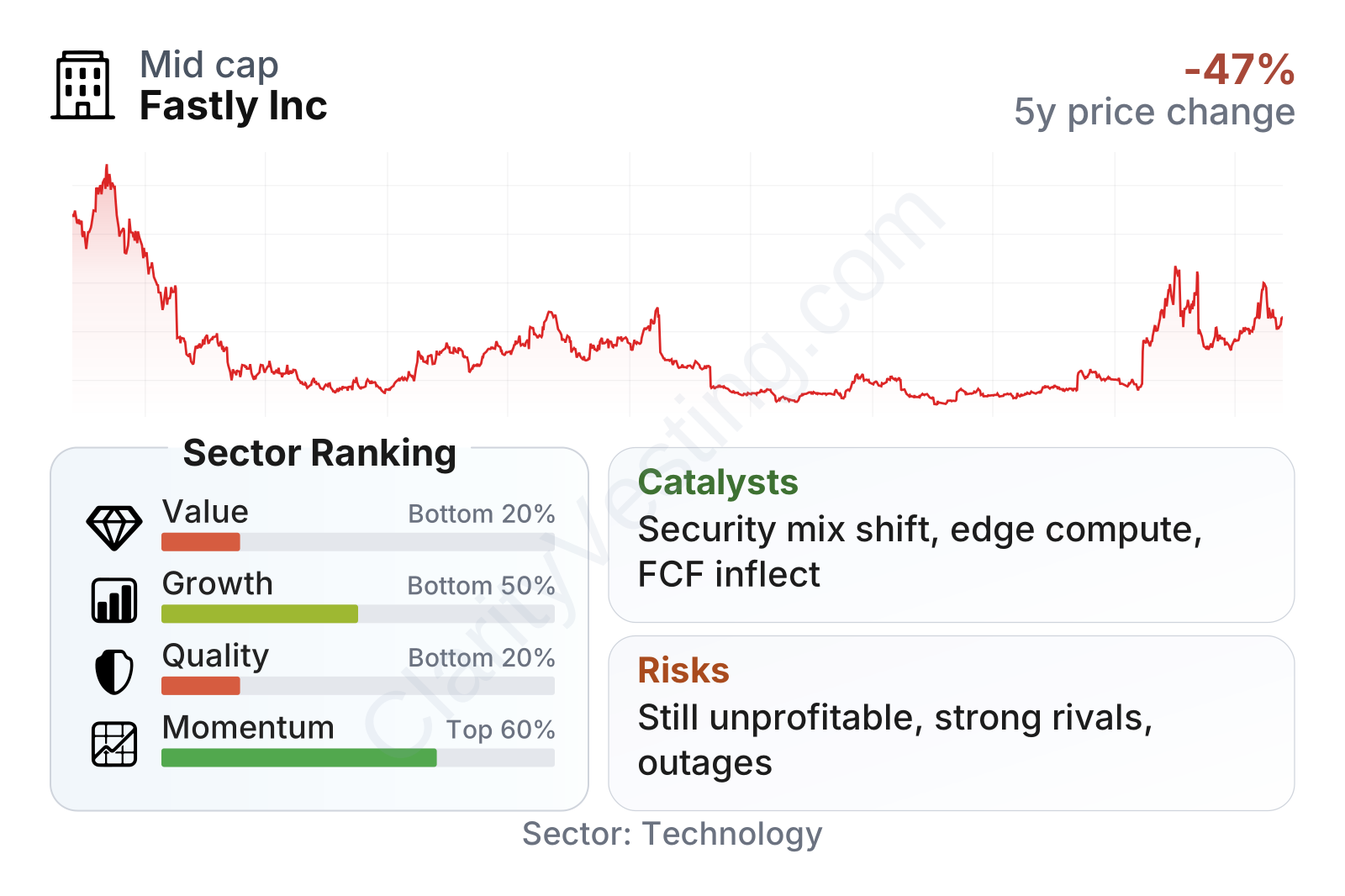
Fastly is a mid-sized software infrastructure company with unusually strong recent share-price momentum, but the underlying business profile is still mixed. Growth has re-accelerated and free cash flow has turned positive, yet profitability and returns on capital remain well below sector norms. The table also shows a split picture: momentum ranks well above most software peers, while value, quality, and growth factors are weaker on a broader fundamental basis.
Growth
Fastly operates in a market with long-term structural tailwinds. Internet traffic keeps rising, applications are becoming more distributed, cybersecurity needs continue to expand, and more computing tasks are being handled closer to users through edge infrastructure. These are not temporary themes. They are tied to streaming, e-commerce, AI-enabled applications, APIs, real-time personalization, and the growing need for speed and resilience online.
Its strategy is logical for that environment. Fastly is trying to build a fuller platform around three linked needs: deliver content quickly, secure applications, and let customers run code at the edge. That combination matters because customers increasingly prefer fewer vendors that can handle performance and security together. The Signal Sciences acquisition gave Fastly more credibility in security, while its developer-oriented edge platform supports the longer-term push beyond basic content delivery.
Growth has not been smooth, but the recent trend is clearly better. Revenue expansion slowed sharply during 2024, at one point dropping close to low single digits, before improving again through 2025 and into 2026. The latest pace, around the low-20% range year over year, is ahead of the sector median and suggests that demand has regained traction. That matters because a company like Fastly needs both scale and utilization growth to make its network economics work.
Another important development is cash generation. Free cash flow was deeply negative in earlier periods, then moved close to break-even, and has recently turned positive at roughly $50 million on a trailing basis. For a company still reporting accounting losses, this is one of the more encouraging signs. It suggests that expense discipline and improving gross profit are starting to show up in actual cash results.
Recent company updates have also pointed to continued product expansion in security and compute, including efforts to make the platform more useful for modern application delivery and AI-related workloads. Fastly is unlikely to be the only beneficiary of these trends, but the broader move toward securing APIs, handling dynamic traffic, and processing data closer to users creates a meaningful opportunity if execution remains steady.
Risks
This article is for informational purposes only and does not constitute financial advice. Some content is AI-generated. See Disclaimer