Stock Analysis · First Solar Inc (FSLR)
Overview
First Solar is an American solar manufacturer focused on utility-scale power projects. In simple terms, it makes solar modules used in large solar farms and sells complete systems and services around those products. Unlike many solar companies that rely on conventional crystalline silicon technology, First Solar uses thin-film cadmium telluride technology. That difference matters because it gives the company a distinct manufacturing process, a product profile that performs well in hot climates, and a business model that is more centered on large-scale electricity generation than on rooftop solar.
The business is still mainly driven by product sales, especially solar modules delivered to developers and energy companies. Based on the company’s recent filings, revenue is heavily concentrated in module sales, while the remainder comes from development activities, engineering and procurement services, operations and maintenance, and other project-related items. A practical way to think about the revenue mix is the following:
- Solar modules and systems sales: roughly 85% to 90% of revenue
- Project development, EPC, and related services: roughly 5% to 10%
- Operations, maintenance, and other sources: a small remainder, generally below 5%
Geographically, First Solar is more diversified than many solar manufacturers because it sells into the United States and a range of international utility markets, but the U.S. market has become especially important as domestic manufacturing incentives and energy policy have improved the economics of local production. That positioning has helped the company present itself not just as a solar producer, but as a strategic domestic manufacturer in a sector tied to energy security and grid expansion.
The business profile has become much stronger over the past few years. Revenue has scaled up meaningfully, while gross profit and operating income have expanded much faster than sales. That shows not only bigger volume, but also better pricing, favorable product mix, and support from manufacturing tax credits.
The long-term pattern is notable: after a difficult 2022, profitability recovered sharply in 2023 and improved again through 2024 and 2025. Costs grew much more slowly than revenue over that period, which points to stronger operating leverage and a more efficient earnings structure.
Key Figures
| Metric | Value | Sector ⓘ |
|---|---|---|
| Date | Jul 18, 2026 | |
| Context | ||
| Sector | Technology | |
| Industry | Solar | |
| Market Cap ⓘ | $22.77B | |
| Beta ⓘ | 1.73 | |
Value (Cheapness) | ||
| P/E Ratio ⓘ | 14.45 | 31.76 |
| FCF Yield ⓘ | 7.32% | 4.18% |
| EBIT / EV ⓘ | 7.93% | 2.56% |
| PEG ⓘ | 0.59 | |
Growth (Business expansion) | ||
| Revenue Growth ⓘ | 23.60% | 13.50% |
| RPS Growth (5Y CAGR) ⓘ | 15.43% | 8.57% |
| EPS Growth (5Y CAGR) ⓘ | N/A | -21.87% |
| Margin Growth (5Y Trend) ⓘ | 11.11% | 0.41% |
| FCF Growth (5Y CAGR) ⓘ | N/A | 9.76% |
Quality (Business durability) | ||
| ROIC (Latest) ⓘ | 17.23% | 8.54% |
| ROIC (5Y Median) ⓘ | 12.71% | 8.12% |
| Net Debt / EBIT (Latest) ⓘ | -1.10 | 0.38 |
| Net Debt / EBIT (5Y Median) ⓘ | -1.46 | 0.38 |
| Operating Margin (Latest) ⓘ | 32.49% | 9.58% |
| Operating Margin (5Y Median) ⓘ | 27.25% | 8.25% |
| Debt to Equity (Latest) ⓘ | 4.31% | 33.52% |
| Profit Margin (Latest) ⓘ | 30.73% | 6.96% |
| Free Cash Flow (Latest) ⓘ | $1.67B | |
Momentum (Price trend) | ||
| 3Y Return ⓘ | +5.17% | +30.91% |
| 12M Return (excl. last month) ⓘ | +77.07% | +28.90% |
| 6M Return ⓘ | -12.99% | +5.38% |
| Price vs. 200-Day MA ⓘ | -9.94% | +7.61% |
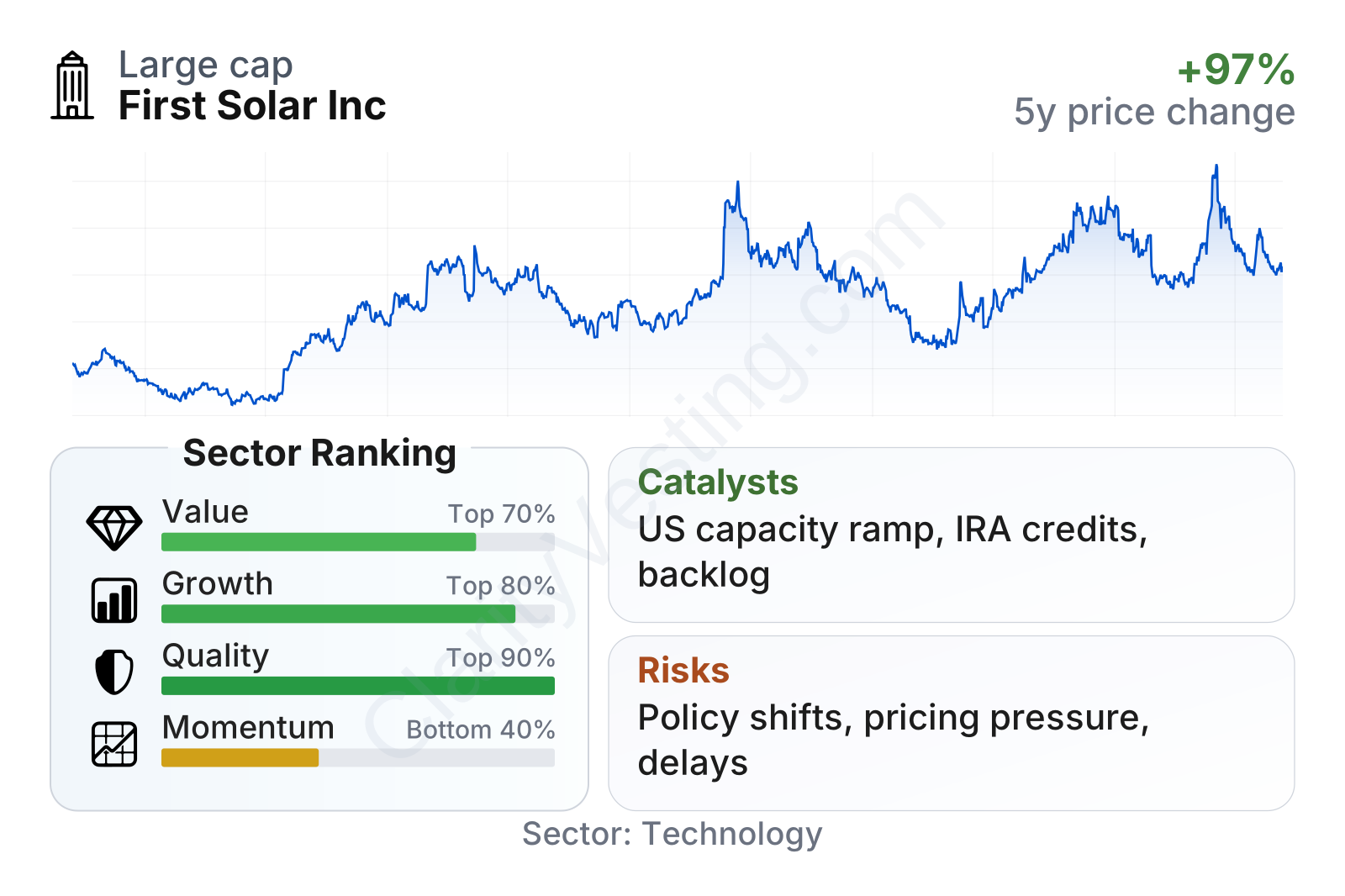
First Solar currently sits in a strong position on business quality and growth relative to much of the broader technology sector, while valuation measures remain less demanding than the sector median. Profitability stands out in particular: operating margin, profit margin, and return on invested capital are all well above typical sector levels. The balance sheet is also unusually conservative, with very low leverage and net cash rather than net debt. The weaker area is recent share-price momentum, which suggests the market has become more cautious even as the underlying business remains financially solid.
At a market value of around $24 billion, First Solar is large enough to benefit from scale, customer relationships, and manufacturing expansion, but still small enough for execution on new factories and contracted deliveries to materially change its earnings profile. The stock has also been volatile, reflected in a beta well above 1, so short-term price swings can be much larger than the broader market.
Growth
The company operates in a sector with strong long-term demand drivers. Solar power continues to benefit from falling system costs, rising electricity demand, grid decarbonization efforts, and the need for new generation capacity. Utility-scale solar is one of the most economical forms of new electricity supply in many regions, which gives the industry a structural tailwind that extends beyond short-term policy cycles.
First Solar’s strategy for growth is relatively straightforward and coherent. It is expanding domestic manufacturing capacity, locking in demand through a large contracted backlog, and focusing on utility-scale customers where it has an established reputation. This strategy reduces some of the uncertainty that affects more fragmented solar businesses. Instead of depending heavily on consumer demand or residential installers, the company works largely with bigger customers making long-duration capital decisions.
Revenue growth has been uneven from quarter to quarter, which is common in this industry because the timing of module shipments and project milestones can move results around. Even so, the broader trend remains positive. Recent year-over-year growth has stayed above the sector median, and the five-year revenue-per-share trend also points to a business that has grown faster than many peers.
Cash generation is another important part of the growth picture. Free cash flow was negative during heavy investment phases, which is not unusual when a manufacturer is building capacity. The more recent swing into strongly positive territory is meaningful because it suggests the company is moving from investment mode toward harvesting returns on that spending. In other words, recent expansion is no longer just a promise on paper; it is beginning to show up in cash.
One of the clearest catalysts is the U.S. policy environment. The Inflation Reduction Act created manufacturing incentives that directly support domestic solar production, and First Solar is one of the most visible beneficiaries because it already has an American manufacturing footprint. That support can improve margins, help finance future expansion, and make the company more attractive to customers seeking U.S.-made supply. Another catalyst is the company’s order backlog, which has historically stretched multiple years ahead and gives better visibility than many industrial businesses usually have.
Recent company updates have continued to emphasize factory buildouts, contracted demand, and the strategic value of domestic manufacturing. For a long-term view, that combination matters more than quarter-to-quarter market sentiment because it suggests First Solar is positioned near the center of a broader industrial and energy transition theme rather than simply riding short-lived solar enthusiasm.
Risks
Solar manufacturing remains a cyclical and politically sensitive business, and that is the main reason First Solar cannot be viewed as a low-risk company despite its strong balance sheet. Module pricing can change quickly, industry supply can swing from shortage to oversupply, and policy changes can alter customer behavior. Even a company with differentiated technology can feel pressure if global competitors cut prices aggressively.
The competitive advantage is real, but it has limits. First Solar’s thin-film technology, domestic manufacturing base, established utility-scale relationships, and strong balance sheet set it apart. It is a leader in U.S. utility-scale solar modules and one of the most distinctive non-silicon manufacturers globally. However, it is not the overall global volume leader in solar manufacturing. The largest industry players are predominantly Chinese companies such as LONGi, JinkoSolar, Trina Solar, JA Solar, and Canadian Solar. Those companies often compete with massive scale and can exert strong pricing pressure across the industry.
Compared with those rivals, First Solar is less exposed to the commodity-like part of the market because its product is technologically different and more concentrated in large projects. That helps, but does not eliminate competition risk. If customers place greater weight on upfront price than lifecycle performance, lower-cost silicon suppliers can still gain share. In addition, trade policy can help domestic players in one period and create uncertainty in another.
The balance sheet is a major stabilizer. Debt to equity is only around 4%, far below the sector norm, and the company’s net cash position gives it flexibility to keep investing through weaker industry periods. This does not remove operational risk, but it lowers financial risk significantly and reduces the chance that a downturn becomes a balance-sheet problem.
Margins are currently unusually strong for the solar industry. Profit margin has climbed to roughly 30%, far above the sector median near the high-single digits. That gap shows how favorable First Solar’s current setup has been. It also creates a risk: when margins are far above normal industry levels, the market may question how durable they are. Any future decline in selling prices, tax-credit economics, or factory utilization could narrow that spread.
Other risks are more company-specific. Manufacturing execution matters because expansion delays, yield issues, or equipment ramp problems can affect deliveries and profitability. Customer concentration can also matter in utility-scale solar since large projects are often tied to a smaller number of counterparties. Finally, trade disputes, import rules, and domestic-content requirements can reshape the competitive landscape quickly, even when the long-term demand outlook stays favorable.
There has been no defining governance scandal or major reputation event that fundamentally changes the business profile, but recent market debate around the durability of solar incentives, future module pricing, and policy implementation remains important because those issues can have a material effect on sentiment and earnings expectations.
Valuation
First Solar’s valuation looks moderate relative to both its own recent history and the broader sector, especially when compared with its profitability and balance-sheet strength. The current price-to-earnings ratio is in the mid-teens, while the sector median is roughly around 30. Free cash flow yield and EBIT relative to enterprise value also compare favorably with peers, which suggests the market is not placing an extreme premium on the company despite its superior margins and financial quality.
The longer-term valuation pattern is also telling. The stock has traded at much higher earnings multiples in prior periods, particularly when profitability was less settled and expectations were more speculative. More recently, the multiple has compressed even as earnings and cash generation improved. That usually means the market has become more skeptical about how sustainable current profits are, rather than simply ignoring the company’s progress.
That skepticism is understandable. First Solar benefits from a favorable set of conditions: domestic manufacturing incentives, a large contracted base, strong utility-scale demand, and unusually high margins. If those conditions remain supportive, the current valuation appears restrained relative to the company’s operating profile. If margins normalize sharply or policy support weakens, the lower multiple may simply reflect realistic caution. In that sense, the current price embeds both confidence in the business and doubt about peak profitability lasting for many years.
Conclusion
First Solar stands out as one of the more substantial and financially disciplined companies in solar. It combines a differentiated product, a strong position in utility-scale projects, a U.S.-focused manufacturing footprint, and a balance sheet that is much cleaner than most peers. Recent years have shown not only rising revenue, but a major step up in profitability and cash generation, which gives the company a far more robust profile than the average renewable-energy name.
The main challenge is that solar remains a tough industry where pricing, policy, and supply conditions can change quickly. First Solar is better insulated than many rivals, but it is not immune. A meaningful part of the investment debate comes down to whether today’s elevated margins and policy-supported economics represent a durable base or an unusually favorable phase.
Overall, the company appears to be positioned on the stronger side of that debate. It is not a pure hype-driven clean-energy stock, nor a simple commodity manufacturer. It looks more like a profitable industrial technology company tied to a long-term expansion in electricity demand and domestic energy infrastructure, though its share price still reflects the market’s caution about how durable that advantage will be.
Sources:
- First Solar, Inc. — Form 10-Q for the quarter ended March 31, 2026
- First Solar, Inc. — Form 10-K for the year ended December 31, 2025
- U.S. Securities and Exchange Commission — EDGAR company filings for First Solar, Inc.
- First Solar Investor Relations — earnings releases and shareholder materials published in 2026
- First Solar Investor Relations — webcast materials and company-hosted earnings call information published in 2026
- Wikipedia — First Solar
- U.S. Department of Energy — Solar Energy Technologies Office public materials
- International Energy Agency — public materials on solar PV and electricity demand trends
This article is for informational purposes only and does not constitute financial advice. Some content is AI-generated. See Disclaimer


