Stock Analysis · Freshworks Inc (FRSH)
Overview
Freshworks Inc is a cloud software company that sells customer engagement and employee service tools to businesses. Its products are designed to help companies manage customer support, sales activity, marketing interactions, and internal IT or HR service requests. The company positions itself as an easier-to-use and more affordable alternative to some larger enterprise software vendors, with a focus on fast deployment and a user-friendly interface.
Freshworks generates nearly all of its revenue from subscription software sold on a recurring basis. It also earns a much smaller amount from professional services and other support-related work. Based on recent annual filings, the revenue mix is approximately:
- Subscription revenue: about 96% to 97% of total revenue. This includes access to products such as Freshdesk, Freshsales, Freshservice, Freshchat, Freshmarketer, and broader platform capabilities.
- Professional services and other revenue: about 3% to 4% of total revenue. This usually includes implementation, training, consulting, and related services.
Within the product portfolio, the company does not provide a fully detailed public revenue split for every individual product line in standard filings, but Freshservice and customer experience products are central parts of the business. Freshservice focuses on IT service management and enterprise workflows, while customer engagement products help businesses manage support tickets, communication channels, and sales processes.
Freshworks has also been improving the economics of its model. Revenue has expanded steadily over the past several years, while gross profit has remained high, which is common for software businesses. At the same time, spending discipline has improved: sales and administrative costs have become more efficient relative to revenue, helping the company move from operating losses to positive operating income by 2025.
The broad pattern shows a software business with strong gross margins and a meaningful shift from heavy losses toward profitability and cash generation. Research and development remains a major expense, which is important because product quality and innovation are central in this market.
Key Figures
| Metric | Value | Sector ⓘ |
|---|---|---|
| Date | Sep 12, 2026 | |
| Context | ||
| Sector | Technology | |
| Industry | Software - Application | |
| Market Cap ⓘ | $3.10B | |
| Beta ⓘ | 0.89 | |
Value (Cheapness) | ||
| P/E Ratio ⓘ | 18.84 | 29.51 |
| FCF Yield ⓘ | 8.06% | 4.25% |
| EBIT / EV ⓘ | 1.69% | 2.85% |
| PEG ⓘ | 0.48 | |
Growth (Business expansion) | ||
| Revenue Growth ⓘ | 16.00% | 15.40% |
| RPS Growth (5Y CAGR) ⓘ | 19.08% | 8.56% |
| EPS Growth (5Y CAGR) ⓘ | N/A | -11.88% |
| Margin Growth (5Y Trend) ⓘ | N/A | 0.46% |
| FCF Growth (5Y CAGR) ⓘ | 219.85% | 9.80% |
Quality (Business durability) | ||
| ROIC (Latest) ⓘ | 19.67% | 9.44% |
| ROIC (5Y Median) ⓘ | -10.80% | 8.30% |
| Net Debt / EBIT (Latest) ⓘ | -11.15 | 0.54 |
| Net Debt / EBIT (5Y Median) ⓘ | N/A | 0.44 |
| Operating Margin (Latest) ⓘ | 4.65% | 9.58% |
| Operating Margin (5Y Median) ⓘ | -28.53% | 8.25% |
| Debt to Equity (Latest) ⓘ | 2.85% | 33.33% |
| Profit Margin (Latest) ⓘ | 20.49% | 7.14% |
| Free Cash Flow (Latest) ⓘ | $249.75M | |
Momentum (Price trend) | ||
| 3Y Return ⓘ | -45.16% | +45.48% |
| 12M Return (excl. last month) ⓘ | -7.29% | +23.48% |
| 6M Return ⓘ | +49.56% | +20.93% |
| Price vs. 200-Day MA ⓘ | +16.64% | +7.43% |
Freshworks is a mid-sized software company with a market value in the low single-digit billions of dollars and a stock volatility level slightly below the broader market. Its profile is unusual in a good way for a software name: growth remains solid, free cash flow generation is strong, and leverage is very low. The main softer area is operating quality relative to more mature peers, because margins are still below the sector median even after a major improvement.
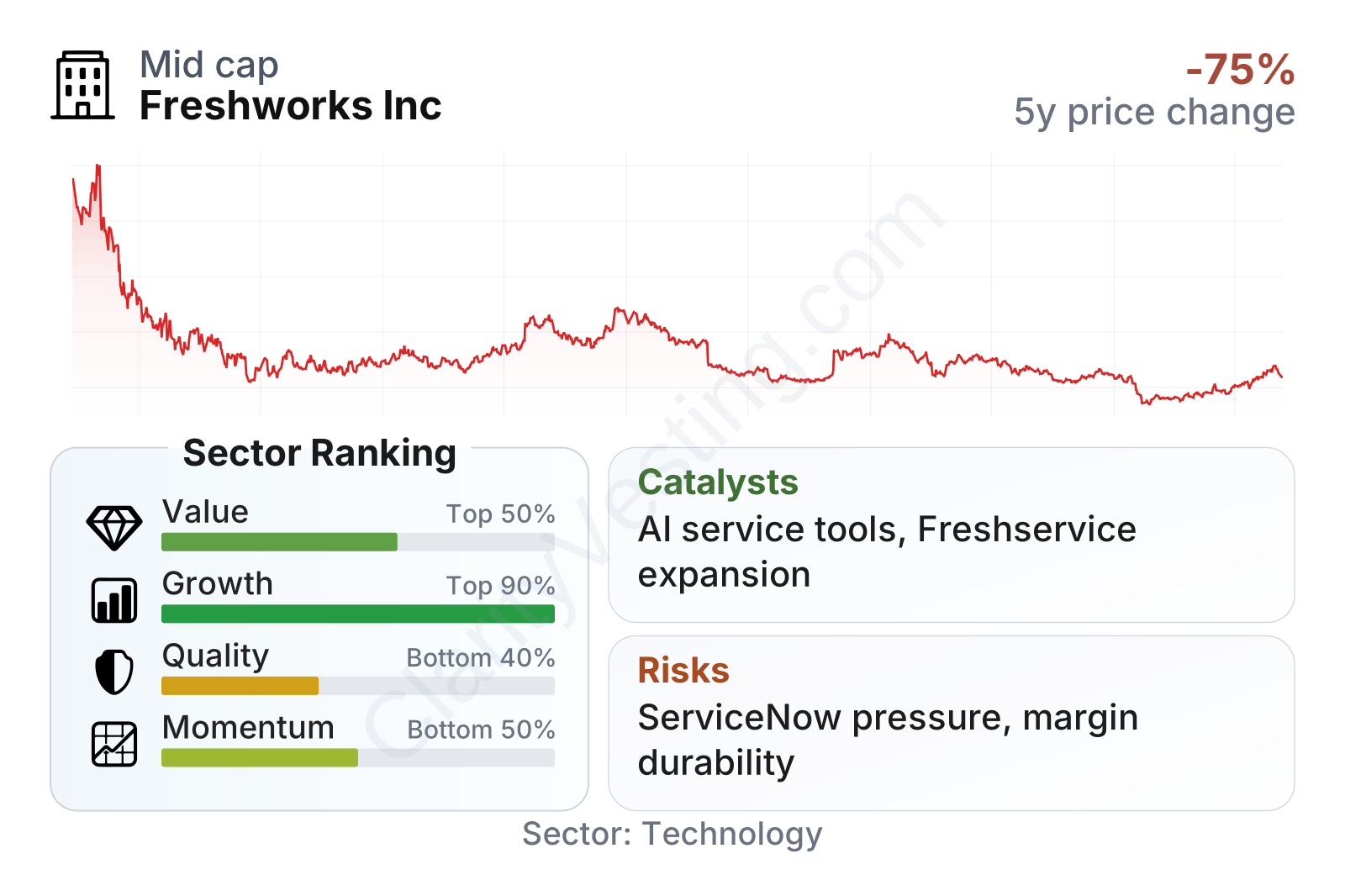
The stock price history has been volatile since the IPO, with a sharp reset from early post-listing levels, followed by periods of recovery and renewed weakness. That pattern reflects a business that has improved fundamentally faster than market sentiment has improved.
Growth
Freshworks operates in a part of the software market that still has room to grow over the long term. Customer support software, IT service management, CRM, and AI-enabled business automation are all benefiting from the same broad trend: companies want to handle more interactions digitally, serve users faster, and reduce manual work. That creates demand for platforms that combine workflow, data, analytics, and automation in one system.
The company’s strategy is coherent for that environment. Rather than competing only for the largest and most complex enterprise contracts, Freshworks has historically targeted organizations that want modern cloud tools without the cost and complexity often associated with legacy vendors. That positioning can be attractive in a cautious spending environment, especially for mid-market businesses and departments inside larger organizations.
Growth has slowed from the very high rates seen earlier in its public-company life, but it has remained resilient at around the mid-teens recently. That matters because the company is no longer relying on growth alone: it is now pairing expansion with a much better earnings and cash profile. Over a five-year view, revenue per share growth has clearly outpaced the sector median, which suggests the business has been scaling better than many peers even as the headline growth rate moderated.
Free cash flow is one of the more encouraging parts of the picture. Freshworks moved from near break-even or negative levels a few years ago to roughly a quarter of a billion dollars on a trailing basis. That shift indicates the company is not just adding revenue but also converting more of that revenue into actual cash. For long-term analysis, this is often more important than accounting profits alone because it gives the company flexibility to invest, acquire, or absorb slowdowns without depending heavily on external financing.
A major catalyst is the broader rollout of artificial intelligence across support and service workflows. Freshworks has been integrating AI capabilities into customer and employee experience products, including automated responses, agent assistance, summarization, and workflow improvements. If these features help customers reduce labor costs or improve response times, they can support both adoption and pricing power. Another potential growth driver is continued expansion of Freshservice, which gives the company exposure to IT service management, a category with sticky use cases and longer customer relationships than some lighter-weight software tools.
Recent company updates have also pointed to a sharper focus on efficiency and higher-value growth. The combination of steadier revenue growth, positive operating income, and stronger cash generation suggests Freshworks is entering a more mature phase where scale benefits are becoming visible.
Risks
This article is for informational purposes only and does not constitute financial advice. Some content is AI-generated. See Disclaimer


