Stock Analysis · Jfrog Ltd (FROG)
Overview
JFrog is a software company that helps businesses manage, secure, and distribute the software they build. Its platform is best known for handling software packages and updates across the entire development process, from code creation to testing, release, deployment, and ongoing maintenance. In simple terms, JFrog provides the infrastructure that helps companies move software from developers to users in a controlled and traceable way.
The company operates in a part of software often described as DevOps, DevSecOps, and software supply chain management. This is an important layer of modern technology because companies now release software continuously, run applications across cloud environments, and need tighter control over security. JFrog’s products are used to manage binaries, container images, machine learning models, and software artifacts, while also helping customers scan for vulnerabilities and automate releases.
Revenue is overwhelmingly subscription-based. Based on recent annual filings, JFrog generates the vast majority of its sales from recurring subscriptions, while a small remainder comes from services tied to onboarding, training, and support.
- Subscriptions: about 95% to 97% of revenue. This includes cloud subscriptions, self-hosted platform subscriptions, and usage of JFrog’s core software delivery and security tools.
- Professional services: about 3% to 5% of revenue. This includes implementation help, consulting, training, and related support activities.
That mix matters because recurring subscriptions usually produce better visibility and stronger customer retention than one-time license sales. The financial flow over recent years also shows a business with consistently high gross margins, but one that still spends heavily on research and development and on sales efforts to expand its platform.
One clear pattern is that revenue and gross profit have risen steadily year after year, while operating losses have narrowed much more slowly. JFrog is therefore not a low-margin business problem; it is more a case of a high-gross-margin company still investing aggressively to capture a larger market.
Key Figures
| Metric | Value | Sector ⓘ |
|---|---|---|
| Date | Sep 12, 2026 | |
| Context | ||
| Sector | Technology | |
| Industry | Software - Application | |
| Market Cap ⓘ | $10.93B | |
| Beta ⓘ | 1.28 | |
Value (Cheapness) | ||
| P/E Ratio ⓘ | N/A | 29.51 |
| FCF Yield ⓘ | 1.55% | 4.25% |
| EBIT / EV ⓘ | -0.41% | 2.85% |
| PEG ⓘ | N/A | |
Growth (Business expansion) | ||
| Revenue Growth ⓘ | 28.70% | 15.40% |
| RPS Growth (5Y CAGR) ⓘ | 20.36% | 8.56% |
| EPS Growth (5Y CAGR) ⓘ | N/A | -11.88% |
| Margin Growth (5Y Trend) ⓘ | N/A | 0.46% |
| FCF Growth (5Y CAGR) ⓘ | 56.57% | 9.80% |
Quality (Business durability) | ||
| ROIC (Latest) ⓘ | -3.50% | 9.44% |
| ROIC (5Y Median) ⓘ | -7.07% | 8.30% |
| Net Debt / EBIT (Latest) ⓘ | N/A | 0.54 |
| Net Debt / EBIT (5Y Median) ⓘ | N/A | 0.44 |
| Operating Margin (Latest) ⓘ | -6.79% | 9.58% |
| Operating Margin (5Y Median) ⓘ | -15.58% | 8.25% |
| Debt to Equity (Latest) ⓘ | 1.52% | 33.33% |
| Profit Margin (Latest) ⓘ | -7.35% | 7.14% |
| Free Cash Flow (Latest) ⓘ | $169.70M | |
Momentum (Price trend) | ||
| 3Y Return ⓘ | +229.60% | +45.48% |
| 12M Return (excl. last month) ⓘ | +109.55% | +23.48% |
| 6M Return ⓘ | +108.12% | +20.93% |
| Price vs. 200-Day MA ⓘ | +31.60% | +7.43% |
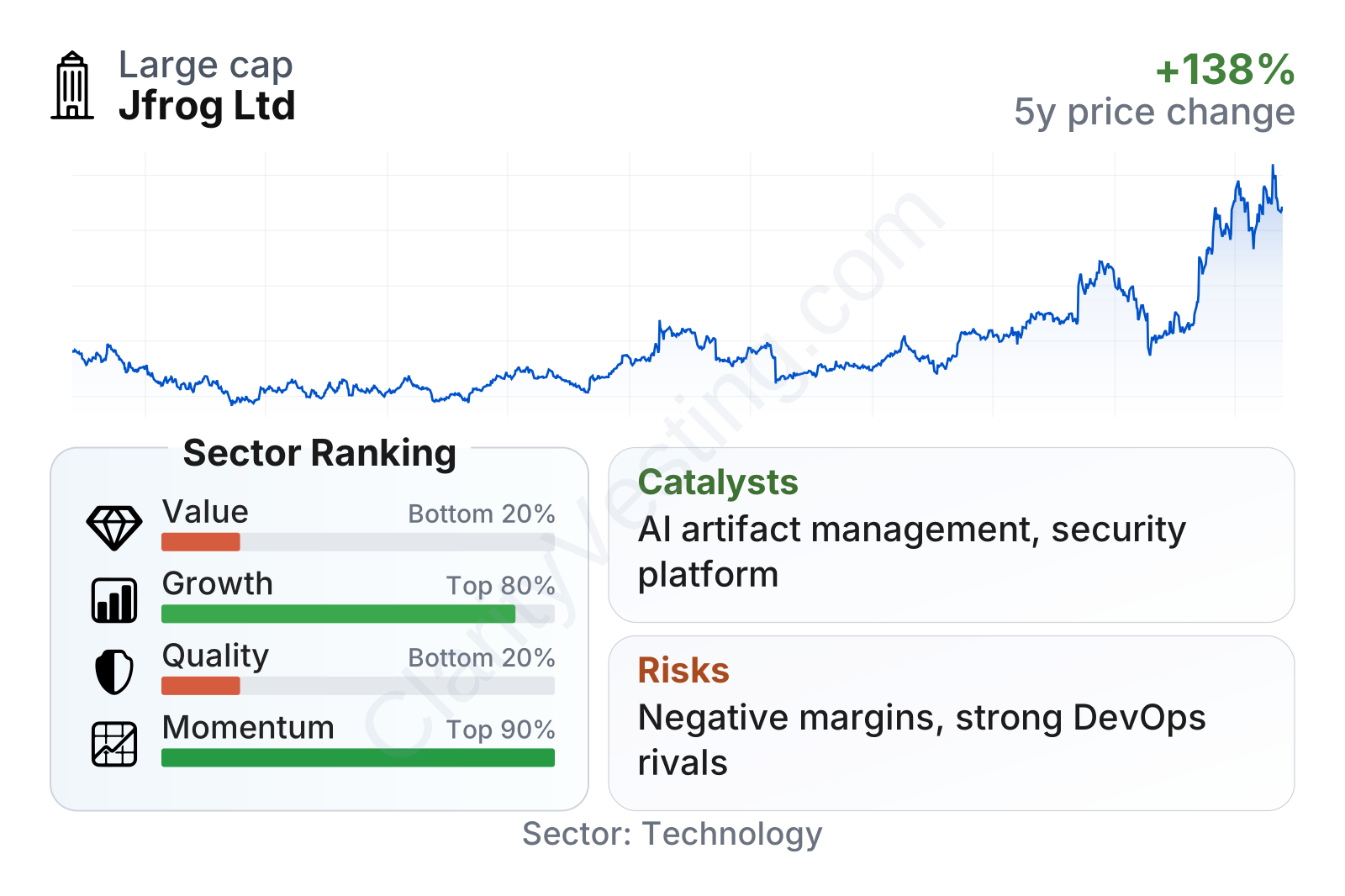
JFrog is now a mid-sized software company with a market value a little above $10 billion, and its share price has been strong over the last year and over the last three years. In growth and momentum, it ranks well above much of the software sector. The weaker side of the picture is profitability and valuation support: operating margin, profit margin, and returns on invested capital remain below sector norms, while cash flow yield is also lower than the median. In short, the market is rewarding growth and strategic relevance more than current earnings power.
Growth
JFrog operates in a sector that still has room to expand. Software teams are shipping updates faster, using more cloud infrastructure, and facing more security pressure. That creates demand for platforms that can manage software artifacts, automate releases, and verify what is being pushed into production. As software supply chain security has become a board-level issue, JFrog’s combination of delivery tools and security features fits a real and durable need.
The company’s strategy also appears coherent for long-term expansion. Rather than offering a single narrow tool, JFrog has been building a broader platform around artifact management, release lifecycle management, security scanning, runtime visibility, and machine learning model handling. That platform approach can increase customer spending over time because a client that starts with package management can later adopt security and distribution modules as well.
Revenue growth has remained strong for a company of JFrog’s size. The pace has cooled from the very high levels seen earlier in its public-company history, but recent year-over-year growth has stayed around the high-20% range, still meaningfully above the sector median. The five-year trend in revenue per share also suggests that expansion has not come from financial engineering; the business itself has been scaling.
Another encouraging point is cash generation. Free cash flow has improved sharply over the last several years, rising from a modest level to well above $150 million on a trailing basis. That does not mean the company is fully mature, but it does show that the core model can produce real cash even while accounting profits remain negative.
A major catalyst is the ongoing convergence of software delivery and security. Enterprises increasingly want fewer disconnected tools and more unified control of the software pipeline. JFrog is positioned to benefit if customers continue consolidating around integrated platforms. The rise of artificial intelligence can also help, not only because AI development creates more models and artifacts to manage, but also because organizations need secure and reproducible ways to move those assets into production.
Recent company communications have also emphasized product launches and partnerships around software supply chain security, cloud-native development, and AI-related workflows. These initiatives matter because they can expand JFrog’s role from a back-end repository tool into a broader operational control layer across development teams.
Risks
This article is for informational purposes only and does not constitute financial advice. Some content is AI-generated. See Disclaimer


