Stock Analysis · Shift4 Payments Inc (FOUR)
Overview
Shift4 Payments is a commerce technology company focused on payment processing and software tools for merchants. In simple terms, it helps businesses accept card and digital payments, run point-of-sale systems, manage commerce across in-person and online channels, and connect those transactions to other business functions. The company has built its presence particularly in restaurants, hotels, entertainment venues, sports locations, specialty retail, nonprofits, and travel-related businesses.
Its business model is centered on handling payment volume for merchants and earning fees from those transactions, while also selling or enabling related software and technology services. Shift4 has expanded over time from a payment processor into a broader commerce platform, and its strategy increasingly emphasizes industry-specific solutions rather than generic payment acceptance.
Based on company filings, the main revenue streams are organized around payment-based and subscription-based activities, with transaction-related income clearly dominating the mix. The broad picture is as follows:
- Payment processing and related services: approximately 80% to 90% of revenue. This includes fees earned from processing card and other payment transactions for merchants.
- Subscription and software-related revenue: approximately 10% to 20% of revenue. This includes point-of-sale software, technology services, gateway capabilities, business management tools, and other recurring platform services.
- Hardware and other revenue: a small portion of revenue. This can include terminals, deployment-related items, and other ancillary services.
Over the last several years, the company’s financial structure has shown a clear pattern: revenue has risen quickly, gross profit has expanded even faster, and operating profit has improved materially despite growing selling and administrative costs. That suggests Shift4 has been scaling successfully, even if bottom-line earnings have remained more uneven because of financing costs, taxes, and acquisition-related complexity.
Key Figures
| Metric | Value | Sector ⓘ |
|---|---|---|
| Date | Sep 12, 2026 | |
| Context | ||
| Sector | Technology | |
| Industry | Software - Infrastructure | |
| Market Cap ⓘ | $3.40B | |
| Beta ⓘ | 1.38 | |
Value (Cheapness) | ||
| P/E Ratio ⓘ | 67.23 | 29.51 |
| FCF Yield ⓘ | 15.11% | 4.25% |
| EBIT / EV ⓘ | 4.99% | 2.85% |
| PEG ⓘ | 0.31 | |
Growth (Business expansion) | ||
| Revenue Growth ⓘ | 34.10% | 15.40% |
| RPS Growth (5Y CAGR) ⓘ | 17.21% | 8.56% |
| EPS Growth (5Y CAGR) ⓘ | 10.65% | -11.88% |
| Margin Growth (5Y Trend) ⓘ | 12.80% | 0.46% |
| FCF Growth (5Y CAGR) ⓘ | N/A | 9.80% |
Quality (Business durability) | ||
| ROIC (Latest) ⓘ | 4.58% | 9.44% |
| ROIC (5Y Median) ⓘ | 5.81% | 8.30% |
| Net Debt / EBIT (Latest) ⓘ | 11.09 | 0.54 |
| Net Debt / EBIT (5Y Median) ⓘ | 9.10 | 0.44 |
| Operating Margin (Latest) ⓘ | 7.94% | 9.58% |
| Operating Margin (5Y Median) ⓘ | 5.91% | 8.25% |
| Debt to Equity (Latest) ⓘ | 282.26% | 33.33% |
| Profit Margin (Latest) ⓘ | 2.20% | 7.14% |
| Free Cash Flow (Latest) ⓘ | $513.50M | |
Momentum (Price trend) | ||
| 3Y Return ⓘ | -18.81% | +45.48% |
| 12M Return (excl. last month) ⓘ | -49.51% | +23.48% |
| 6M Return ⓘ | +2.60% | +20.93% |
| Price vs. 200-Day MA ⓘ | -11.99% | +7.43% |
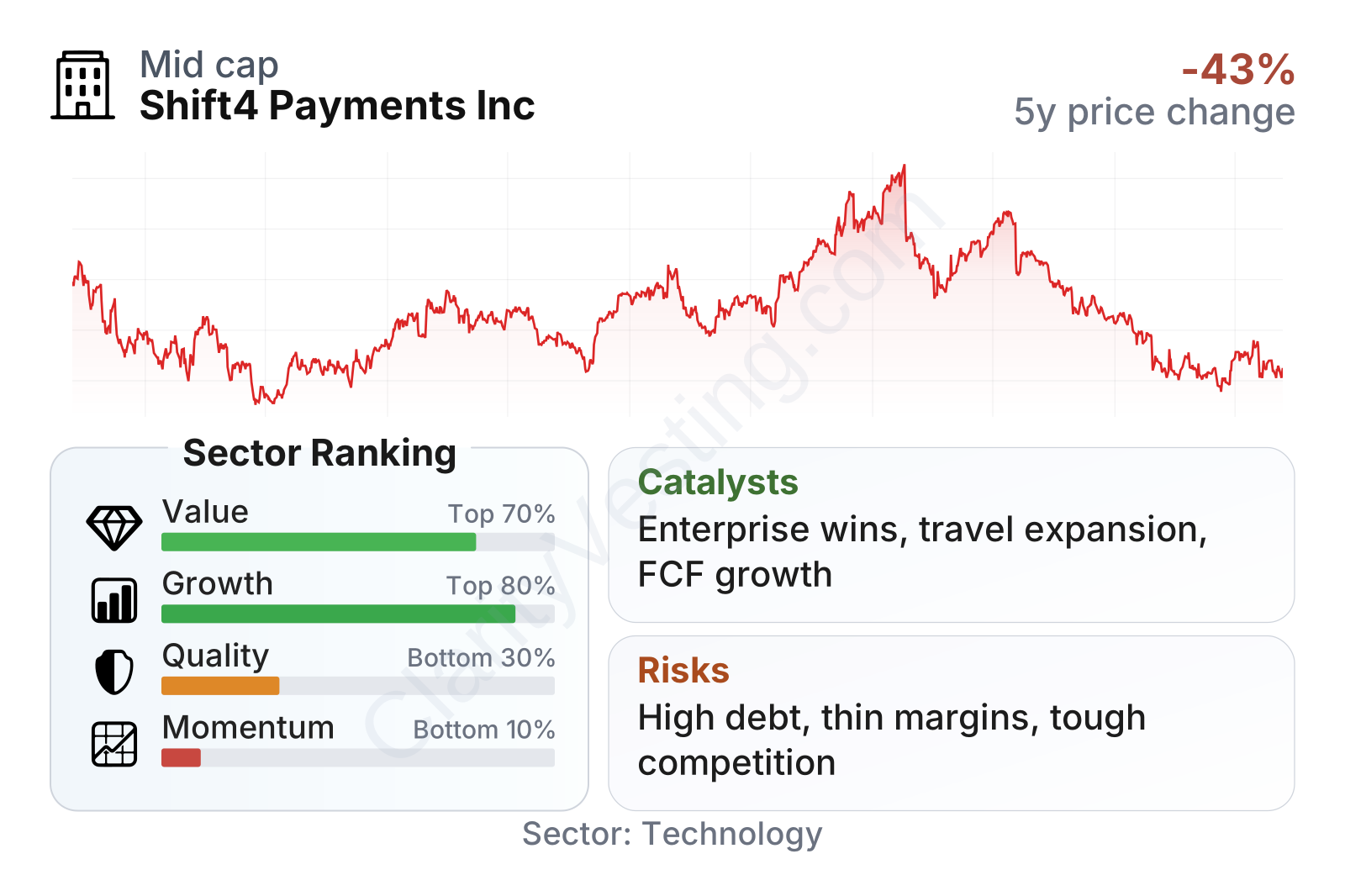
Shift4 sits in the mid-cap range and shows a mixed profile. Growth and cash generation stand out positively versus much of the technology sector, while balance-sheet leverage and profitability metrics remain weaker than many peers. The market has also treated the stock cautiously: recent share-price momentum has been far below the sector, which often reflects investor concern about debt, integration risk, or margin durability even when revenue is still expanding.
Growth
Shift4 operates in a market with long-term structural support. Electronic payments continue to take share from cash, more merchants want integrated software tied directly to payments, and industries such as hospitality, sports venues, and travel increasingly prefer all-in-one commerce systems. This is a favorable backdrop because Shift4 is not simply offering a commodity payment pipe; it is trying to bundle payments with industry-focused software and operational tools.
The recent growth record has been strong. Revenue growth has remained well above the sector median, with year-over-year increases still running around the low-30% range most recently. That is notable because many payment-related businesses slow down as they get larger, yet Shift4 has continued to expand at a pace that remains high for its size.
The company’s strategy also makes sense for future expansion. Management has consistently pushed into verticals where payments are mission-critical and where specialized software can make merchant switching less likely. Restaurants, hotels, stadiums, gaming, and travel are useful examples because these customers often need more than a simple checkout function. If Shift4 can control more of the commerce workflow, it can deepen customer relationships and capture more revenue per merchant.
Another encouraging point is cash generation. Free cash flow has moved from negative territory to a substantial positive level over a relatively short period. That matters because it shows the underlying economics are improving even while the company continues to invest and integrate acquisitions.
A major catalyst has been Shift4’s ongoing push into enterprise customers and complex venues, where transaction volume can be very large and multi-location relationships can last for years. The company has also emphasized international expansion and travel-related payment opportunities, both of which can broaden its addressable market beyond its earlier U.S.-centered base. Recent corporate updates have continued to point toward product expansion, partnerships, and acquisitions as tools to accelerate that strategy.
Risks
This article is for informational purposes only and does not constitute financial advice. Some content is AI-generated. See Disclaimer


