Stock Analysis · FormFactor Inc (FORM)
Overview
FormFactor is a semiconductor test and measurement equipment company. In simple terms, it makes specialized hardware used to check whether advanced chips and wafers work properly before they are packaged and shipped. Its products are used by chip manufacturers, outsourced test providers, and companies designing high-performance processors, memory, radio-frequency chips, and photonics devices. The business sits in an important part of the semiconductor supply chain: as chips become smaller, faster, and more complex, testing becomes more difficult and more valuable.
The company’s revenue mainly comes from probe cards and engineering systems. Probe cards are used in wafer testing and are the core of the business, while engineering systems include thermal and measurement tools used in development, characterization, and reliability testing. Based on recent company disclosures, the revenue mix can be summarized approximately as follows:
- Probe Cards: about 80% to 85% of revenue. These are precision interfaces used to test semiconductor wafers before chips are cut and packaged. They serve areas such as foundry and logic, DRAM, flash memory, and advanced packaging-related applications.
- Systems: about 15% to 20% of revenue. This segment includes cryogenic probe stations, thermal subsystems, and other engineering and reliability tools used in chip development, characterization, and specialized test environments.
Geographically, FormFactor has meaningful exposure to Asia because much of the world’s semiconductor manufacturing and outsourced testing is concentrated there. Customer concentration also matters: a relatively small number of large semiconductor companies can account for a significant share of sales in any given year, which is common in this industry.
Over the last several years, the business has shown a mix of cyclical swings and operating discipline. Revenue dipped during weaker semiconductor demand, but the company kept investing in research and development while preserving profitability and a very conservative balance sheet. That combination is important because this is not a commodity business; it depends on technical performance, customer relationships, and the ability to support next-generation chip designs.
The revenue base has been uneven from year to year, which reflects normal semiconductor cycles, but the expense structure has stayed relatively controlled. Research and development remains a large ongoing commitment, showing that FormFactor is paying to stay relevant in advanced test applications rather than simply maximizing short-term earnings.
Key Figures
| Metric | Value | Sector ⓘ |
|---|---|---|
| Date | Sep 12, 2026 | |
| Context | ||
| Sector | Technology | |
| Industry | Semiconductor Equipment & Materials | |
| Market Cap ⓘ | $8.74B | |
| Beta ⓘ | 1.24 | |
Value (Cheapness) | ||
| P/E Ratio ⓘ | 78.96 | 29.51 |
| FCF Yield ⓘ | 1.56% | 4.25% |
| EBIT / EV ⓘ | 1.51% | 2.85% |
| PEG ⓘ | 1.39 | |
Growth (Business expansion) | ||
| Revenue Growth ⓘ | 31.90% | 15.40% |
| RPS Growth (5Y CAGR) ⓘ | 0.76% | 8.56% |
| EPS Growth (5Y CAGR) ⓘ | 1.36% | -11.88% |
| Margin Growth (5Y Trend) ⓘ | -4.23% | 0.46% |
| FCF Growth (5Y CAGR) ⓘ | -36.64% | 9.80% |
Quality (Business durability) | ||
| ROIC (Latest) ⓘ | 10.65% | 9.44% |
| ROIC (5Y Median) ⓘ | 7.43% | 8.30% |
| Net Debt / EBIT (Latest) ⓘ | -0.61 | 0.54 |
| Net Debt / EBIT (5Y Median) ⓘ | -1.01 | 0.44 |
| Operating Margin (Latest) ⓘ | 14.43% | 9.58% |
| Operating Margin (5Y Median) ⓘ | 10.45% | 8.25% |
| Debt to Equity (Latest) ⓘ | 2.69% | 33.33% |
| Profit Margin (Latest) ⓘ | 12.80% | 7.14% |
| Free Cash Flow (Latest) ⓘ | $136.12M | |
Momentum (Price trend) | ||
| 3Y Return ⓘ | +257.88% | +45.48% |
| 12M Return (excl. last month) ⓘ | +331.82% | +23.48% |
| 6M Return ⓘ | +30.03% | +20.93% |
| Price vs. 200-Day MA ⓘ | +11.27% | +7.43% |
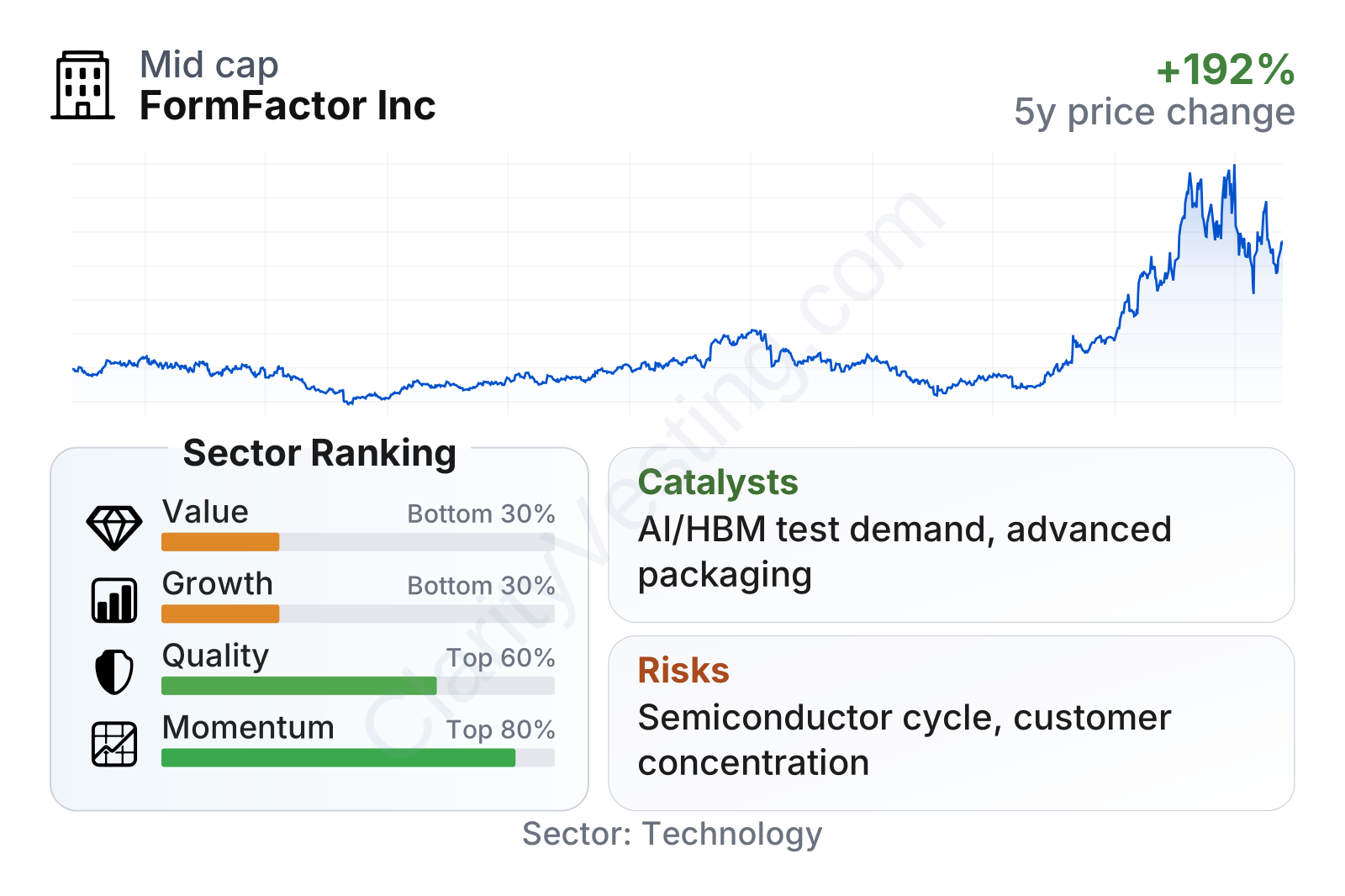
FormFactor is a mid-sized semiconductor equipment company with above-average share price momentum and decent operating quality, but the current profile is less convincing on traditional valuation measures. Profitability and balance sheet metrics compare well with much of the sector, while growth measures look mixed because short-term acceleration is strong but the longer multi-year record is more uneven.
The stock performance has been very strong recently after a volatile period. That rebound suggests the market is pricing in a much better demand environment and a stronger earnings outlook than what was visible during the industry slowdown.
Growth
FormFactor operates in a sector with long-term structural support. Semiconductor content keeps rising in data centers, artificial intelligence infrastructure, smartphones, autos, industrial equipment, and connected devices. Even when chip demand moves through downcycles, the broader direction remains upward because more computing power is being deployed across the economy. Testing also becomes more critical as chip architectures become more advanced, especially in high-bandwidth memory, advanced packaging, leading-edge logic, silicon photonics, and high-performance compute.
That industry backdrop fits FormFactor’s strategy. The company is focused on the part of semiconductor testing that becomes harder as chip complexity rises. This matters because advanced test requirements can raise barriers to entry. If a customer needs very high precision, thermal control, signal integrity, and reliability at the wafer level, performance matters more than price alone. FormFactor has positioned itself around those demanding applications rather than lower-value parts of the market.
Recent revenue growth has improved sharply, with year-over-year expansion running well above the broader sector median. That is encouraging, but it should be read alongside the company’s more uneven five-year growth record. In other words, the recent upswing is real, yet it comes after a period that included industry weakness and company-specific fluctuations rather than a perfectly steady climb.
One of the strongest catalysts is the buildout of AI-related semiconductor infrastructure. Advanced processors and especially high-bandwidth memory require complex testing steps, and those categories are seeing heavy industry investment. FormFactor has repeatedly emphasized leading-edge foundry and logic, DRAM, and advanced packaging-related opportunities as areas of demand. If those customer programs continue scaling, the company has room to expand both revenue and margins because higher-end products typically carry better economics.
Another supportive factor is engineering systems exposure to specialized applications such as cryogenic and photonics testing. These are not the largest revenue contributors today, but they give the company access to emerging technical niches tied to next-generation computing and communications.
Cash generation has been positive, but not smooth. Free cash flow remains comfortably above zero, which supports flexibility, yet its path has been lumpy rather than steadily rising. For a cyclical equipment supplier, that is not unusual; still, it means investors need to distinguish between a temporary recovery in demand and a durable step-up in the company’s earning power.
Risks
This article is for informational purposes only and does not constitute financial advice. Some content is AI-generated. See Disclaimer


