Stock Analysis · Floor & Decor Holdings Inc (FND)
Overview
Floor & Decor Holdings Inc. is a specialty retailer focused on hard-surface flooring and related home-improvement products. Its stores are designed as large warehouse-style locations that offer tile, wood, laminate, vinyl, natural stone, installation materials, and decorative accessories. The company serves both do-it-yourself homeowners and professional installers, which gives it exposure to remodeling, renovation, and repair activity across residential and commercial projects.
The business model is fairly straightforward: Floor & Decor buys products directly from manufacturers around the world, sells a broad assortment at warehouse prices, and supports those sales with design services, contractor-focused programs, and an e-commerce channel that helps customers research products and check store availability. The company’s differentiation is based on depth of assortment in hard flooring rather than general home improvement.
Revenue comes mainly from merchandise sales in stores, with digital sales supporting the same product categories. Based on company disclosures and the structure of the business, the main revenue sources are approximately the following:
- Hard-surface flooring products: about 60% to 70% of revenue. This includes tile, wood, laminate, vinyl, and stone flooring.
- Installation materials and tools: about 15% to 20% of revenue. This includes underlayment, mortar, grout, adhesives, trims, and tools needed for flooring projects.
- Decorative and adjacent categories: about 10% to 15% of revenue. This includes backsplashes, wall tile, countertops, shower systems, and accessories.
- Services and other activity: a small share of revenue. The company offers design-related support, but it is primarily a product retailer rather than a service-led model.
Over the last several years, the company has expanded revenue meaningfully, but the earnings flow shows some pressure: sales moved from roughly $3.4 billion in 2021 to about $4.7 billion in 2025, while net income fell from roughly $283 million to about $209 million over the same period. That points to a company still growing its footprint, but with a tougher margin environment than it had during the housing and renovation boom.
The operating picture shows a business that has continued to add sales, but a larger share of revenue is being absorbed by merchandise costs and operating expenses than a few years ago. Gross profit has stayed relatively solid in dollars, while operating income and net income have not kept pace with revenue growth, which suggests expansion and a softer demand backdrop have reduced efficiency.
Key Figures
| Metric | Value | Sector ⓘ |
|---|---|---|
| Date | Sep 12, 2026 | |
| Context | ||
| Sector | Consumer Cyclical | |
| Industry | Home Improvement Retail | |
| Market Cap ⓘ | $4.99B | |
| Beta ⓘ | 1.55 | |
Value (Cheapness) | ||
| P/E Ratio ⓘ | 21.90 | 17.10 |
| FCF Yield ⓘ | 4.24% | 8.53% |
| EBIT / EV ⓘ | 4.65% | 6.46% |
| PEG ⓘ | 2.20 | |
Growth (Business expansion) | ||
| Revenue Growth ⓘ | 3.00% | 5.75% |
| RPS Growth (5Y CAGR) ⓘ | 7.82% | 9.14% |
| EPS Growth (5Y CAGR) ⓘ | -26.37% | -18.21% |
| Margin Growth (5Y Trend) ⓘ | -3.94% | -0.23% |
| FCF Growth (5Y CAGR) ⓘ | N/A | 4.91% |
Quality (Business durability) | ||
| ROIC (Latest) ⓘ | 9.28% | 12.61% |
| ROIC (5Y Median) ⓘ | 12.11% | 10.72% |
| Net Debt / EBIT (Latest) ⓘ | 5.38 | 2.10 |
| Net Debt / EBIT (5Y Median) ⓘ | 4.95 | 2.32 |
| Operating Margin (Latest) ⓘ | 6.68% | 9.25% |
| Operating Margin (5Y Median) ⓘ | 7.28% | 9.64% |
| Debt to Equity (Latest) ⓘ | 80.64% | 75.78% |
| Profit Margin (Latest) ⓘ | 4.93% | 5.33% |
| Free Cash Flow (Latest) ⓘ | $211.40M | |
Momentum (Price trend) | ||
| 3Y Return ⓘ | -49.50% | +14.53% |
| 12M Return (excl. last month) ⓘ | -29.08% | +3.08% |
| 6M Return ⓘ | -15.04% | +0.55% |
| Price vs. 200-Day MA ⓘ | -18.03% | -0.54% |
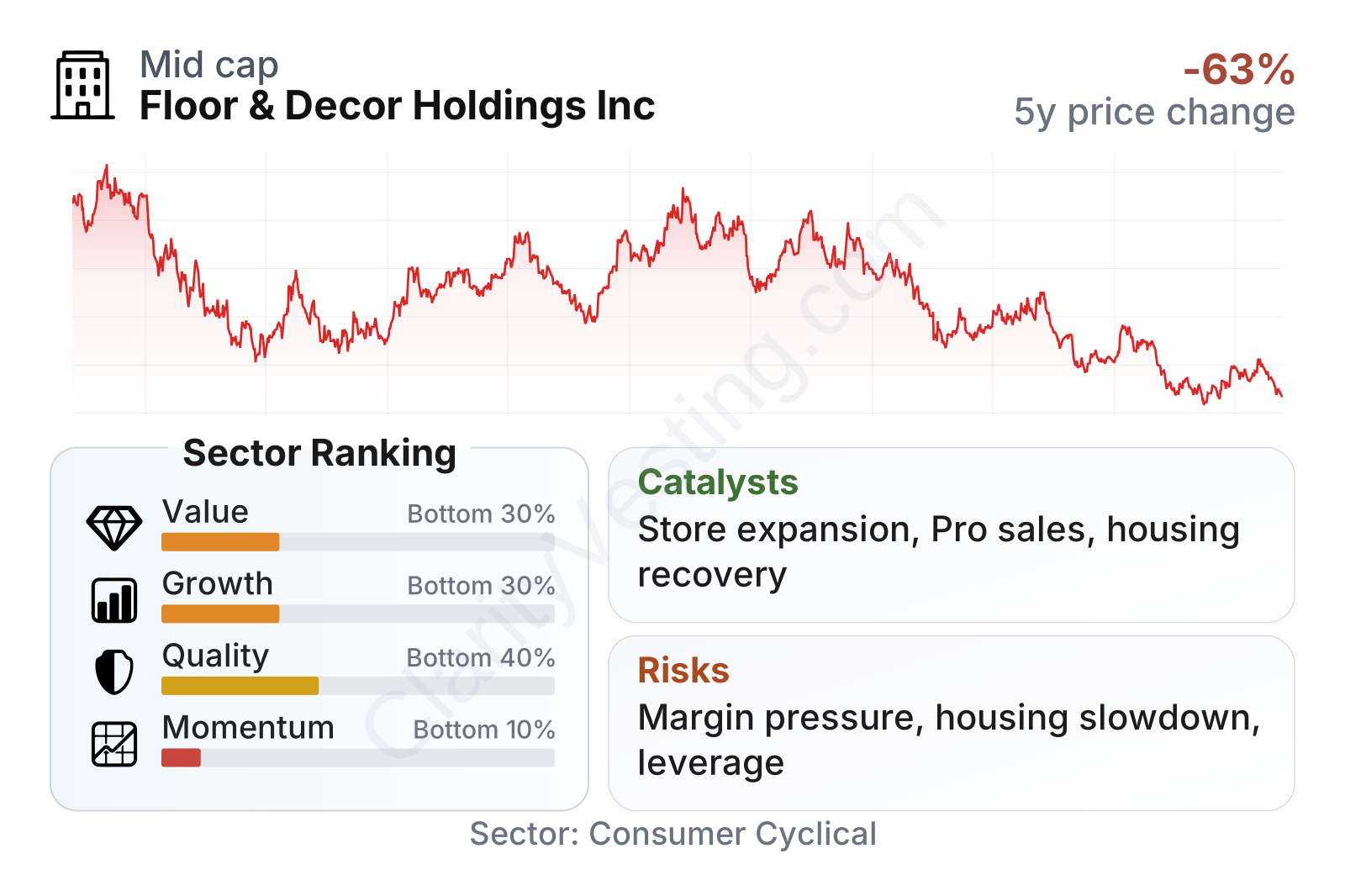
Floor & Decor is a mid-sized company in its sector, and the market currently treats it as a more volatile stock than average, with a beta around 1.6. The broader factor profile is mixed to weak: valuation, growth, quality, and momentum all rank in the lower part of the sector. The most notable positives are a still-respectable return on invested capital over a five-year period and positive free cash flow. The weaker points are slower recent growth, lower margins than the sector median, and a valuation that still sits above many peers despite those pressures.
The share price history reflects that tension. After trading at much higher levels in 2021 and parts of 2024, the stock has moved down sharply over the last few years, which shows how sensitive the company is to shifts in housing demand, remodeling activity, and expectations around future earnings.
Growth
Floor & Decor operates in a market that still has long-term room for growth. Flooring replacement and renovation are recurring needs, and hard-surface flooring has benefited from consumer preference trends for durability, easier maintenance, and modern design. In addition, the U.S. housing stock is aging, which supports renovation demand over time even when short-term housing turnover slows.
The company’s strategy also makes sense for future expansion. It is still building out its store base, which remains much smaller than broad home-improvement chains on a national level. Its warehouse format, direct sourcing, and focus on professional customers create a path to take share in a specialized category. The professional segment is especially important because repeat contractor business can support steadier sales than one-time homeowner purchases.
Recent growth, however, has clearly cooled. Revenue growth was very strong in 2021 and 2022, then slowed sharply, briefly turned negative in 2024, recovered in 2025, and most recently sits in the low single digits. That pattern fits a company moving through a cyclical slowdown rather than a business that has lost relevance, but it also means future expansion likely depends more on new stores and market-share gains than on easy demand tailwinds.
Cash generation has improved compared with the period when expansion and working-capital needs pushed free cash flow below zero. The business is now generating positive trailing free cash flow, although the recent level appears below the stronger rebound seen earlier. That matters because store growth is capital-intensive, and durable free cash flow would make expansion easier to fund without putting more strain on the balance sheet.
A meaningful catalyst is any improvement in the home-turnover and remodeling environment. Lower financing pressure, better housing affordability, or stronger repair-and-remodel spending could help project activity recover. Another important catalyst is continued unit expansion: if new stores mature well and same-store trends stabilize, revenue can continue to grow even in a modest demand backdrop. The company has also highlighted initiatives around design services, commercial business, and professional customer engagement, which could raise average project size and customer retention over time.
Recent company updates have continued to emphasize store openings and market expansion rather than a major change in business model. That is significant because it suggests management still sees a long runway for physical growth, even while the near-term environment remains uneven.
Risks
This article is for informational purposes only and does not constitute financial advice. Some content is AI-generated. See Disclaimer