Stock Analysis · Orange S.A (FNCTF)
Overview
Orange S.A. is one of Europe’s largest telecom operators. The group provides mobile and fixed-line communications, broadband internet, fiber, pay-TV, IT and integration services for businesses, cybersecurity, and mobile financial services in parts of Africa and the Middle East. For everyday customers, Orange is mainly the company behind phone plans, home internet, and bundled telecom offers. For companies and public-sector clients, it also sells network services, cloud connectivity, digital workplace tools, and security solutions.
The business is built around recurring subscription revenue, which gives it a relatively predictable profile compared with more cyclical industries. Orange’s strongest positions are in France, Spain, Poland, Belgium-Luxembourg, and a broad footprint across Africa and the Middle East. That geographic mix matters: mature European markets tend to grow slowly but generate stable cash flows, while African and Middle Eastern operations often deliver faster customer and revenue expansion.
Based on the latest annual disclosures, Orange’s revenue mix is still dominated by traditional telecom services, with enterprise and Africa/Middle East operations acting as the main growth engines. At a high level, the revenue base can be viewed approximately as follows:
- France retail and telecom services: the largest contributor, roughly around two-fifths of group revenue.
- Africa and Middle East: roughly one-fifth, supported by mobile subscribers, data usage, and Orange Money.
- Enterprise services: close to one-fifth, including connectivity, cybersecurity, and IT services through Orange Business.
- Other European markets: roughly one-fifth combined, led by Spain, Poland, and Belgium-Luxembourg.
- Equipment sales and smaller activities: a low-single-digit share depending on the year.
In broad terms, Orange remains a classic telecom incumbent: essential infrastructure, large customer bases, and heavy capital needs. That usually means slower top-line growth than technology companies, but also stronger resilience because communication services have become basic household and business necessities.
The long-term picture is that revenue has been fairly stable, while profitability has moved around more than sales. Operating income held up better than net income in recent years, suggesting that financing costs, taxes, and one-off items have had a meaningful effect on reported earnings. That distinction is important for Orange because cash generation often tells more than headline profit alone.
Key Figures
| Metric | Value | Sector ⓘ |
|---|---|---|
| Date | Sep 05, 2026 | |
| Context | ||
| Sector | Communication Services | |
| Industry | Telecom Services | |
| Market Cap ⓘ | $48.24B | |
| Beta ⓘ | 0.24 | |
Value (Cheapness) | ||
| P/E Ratio ⓘ | 10.55 | 18.41 |
| FCF Yield ⓘ | 16.30% | 13.13% |
| EBIT / EV ⓘ | N/A | 4.58% |
| PEG ⓘ | 0.27 | |
Growth (Business expansion) | ||
| Revenue Growth ⓘ | 5.50% | 5.50% |
| RPS Growth (5Y CAGR) ⓘ | -18.17% | 5.02% |
| EPS Growth (5Y CAGR) ⓘ | N/A | -18.11% |
| Margin Growth (5Y Trend) ⓘ | 1.82% | 0.70% |
| FCF Growth (5Y CAGR) ⓘ | 9.38% | 5.95% |
Quality (Business durability) | ||
| ROIC (Latest) ⓘ | N/A | 8.53% |
| ROIC (5Y Median) ⓘ | 5.08% | 8.32% |
| Net Debt / EBIT (Latest) ⓘ | N/A | 1.70 |
| Net Debt / EBIT (5Y Median) ⓘ | 9.92 | 2.78 |
| Operating Margin (Latest) ⓘ | N/A | 14.90% |
| Operating Margin (5Y Median) ⓘ | 11.05% | 13.00% |
| Debt to Equity (Latest) ⓘ | 178.33% | 60.83% |
| Profit Margin (Latest) ⓘ | 9.98% | 8.78% |
| Free Cash Flow (Latest) ⓘ | $7.87B | |
Momentum (Price trend) | ||
| 3Y Return ⓘ | +90.47% | +48.60% |
| 12M Return (excl. last month) ⓘ | +12.82% | +2.67% |
| 6M Return ⓘ | -11.48% | +2.20% |
| Price vs. 200-Day MA ⓘ | +15.41% | +3.64% |
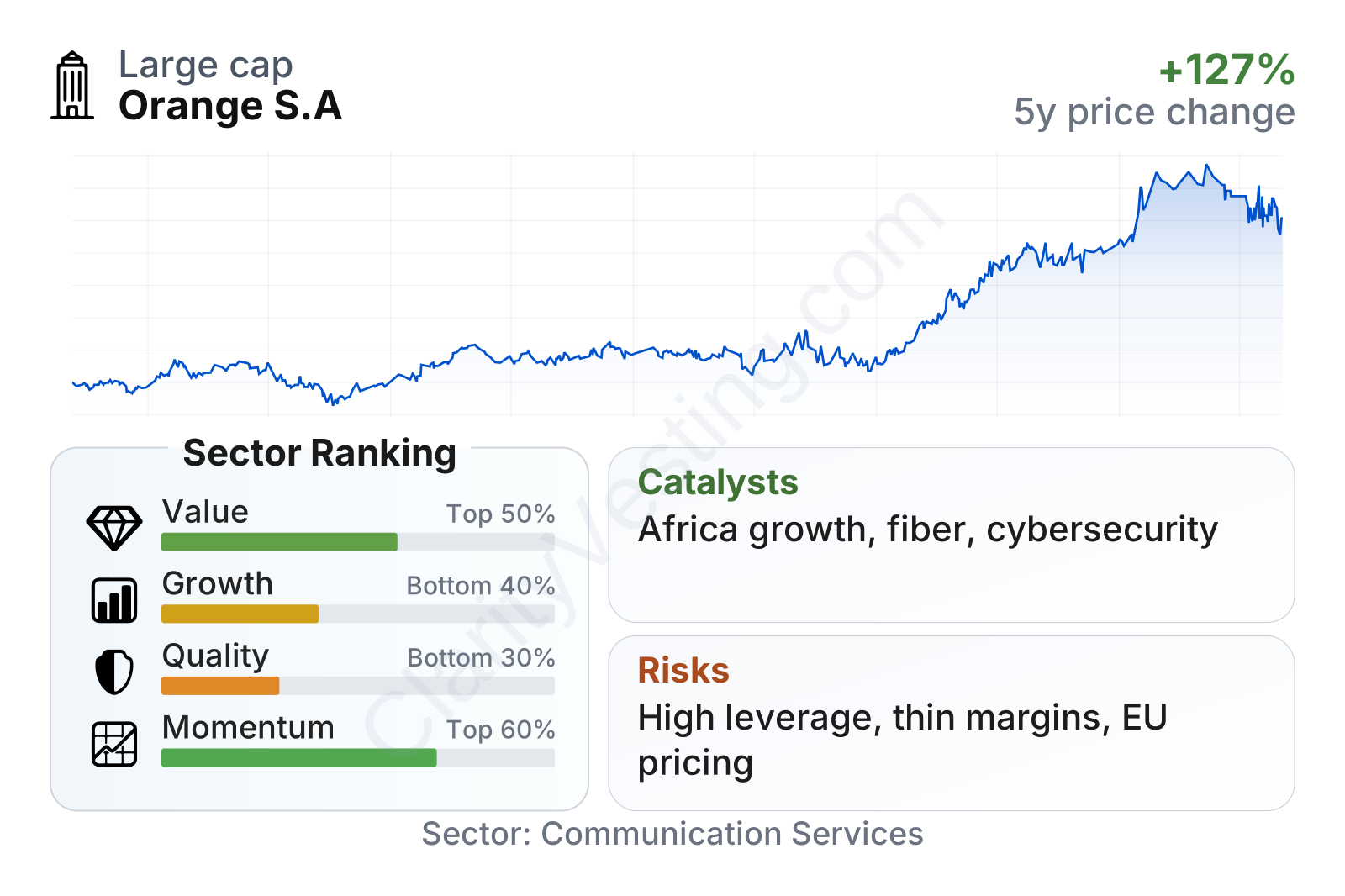
Orange sits in the large-cap category, with a market value a little above $50 billion, and its very low beta points to a stock that has historically moved less than the broader market. The factor picture is mixed. Growth and quality rank below many peers in the communication services sector, reflecting slow revenue expansion, modest returns on capital, and a balance sheet carrying more leverage than the median competitor. On the other hand, free cash flow generation looks solid, and recent price momentum has been notably stronger than the sector median.
The tension in the numbers is straightforward: Orange looks more like a cash-generating utility-style telecom than a fast-growing communications platform. That can support stability, but it also means valuation needs to be judged carefully against limited growth and weaker profitability metrics.
Growth
Telecom is not a high-growth sector in the traditional sense, especially in Western Europe where mobile and broadband markets are mature and competition is intense. Still, it remains an attractive long-duration sector because data consumption keeps rising, fiber penetration continues to expand, and mobile networks become more central to digital life every year. In that environment, growth usually comes from pricing discipline, better network quality, convergent bundles, business services, and expansion in underpenetrated regions rather than from explosive customer additions.
Orange’s strategy broadly fits that reality. In mature markets, the company has focused on fiber rollout, premium network positioning, and combining mobile and broadband offers to reduce churn. In business services, Orange has been trying to move further into cybersecurity and digital infrastructure, where demand is supported by long-term digitization needs. In Africa and the Middle East, the group has a more traditional growth runway through mobile data adoption, financial services, and still-expanding customer bases.
The challenge is that recent revenue growth has been very modest overall, close to flat on a year-over-year basis, which is weaker than the sector median. That confirms that Orange is not currently delivering broad-based expansion at the group level. However, the slower top line has been partly offset by better discipline in margins over time and stronger cash generation than the company’s revenue profile alone would suggest.
Free cash flow is one of the more constructive parts of the story. The company has generated several billion dollars equivalent in trailing cash flow, and the five-year trend has improved faster than the sector median. For a telecom operator, that matters because network investment is unavoidable; if a company can still produce substantial cash after those investments, it has more flexibility to manage debt, maintain distributions, and fund selective growth projects.
A meaningful catalyst is Orange’s exposure to Africa and the Middle East, where mobile data usage and fintech adoption remain important structural drivers. Orange Money is especially relevant because it broadens the relationship beyond telecom into payments and financial transactions. Another potential support comes from enterprise cybersecurity and connectivity services, areas where demand is more tied to digital transformation than to consumer handset cycles.
Recent company communications have also emphasized efficiency initiatives, fiber monetization, and disciplined capital allocation. None of these are dramatic on their own, but together they support the idea that Orange’s future progress is more likely to come from steady execution and cash conversion than from rapid revenue acceleration.
Risks
This article is for informational purposes only and does not constitute financial advice. Some content is AI-generated. See Disclaimer


