Stock Analysis · Federal Home Loan Mortgage Corp Pref Perpetual (FMCCT)
Overview
Federal Home Loan Mortgage Corp, better known as Freddie Mac, is a government-sponsored enterprise that supports the U.S. housing market. Its role is not the same as a typical retail bank. Instead of mainly making home loans directly to consumers, it buys mortgages that meet its standards, guarantees mortgage-backed securities, and invests in housing-related assets. This helps lenders free up capital and continue making new home loans.
For long-term analysis, it is important to note that FMCCT is a perpetual preferred stock, not the company’s common stock. That means its economics are tied to Freddie Mac’s overall financial strength, capital position, and legal structure, but the security itself does not represent the same claim as common equity.
Freddie Mac’s business is centered on credit guarantees and mortgage funding. Based on the company’s recent annual reporting structure, its main economic revenue drivers can be summarized as follows:
- Net interest income and portfolio earnings: roughly 55% to 65% of recent total revenue. This includes income from mortgages and mortgage-related investments held on balance sheet, minus funding costs.
- Guarantee fee income: roughly 25% to 35%. This comes from fees charged for guaranteeing the credit performance of mortgage-backed securities sold to investors.
- Gains, fair value changes, and other income: roughly 5% to 15%. This area can include derivatives, investment marks, and other items that may move significantly from one period to another.
Operationally, the company reports through two major segments:
- Single-Family: the largest business, focused on standard U.S. home mortgages, refinancing activity, and credit guarantees on single-family loans.
- Multifamily: financing and securitization for apartment buildings and rental housing, generally a smaller but strategically important contributor.
Recent years show a business with very large financing flows, modest overhead relative to revenue, and earnings that remain highly influenced by interest rates, mortgage volumes, and accounting marks. Revenue rose strongly from 2023 through 2024, then softened slightly in 2025, while net income stayed above $10 billion.
The broad picture is a scaled housing-finance platform with recurring fee income and a large interest-sensitive balance sheet. That combination creates strong earnings power when mortgage credit remains stable, but it also makes results less straightforward than those of a simple lender.
Key Figures
| Metric | Value | Sector ⓘ |
|---|---|---|
| Date | Nov 21, 2026 | |
| Context | ||
| Sector | Financial Services | |
| Industry | Mortgage Finance | |
| Market Cap ⓘ | $58.92B | |
| Beta ⓘ | 1.79 | |
Value (Cheapness) | ||
| P/E Ratio ⓘ | 142.79 | 12.01 |
| P/B Ratio ⓘ | 0.07 | 1.48 |
| FCF Yield ⓘ | 22.79% | 8.77% |
| Dividend Yield ⓘ | N/A | 3.01% |
| EBIT / EV ⓘ | N/A | 8.31% |
| PEG ⓘ | N/A | |
Growth (Business expansion) | ||
| Revenue Growth ⓘ | 8.00% | 6.70% |
| RPS Growth (5Y CAGR) ⓘ | 51.90% | 12.35% |
| EPS Growth (5Y CAGR) ⓘ | N/A | -0.27% |
| BVPS Growth (5Y CAGR) ⓘ | 25.88% | 4.83% |
| Margin Growth (5Y Trend) ⓘ | N/A | -4.16% |
| FCF Growth (5Y CAGR) ⓘ | 4.33% | 4.69% |
| DPS Growth (5Y CAGR) ⓘ | N/A | 8.82% |
Quality (Business durability) | ||
| ROIC (Latest) ⓘ | N/A | 9.49% |
| ROE (Latest) ⓘ | 17.72% | 14.02% |
| ROA (Latest) ⓘ | 0.38% | 1.53% |
| ROIC (5Y Median) ⓘ | N/A | 7.80% |
| ROE (5Y Median) ⓘ | 16.51% | 12.09% |
| ROA (5Y Median) ⓘ | 0.32% | 1.28% |
| Net Debt / EBIT (Latest) ⓘ | N/A | 0.88 |
| Net Debt / EBIT (5Y Median) ⓘ | N/A | 0.73 |
| Net Debt / EBITDA (Latest) ⓘ | N/A | 0.71 |
| Operating Margin (Latest) ⓘ | N/A | 23.37% |
| Operating Margin (5Y Median) ⓘ | N/A | 24.29% |
| Debt to Equity (Latest) ⓘ | N/A | 59.34% |
| Profit Margin (Latest) ⓘ | 53.53% | 26.65% |
| Free Cash Flow (Latest) ⓘ | $13.43B | |
Momentum (Price trend) | ||
| 3Y Return ⓘ | +189.06% | +73.29% |
| 12M Return (excl. last month) ⓘ | -59.45% | +18.35% |
| 6M Return ⓘ | -51.32% | +3.24% |
| Price vs. 200-Day MA ⓘ | -42.05% | +2.17% |
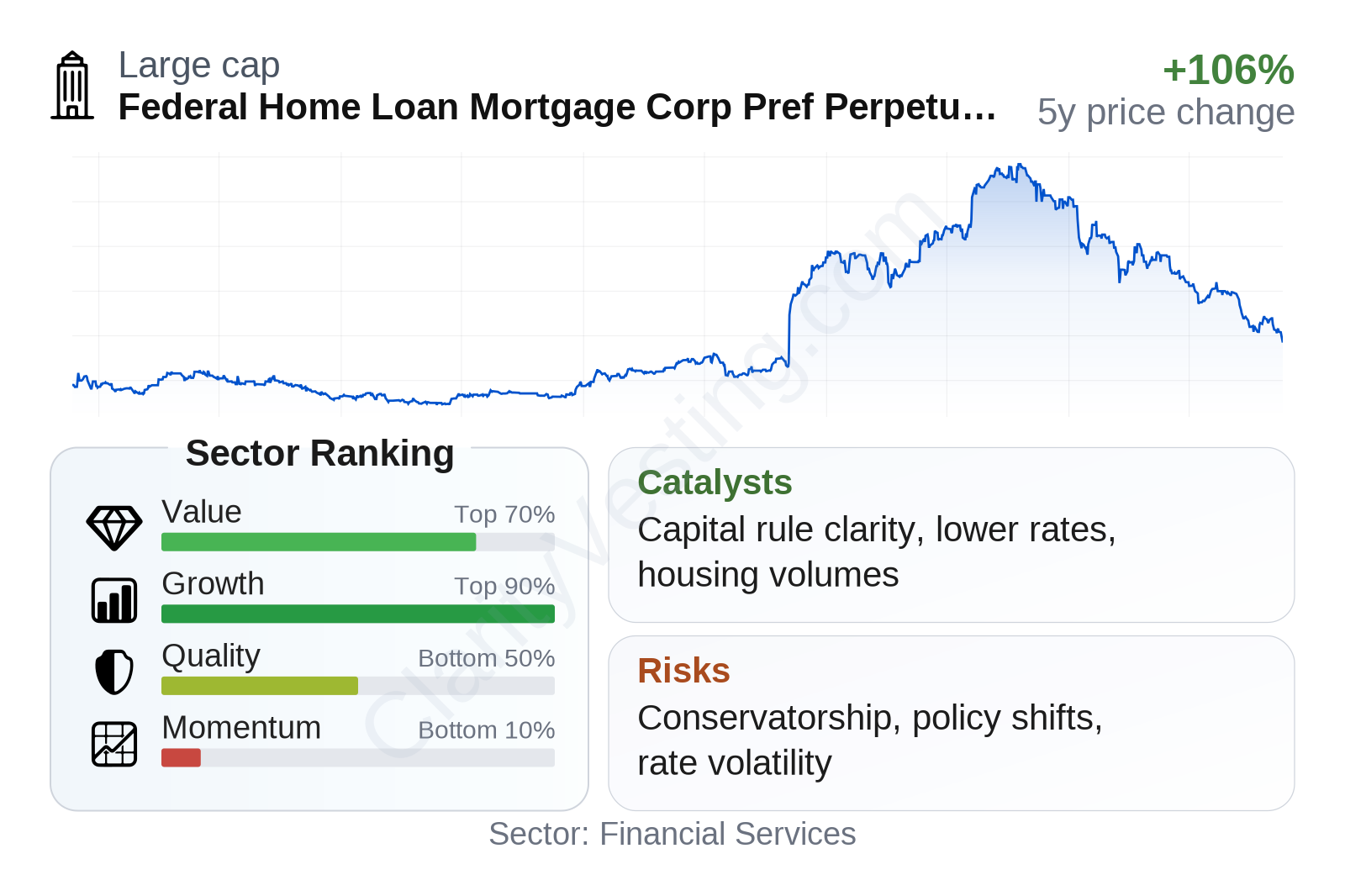
The overall profile is unusual. Growth metrics rank near the top of the sector, helped by strong recent revenue expansion and a long rise in book value per share. Profitability is mixed: return on equity is solid and profit margin is high, but return on assets is well below the sector median, which is common for highly leveraged mortgage finance models. Valuation signals also conflict. The price-to-book ratio is extremely low versus the sector, yet the price-to-earnings ratio appears very high, suggesting that accounting structure and share-class specifics matter more here than simple screening multiples. Recent market performance has also weakened sharply after a strong multi-year run, which points to elevated volatility rather than a smooth long-term trend.
Growth
Freddie Mac operates in a sector with long-term structural relevance. U.S. housing finance remains a massive market, and the need for liquidity in mortgage lending is unlikely to disappear. Demand is supported by population trends, household formation, refinancing cycles, and the ongoing national need for both owner-occupied and rental housing. Within that framework, Freddie Mac remains one of the central institutions in conventional mortgage securitization.
The company’s strategy also has a clear long-term logic. It combines a large single-family franchise with a multifamily platform, relies on guarantee fees that can recur over time, and uses credit risk transfer and securitization to manage exposure. In practical terms, that means Freddie Mac does not need housing prices to surge to remain relevant; it mainly needs continued mortgage origination activity, stable credit performance, and functioning capital markets.
Earnings visibility is not perfectly smooth, and the recent earnings-per-share path shows that clearly. A positive full-year reading followed by a negative mid-year number suggests quarterly or interim profitability can move around with interest-rate dynamics, fair value adjustments, and security-specific considerations. That does not automatically imply business deterioration, but it does show why long-term readers should focus more on normalized profitability and capital accumulation than on one short period.
One of the stronger indicators is the steady rise in book value per share over the last several years. The increase from the low-$40s to above $100 by 2025 points to substantial retained earnings and balance-sheet growth. That matters because Freddie Mac’s ability to build capital has been a central issue for years, especially given its regulated status and the broader discussion around the future of the government-sponsored enterprises.
A major catalyst is any development that improves capital flexibility, clarifies the company’s long-term legal framework, or increases normal mortgage market activity. Lower interest rates could help housing turnover and refinancing volumes. Continued strength in multifamily finance and further growth in guarantee balances could also support revenue. More broadly, any policy move that makes the path of Freddie Mac’s capitalization and governance easier to understand could materially change how the market values the security.
Risks
This article is for informational purposes only and does not constitute financial advice. Some content is AI-generated. See Disclaimer