Stock Analysis · Fukuoka Financial Group Inc (FKKFY)
Overview
Fukuoka Financial Group Inc. is a Japanese regional banking group centered in Kyushu, one of Japan’s major local economic areas. The group was built around Bank of Fukuoka and has expanded through additional regional banking subsidiaries and financial service units. In simple terms, it collects deposits from households and businesses, lends that money to customers, earns fees from financial services, and invests part of its balance sheet in securities.
Its business model is still primarily that of a traditional bank, but with a broad local franchise that also includes leasing, credit cards, securities, consulting, and digital banking initiatives. Because it is a regional institution rather than a nationwide megabank, its performance depends heavily on local economic activity, loan demand, deposit growth, and interest rate conditions in Japan.
The company’s revenue mix is not disclosed in a simple product-by-product percentage format in U.S. market materials, but the latest annual disclosures and banking segment structure indicate the following broad order of importance:
- Net interest income: likely the largest source of revenue, generated from loans to businesses and individuals, securities investments, and the spread between lending yields and funding costs.
- Fees and commissions: the second-largest source, including settlement services, asset management and investment products, credit-related fees, and other customer service charges.
- Trading and securities-related income: income tied to bond holdings, market operations, and gains or losses on financial instruments.
- Other non-interest income: leasing, card businesses, consulting, and other group services.
Recent financial flow trends point to a business that has been expanding revenue meaningfully over the last several fiscal years. Total revenue has risen strongly since fiscal 2022, while operating income and net income have also improved overall, even though funding costs and interest expense have climbed as the rate environment changed. That matters for a bank: growth is visible, but part of the gain is being offset by a higher cost of money.
Key Figures
| Metric | Value | Sector ⓘ |
|---|---|---|
| Date | Nov 21, 2026 | |
| Context | ||
| Sector | Financial Services | |
| Industry | Banks - Regional | |
| Market Cap ⓘ | $8.04B | |
| Beta ⓘ | 0.16 | |
Value (Cheapness) | ||
| P/E Ratio ⓘ | 12.51 | 12.01 |
| P/B Ratio ⓘ | N/A | 1.48 |
| FCF Yield ⓘ | 1.94% | 8.77% |
| Dividend Yield ⓘ | 1.38% | 3.01% |
| EBIT / EV ⓘ | N/A | 8.31% |
| PEG ⓘ | N/A | |
Growth (Business expansion) | ||
| Revenue Growth ⓘ | 52.20% | 6.70% |
| RPS Growth (5Y CAGR) ⓘ | 26.79% | 12.35% |
| EPS Growth (5Y CAGR) ⓘ | -7.61% | -0.27% |
| BVPS Growth (5Y CAGR) ⓘ | 3.67% | 4.83% |
| Margin Growth (5Y Trend) ⓘ | -10.11% | -4.16% |
| FCF Growth (5Y CAGR) ⓘ | -69.30% | 4.69% |
| DPS Growth (5Y CAGR) ⓘ | 16.29% | 8.82% |
Quality (Business durability) | ||
| ROIC (Latest) ⓘ | N/A | 9.49% |
| ROE (Latest) ⓘ | 9.40% | 14.02% |
| ROA (Latest) ⓘ | 0.31% | 1.53% |
| ROIC (5Y Median) ⓘ | 0.87% | 7.80% |
| ROE (5Y Median) ⓘ | 6.38% | 12.09% |
| ROA (5Y Median) ⓘ | 0.20% | 1.28% |
| Net Debt / EBIT (Latest) ⓘ | N/A | 0.88 |
| Net Debt / EBIT (5Y Median) ⓘ | -8.20 | 0.73 |
| Net Debt / EBITDA (Latest) ⓘ | 17.36 | 0.71 |
| Operating Margin (Latest) ⓘ | N/A | 23.37% |
| Operating Margin (5Y Median) ⓘ | 24.29% | 24.29% |
| Debt to Equity (Latest) ⓘ | 752.43% | 59.34% |
| Profit Margin (Latest) ⓘ | 21.18% | 26.65% |
| Free Cash Flow (Latest) ⓘ | $155.94M | |
Momentum (Price trend) | ||
| 3Y Return ⓘ | +109.59% | +73.29% |
| 12M Return (excl. last month) ⓘ | +65.03% | +18.35% |
| 6M Return ⓘ | +3.83% | +3.24% |
| Price vs. 200-Day MA ⓘ | -1.51% | +2.17% |
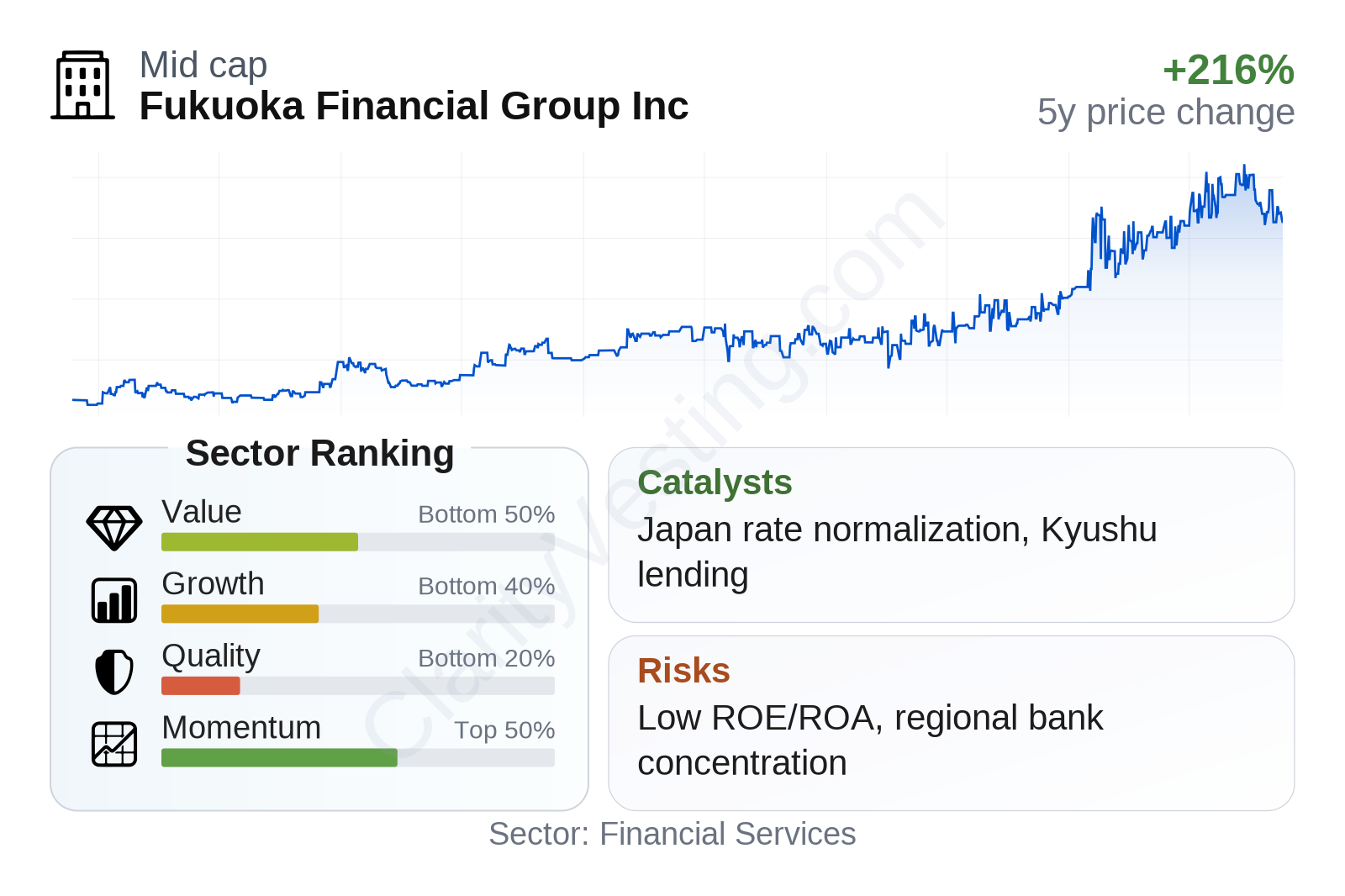
Fukuoka Financial Group is a mid-sized listed bank by global standards, with a low beta that suggests the stock has historically moved less than the broader equity market. The share price trend over the last several years has been clearly upward, with especially strong performance in the last 12 to 24 months. That strength likely reflects improving earnings expectations for Japanese banks as interest rates normalized.
The metric profile is more mixed than the stock chart. On valuation, the shares trade around the sector’s typical earnings multiple rather than at a clear discount. On growth, recent revenue expansion looks strong, but the company ranks lower when looking across a broader set of measures because earnings per share and free cash flow trends have been less consistent over five years. On quality, profitability remains below many peers in the financial sector, especially on return on equity and return on assets.
Growth
Fukuoka Financial Group operates in a sector that has become more interesting after many years of extremely low Japanese interest rates. For regional banks, even modest rate normalization can improve lending spreads and lift income from core banking operations. This is one of the clearest structural tailwinds for the company. A healthier rate environment can help banks earn more on loans and securities, provided deposit costs do not rise too quickly.
The company’s strategy also makes sense in the context of Japanese regional banking. Scale matters because local banks face slow population growth, competition for deposits, and rising technology costs. Fukuoka Financial Group already has meaningful regional scale in Kyushu and has been using that platform to widen services beyond plain lending, including business support, wealth products, and digital offerings. That broadening can improve customer retention and reduce reliance on a single income stream.
Recent growth has been visible in revenue per share over five years, which has risen at a rate clearly above the sector median. Dividend growth has also been strong over that period. Book value per share has increased, though at a more moderate pace than some peers, which suggests the balance sheet has continued to build value but not in a dramatic way.
The earnings path has not been smooth. Reported earnings per share show volatility, including what appears to be a one-off spike that does not reflect a steady linear trend. For long-term analysis, that makes normalized earnings more useful than any single annual figure. Even so, the broader direction of profit recovery appears better than it was a few years ago.
Book value per share has generally moved upward despite some fluctuations, which is important for a bank because book value often serves as a rough anchor for franchise strength and capital accumulation. In a banking business, durable long-term progress usually requires both stable book value growth and improving returns on that equity base. Fukuoka Financial Group has achieved the first condition more clearly than the second.
A practical catalyst is the continued shift in Japan’s rate regime. Another is stronger business activity in Kyushu, where semiconductor investment and industrial development have been attracting attention in recent years. A bank with a concentrated regional footprint can benefit when local corporate customers invest, hire, borrow, and move more cash through the financial system.
Risks
This article is for informational purposes only and does not constitute financial advice. Some content is AI-generated. See Disclaimer