Stock Analysis · Five9 Inc (FIVN)
Overview
Five9 is a cloud software company focused on customer service and sales communications. Its platform helps businesses run contact centers without relying on older on-premise phone systems. In practice, that means routing calls, managing digital messages such as chat, email, and social interactions, supporting agents and supervisors, and increasingly adding artificial intelligence tools that automate routine tasks or assist human agents during conversations.
The company operates in the cloud contact center market, often called CCaaS, short for Contact Center as a Service. This is part of the broader shift by enterprises away from hardware-heavy communications systems and toward subscription software. Five9 sells mainly to businesses and organizations that need customer support, sales outreach, appointment scheduling, collections, and other high-volume customer interaction capabilities.
Revenue is largely subscription-based, which makes the business more recurring than transactional. Based on company filings and disclosures, Five9’s main revenue sources are structured as follows:
- Subscription revenue: about 85% to 90% of total revenue. This includes access to the core cloud contact center platform, voice and digital engagement tools, workforce optimization, analytics, and AI-related capabilities.
- Professional services and other revenue: about 10% to 15%. This includes implementation, consulting, training, and related support work tied to customer deployments.
Within the broader platform, growth priorities have increasingly centered on enterprise customers, digital engagement, workflow automation, and AI-enabled products such as virtual agents, agent assistance, summarization, and integrations with major CRM and unified communications platforms. The business model is attractive when it scales well because recurring software revenue tends to carry high gross margins, but it also requires continued spending on product development, sales, and infrastructure.
Over the last several years, Five9 has expanded from a smaller pure-play cloud call center provider into a broader customer experience software vendor. Revenue has continued to rise, and the business has recently moved from operating losses into positive operating income and net income. That transition matters because it suggests the company is no longer relying only on growth expectations; it is starting to show evidence of financial maturity as well.
The income flow shows a clear improvement in operating discipline. Revenue has climbed from roughly $600 million in 2021 to more than $1.1 billion in 2025, while operating profit moved from losses to a positive level. Research and development remains substantial, but selling and administrative costs have become more controlled relative to revenue, helping turn scale into earnings.
Key Figures
| Metric | Value | Sector ⓘ |
|---|---|---|
| Date | Sep 12, 2026 | |
| Context | ||
| Sector | Technology | |
| Industry | Software - Infrastructure | |
| Market Cap ⓘ | $2.26B | |
| Beta ⓘ | 1.49 | |
Value (Cheapness) | ||
| P/E Ratio ⓘ | 44.49 | 29.51 |
| FCF Yield ⓘ | 8.81% | 4.25% |
| EBIT / EV ⓘ | 3.28% | 2.85% |
| PEG ⓘ | 0.23 | |
Growth (Business expansion) | ||
| Revenue Growth ⓘ | 10.30% | 15.40% |
| RPS Growth (5Y CAGR) ⓘ | 9.96% | 8.56% |
| EPS Growth (5Y CAGR) ⓘ | -9.77% | -11.88% |
| Margin Growth (5Y Trend) ⓘ | N/A | 0.46% |
| FCF Growth (5Y CAGR) ⓘ | N/A | 9.80% |
Quality (Business durability) | ||
| ROIC (Latest) ⓘ | 4.62% | 9.44% |
| ROIC (5Y Median) ⓘ | -4.61% | 8.30% |
| Net Debt / EBIT (Latest) ⓘ | 7.79 | 0.54 |
| Net Debt / EBIT (5Y Median) ⓘ | N/A | 0.44 |
| Operating Margin (Latest) ⓘ | 6.59% | 9.58% |
| Operating Margin (5Y Median) ⓘ | -7.88% | 8.25% |
| Debt to Equity (Latest) ⓘ | 102.58% | 33.33% |
| Profit Margin (Latest) ⓘ | 4.94% | 7.14% |
| Free Cash Flow (Latest) ⓘ | $199.11M | |
Momentum (Price trend) | ||
| 3Y Return ⓘ | -55.23% | +45.48% |
| 12M Return (excl. last month) ⓘ | +26.88% | +23.48% |
| 6M Return ⓘ | +88.68% | +20.93% |
| Price vs. 200-Day MA ⓘ | +42.57% | +7.43% |
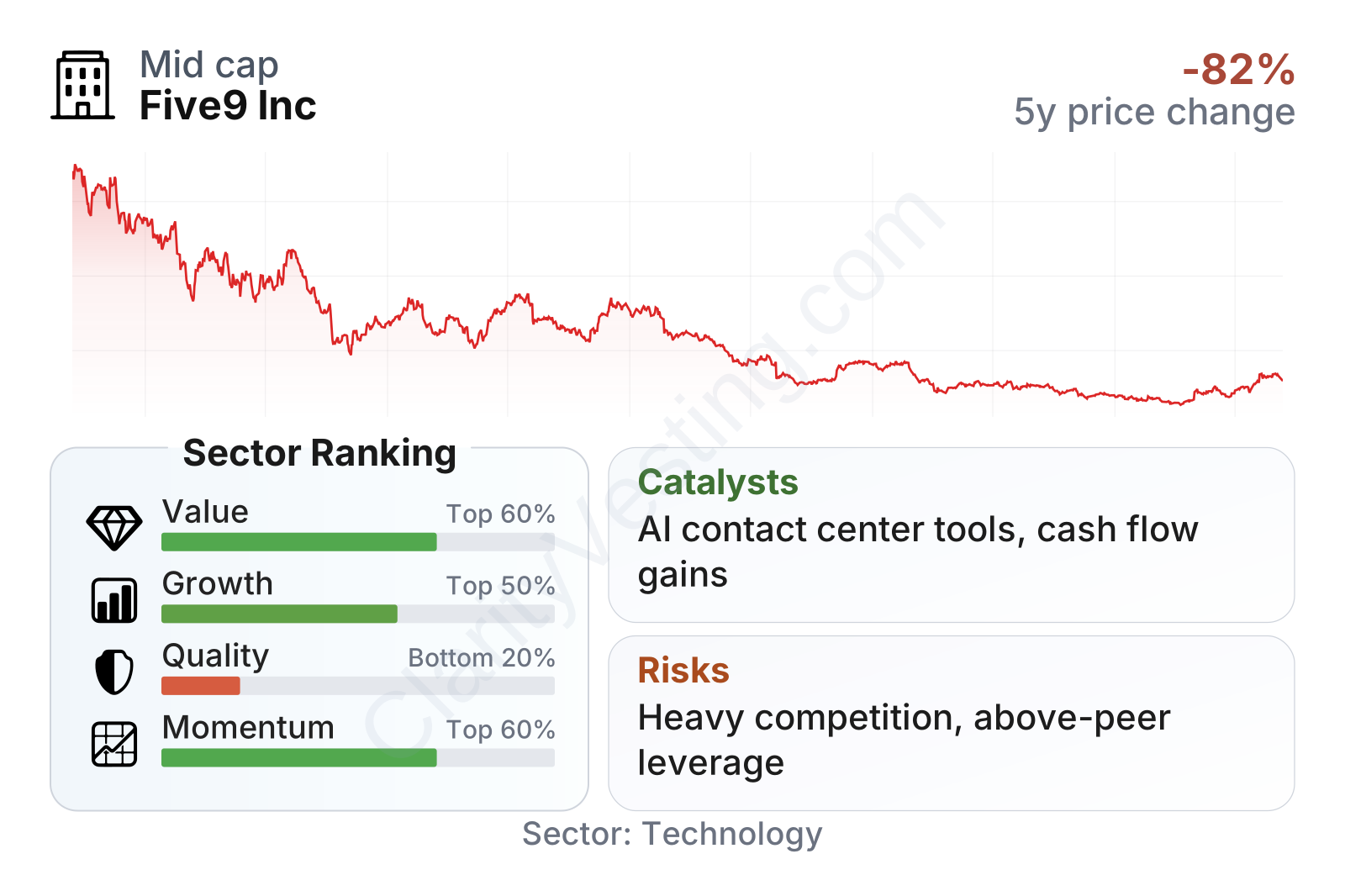
Five9 sits in the mid-sized range within software, with a stock that has been far more volatile than the broader market. The share price remains well below its 2021 peak, but recent momentum has improved sharply. On fundamentals, the profile is mixed: cash generation looks strong, valuation is not low on earnings, growth is moderate rather than fast, and balance-sheet and profitability measures still trail many software peers.
The factor breakdown points to an important contrast. Value-related metrics look better than many software names because free cash flow is meaningful relative to the company’s size, while quality measures remain weak because returns on capital, margins, and leverage are still not at sector norms. This makes Five9 less of a pure high-growth software name than it used to be and more of a turnaround toward steadier profitability.
Growth
Five9 operates in a sector that still has a long runway. Customer service operations continue to migrate from legacy systems to cloud-based platforms, and companies increasingly want a single system that can handle voice, chat, messaging, workflow automation, analytics, and AI. That broader market trend remains favorable because customer experience is becoming more important, while many organizations still run fragmented or aging tools.
Five9’s strategy is aligned with that trend. It is positioning itself as a platform rather than a narrow phone solution. The company has emphasized enterprise customers, partner-led distribution, international expansion, and AI features that can raise the value of each deployment. Integrations with CRM vendors and unified communications providers matter because large companies often choose software that fits into their existing technology stack rather than isolated tools.
Growth has clearly slowed from the very high levels seen a few years ago. Year-over-year revenue expansion was above 30% in 2021 and 2022, then gradually cooled into the low-double-digit range. That is no longer standout software growth, but it still shows that demand has remained positive through a more difficult enterprise spending environment. More importantly, the company has avoided a collapse in revenue growth while improving profitability.
Free cash flow has improved sharply, moving from slightly negative territory in 2022 to well above $100 million and then to roughly $200 million on a trailing basis more recently. For a long-term business assessment, this is one of the most constructive signals around Five9. It suggests the company is converting more of its sales into actual cash, giving it more flexibility to invest in product development, support customers, and manage debt.
One of the strongest catalysts is the spread of AI in contact centers. Businesses are looking for tools that can automate basic interactions, assist live agents, summarize conversations, and improve service outcomes. Five9 already has a base platform where these tools can be embedded, which can support higher spending per customer if adoption deepens. Another catalyst is enterprise replacement cycles: many companies still use older contact center infrastructure that may eventually need modernization.
Recent company updates have also highlighted progress in profitability and cash flow, which changes the conversation around Five9. Instead of being judged only on revenue expansion, the company can now point to improving operating efficiency. In a software market that has become more selective, that shift can be important.
Risks
This article is for informational purposes only and does not constitute financial advice. Some content is AI-generated. See Disclaimer